
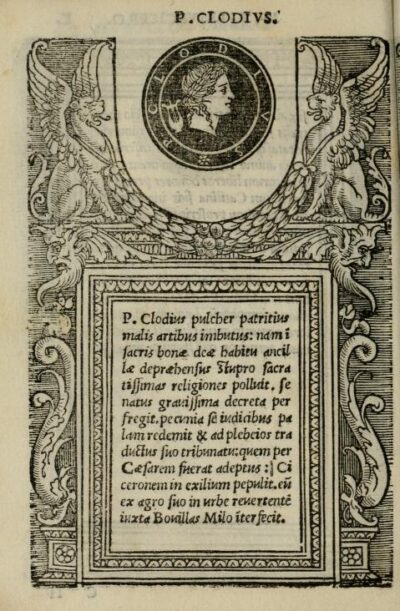
Publius Clodius Pulcher
Publius Clodius Pulcher was a Roman politician and street agitator. Born 90s BC, in Ancient Rome. Died January 18, 52 BC, in Bovillae. Positions held include ancient Roman senator, quaestor and aedile (-56).
Facts
20 facts · 0 confirmed by two sources · 4 cited · 15 from one source · 1 where the sources disagree
What’s different
- Father: we show Appius Claudius Pulcher (Sources disagree). Wikidata also lists Publius Fonteius
Where this comes from
Papalocal keeps its own record. It started from these sources; what each one said is kept here as it was copied, so a change on their side never changes this page by itself. Tap one to read its version.
What Wikidata says · copied November 16, 2026 · revision 2565600204
- Described as
- Roman politician and street agitator (93–52 BC)
- Other names
- Clodius, Clodius Pulcher, Publius Claudius Pulcher
- Born
- 90s BC · 1 reference
- Died
- January 18, 52 BC · 1 reference
- Born in
- Ancient Rome
- Died in
- Bovillae
- Citizen of
- Ancient Rome
- Occupation
- politician
- Positions held
- ancient Roman senator; quaestor; aedile (-56); tribune of the plebs (-58)
- Spouse
- Fulvia
- Children
- Claudia · 2 references; Publius Claudius Pulcher
- Father
- Appius Claudius Pulcher · 1 reference; Publius Fonteius
- Mother
- Caecilia Metella
- Siblings
- Clodia · 1 reference; Gaius Claudius Pulcher · 1 reference; Appius Claudius Pulcher · 1 reference; Clodia; Clodia Tertia
- Wikipedias with a page
- 32
Wikidata item Q313664 (wikidata.org/wiki/Q313664), public domain (CC0). Copied November 16, 2026.
What Wikipedia says · copied November 16, 2026 · revision 1383415433
Publius Clodius Pulcher (c. 92 – 18 January 52 BC) was a Roman politician and demagogue. A noted opponent of Cicero, he was responsible during his plebeian tribunate in 58 BC for a massive expansion of the Roman grain dole as well as Cicero's exile from the city. Leader of one of the political mobs in the 50s, his political tactics – combining connections throughout the oligarchy with mass support from the poor plebs – made him a central player in the politics of the era.
Born to the influential patrician gens Claudia, he was embroiled early in his political career in a religious scandal which saw him develop a rivalry with the orator Cicero and become a plebeian in order to be eligible for the plebeian tribunate. He successfully stood as tribune of the plebs for 58 BC and passed six laws to restore Rome's collegia (private guilds and fraternities), expand the grain dole (making it free rather than subsidised while also using those collegia as means for distribution), annex Cyprus to pay for the dole, clarify augural law on religious obstruction, make it more difficult for the censors to expel senators from the senate, and exile Cicero for the unlawful execution of conspirators during the Catilinarian conspiracy.
When curule aedile in 56 BC, he feuded with and attempted to prosecute his political enemy, Titus Annius Milo, who controlled a rival set of urban mobs. Starting the year an opponent of Caesar, Pompey, and Crassus, he and his family reconciled with them to form a political alliance. A few years later in 52 BC, amid renewed political violence and a campaign for the praetorship, Milo and Clodius encountered each other on the via Appia outside Rome, where Clodius was killed. His body, brought back to Rome, was brought to the forum and then cremated in the senate house, causing its destruction by fire.
His politics were advanced largely by his cultivation of urban mobs in Rome which, by exercising violent control of the places where the republic operated, furthered his political objectives. These violent tactics, however, were not his only sources of influence: his family connections and nobilitas made him a valuable ally to many parties – including, at various times, Caesar, Cato, and Pompey – in the ad hoc factionalism of the late republic. The older view that Clodius acted as an agent of magnates, such as Caesar or Pompey, is now rejected by scholars; he is now seen as an opportunistic and independent politician.
From the Wikipedia article “Publius Clodius Pulcher” (en.wikipedia.org/wiki/Publius_Clodius_Pulcher), by its contributors, under CC BY-SA 4.0 (creativecommons.org/licenses/by-sa/4.0/). Copied November 16, 2026; not changed.
Confirmed Two sources agree. Cited One source, and it names where it got it. One source One source, without a reference of its own. Sources disagree The sources disagree. We show the best-supported value and keep theirs below.
