
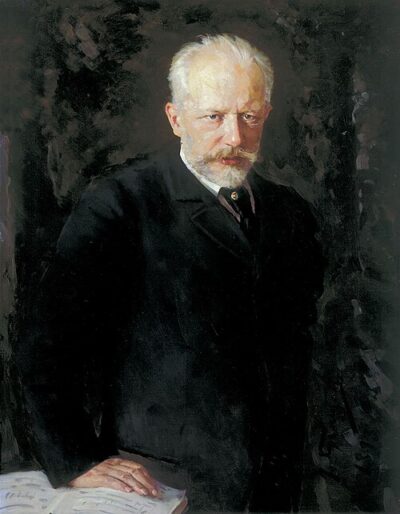
Pyotr Ilyich Tchaikovsky
Pyotr Ilyich Tchaikovsky was a Russian composer. Born April 25, 1840, in Votkinsk. Died October 25, 1893, in Malaya Morskaya Street, 13. Positions held include professor. Known for Swan Lake, The Nutcracker and The Sleeping Beauty. Educated at Saint Petersburg Conservatory and Imperial School of Jurisprudence. Awards include Order of St. Vladimir, 4th class.
Facts
53 facts · 0 confirmed by two sources · 8 cited · 43 from one source · 2 where the sources disagree
What’s different
- Born: we show April 25, 1840 (Sources disagree). Wikipedia says May 7, 1840
- Died: we show October 25, 1893 (Sources disagree). Wikipedia says November 6, 1893
Where this comes from
Papalocal keeps its own record. It started from these sources; what each one said is kept here as it was copied, so a change on their side never changes this page by itself. Tap one to read its version.
What Wikidata says · copied November 16, 2026 · revision 2565537260
- Described as
- Russian composer (1840–1893)
- Other names
- Chajkovskij, Piotr Ilyitch Tchaikovsky, Tschaikowsky, Pyotr Il'ich Chaikovskiy, Chaikovsky, Tschaikowski, Pyotr Tchaikovsky, Pyotr Il'yich Tchaikovsky, Peter Tchaikovsky, Peter Ilich Tchaikovsky, Tchaikovsky
- Born
- April 25, 1840 · 10 references
- Died
- October 25, 1893 · 11 references
- Born in
- Votkinsk · 2 references
- Died in
- Malaya Morskaya Street, 13 · 1 reference
- Buried in
- Tikhvin Cemetery
- Cause of death
- cholera
- Citizen of
- Russian Empire
- Occupation
- composer · 3 references; librettist; conductor (–1893) · 2 references; choreographer; music educator (1866–1878); pianist; autobiographer; music critic
- Positions held
- professor
- Worked for
- Moscow Conservatory (1866–); University of Washington
- Education
- Saint Petersburg Conservatory (–1865); Imperial School of Jurisprudence (1850–1859) · 1 reference
- Genre
- symphony; opera; ballet; classical music; Romantic music
- Instrument
- piano
- Known for
- Swan Lake; The Nutcracker; The Sleeping Beauty; Symphony No. 6; Piano Concerto No. 1; 1812 Overture; Violin Concerto; Eugene Onegin; The Queen of Spades
- Awards
- Order of St. Vladimir, 4th class
- Field
- music composing; music-learning theory; music education; music · 1 reference
- Spouse
- Antonina Miliukova (1877) · 1 reference
- Father
- Ilya Petrovich Tchaikovsky · 1 reference
- Mother
- Aleksandra Tchaikovskaya
- Siblings
- Modest Tchaikovsky · 1 reference; Anatoly Tchaikovsky; Aleksandra Davydova; Ippolit Chaykovsky
- Religion
- Eastern Orthodoxy
- Lived in
- Saint Petersburg (1848–1866); Moscow (3 times) (1848–1881) · 1 reference; Votkinsk (1840–1848); Alapayevsk (1849–1850); Clarens (1877)
- Wikipedias with a page
- 192
Wikidata item Q7315 (wikidata.org/wiki/Q7315), public domain (CC0). Copied November 16, 2026.
What Wikipedia says · copied November 16, 2026 · revision 1384293844
Pyotr Ilyich Tchaikovsky ( chy-KOF-skee; 7 May 1840 – 6 November 1893) was a Russian composer of the Romantic period. He was the first Russian composer whose music made a lasting impression internationally. Tchaikovsky wrote some of the most popular concert and theatrical music in the classical repertoire, including the 1812 Overture, his First Piano Concerto, the Violin Concerto, the Romeo and Juliet Overture-Fantasy, several symphonies, the opera Eugene Onegin, and the ballets Swan Lake, The Sleeping Beauty and The Nutcracker.
Although musically precocious, Tchaikovsky was educated for a career as a civil servant as there was little opportunity for a musical career in Russia at the time and no institutional music education system. When an opportunity for such an education arose, he entered the nascent Saint Petersburg Conservatory, from which he graduated in 1865. The formal Western-oriented teaching Tchaikovsky received there set him apart from composers of the contemporary nationalist movement embodied by the Russian composers of The Five, with whom his professional relationship was mixed.
Despite his many popular successes, Tchaikovsky's life was punctuated by personal crises and depression. Contributory factors included his early separation from his mother for boarding school followed by her early death, the death of his close friend and colleague Nikolai Rubinstein, his failed marriage to Antonina Miliukova, and the collapse of his 13-year association with the wealthy patroness Nadezhda von Meck. Tchaikovsky's homosexuality, which he kept private, has traditionally also been considered a major factor, though some scholars have downplayed its importance. His dedication of his Sixth Symphony to his nephew Vladimir Davydov and the feelings he expressed about Davydov in letters to others have been cited as evidence for romantic love between the two. Tchaikovsky's sudden death at the age of 53 is generally ascribed to cholera, but there is an ongoing debate as to whether cholera was indeed the cause and whether the death was intentional.
While his music has remained popular among audiences, critical opinions were initially mixed. Some Russians did not feel it sufficiently represented native musical values and expressed suspicion that Europeans accepted the music for its Western elements. In an apparent reinforcement of that claim, some Europeans lauded Tchaikovsky for offering music more substantive than exoticism and said he transcended the stereotypes of Russian classical music. Others dismissed Tchaikovsky's music as deficient because it did not stringently follow Western principles.
- Born, in its opening lines
- May 7, 1840
- Died, in its opening lines
- November 6, 1893
From the Wikipedia article “Pyotr Ilyich Tchaikovsky” (en.wikipedia.org/wiki/Pyotr_Ilyich_Tchaikovsky), by its contributors, under CC BY-SA 4.0 (creativecommons.org/licenses/by-sa/4.0/). Copied November 16, 2026; not changed.
Confirmed Two sources agree. Cited One source, and it names where it got it. One source One source, without a reference of its own. Sources disagree The sources disagree. We show the best-supported value and keep theirs below.
