
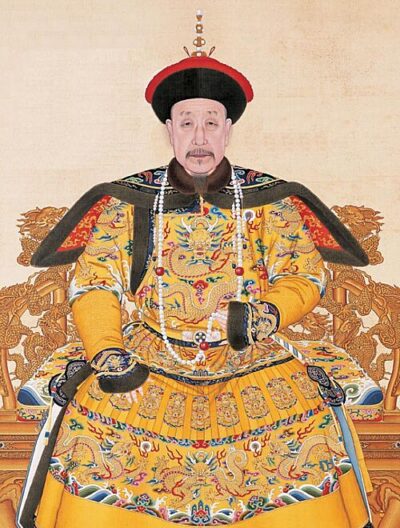
Qianlong Emperor
Qianlong Emperor was an emperor of the Qing Dynasty. Born September 25, 1711, in Beijing. Died February 7, 1799, in Beijing. Positions held include Emperor of China (1735–1796), Taishang Huang (1796–1799) and Heshuo Qinwang (1733–). Known for Sheng jing fu and The Complete Works of the Imperial Le Shan Hall.
Facts
48 facts · 2 confirmed by two sources · 2 cited · 43 from one source · 1 where the sources disagree
What’s different
- Name at birth: we show ᡥᡠᠩ ᠯᡳ (Sources disagree). Wikidata also lists 弘曆
Where this comes from
Papalocal keeps its own record. It started from these sources; what each one said is kept here as it was copied, so a change on their side never changes this page by itself. Tap one to read its version.
What Wikidata says · copied November 16, 2026 · revision 2569188305
- Described as
- emperor of the Qing Dynasty (1711–1799)
- Other names
- Chien-lung Emperor, Hung-li, Hongli, Hong Li, Fatianlongyunzhichengxianjiaotiyuanlijifuwenfenwuqinmingxiaocishenshengchunhuangdi, Shiquanlaoren, Xintianzhuren, Changchunjushi, Guxitianzi, Emperor Gaozong of Qing, Tchien Lung the great emperor, Perfect Old Sage
- Born
- September 25, 1711 · 6 references
- Died
- February 7, 1799 · 7 references
- Born in
- Beijing
- Died in
- Beijing
- Buried in
- Yuling Mausoleum (Qing dynasty)
- Cause of death
- falling from height
- Name at birth
- ᡥᡠᠩ ᠯᡳ; 弘曆
- Citizen of
- Qing dynasty · 1 reference
- Occupation
- calligrapher; monarch; poet; art collector
- Positions held
- Emperor of China (1735–1796); Taishang Huang (1796–1799); Heshuo Qinwang (1733–)
- Known for
- Sheng jing fu; The Complete Works of the Imperial Le Shan Hall
- Spouse
- Empress Xiaoxianchun; Empress Nara; Empress Xiaoyichun · 1 reference; Imperial Noble Consort Huixian · 1 reference; Imperial Noble Consort Chunhui · 1 reference; Imperial Noble Consort Qinggong
- Children
- Yonghuang; Yonglian; Yongzhang; Yongcheng; Yongqi; Yongrong · 1 reference; Yongcong; Yongxuan; ninth son of Qianlong; tenth son of Qianlong; Yongxing; Yongji
- Father
- Yongzheng Emperor · 2 references
- Mother
- Empress Xiaoshengxian
- Siblings
- Heshuo Princess Huaike; Hongshi; Hongzhou; Honghui; Hongpan; Hongyun; Fuyi; Fuhui; Fupei; Hongyan
- Religion
- Tibetan Buddhism · 1 reference
- Wikipedias with a page
- 65
Wikidata item Q19133 (wikidata.org/wiki/Q19133), public domain (CC0). Copied November 16, 2026.
What Wikipedia says · copied November 16, 2026 · revision 1383891623
The Qianlong Emperor (25 September 1711 – 7 February 1799), also known by his temple name Emperor Gaozong of Qing, personal name Hongli, was the fifth emperor of the Qing dynasty and the fourth Qing emperor to rule over China proper. He reigned officially from 1735 until his abdication and retirement in 1796, but retained ultimate power subsequently until his death in 1799, making him one of history's longest-reigning and longest-lived monarchs.
The fourth and favourite son of the Yongzheng Emperor, Qianlong ascended the throne in 1735. A highly ambitious military leader, he led a series of campaigns into Inner Asia, Burma, Nepal and Vietnam and suppressed rebellions in Jinchuan and Taiwan. The most significant of the campaigns conquered Xinjiang from the Dzungar Khanate. He ordered the Dzungar genocide. He was given the honorific title Emperor Manjushri in Qing Tibet. Domestically, Qianlong was a major patron of the arts and a prolific writer. He sponsored the compilation of the Siku Quanshu (Complete Library of the Four Treasuries), the largest collection ever made of Chinese history, and oversaw extensive literary inquisitions that suppressed some 3,100 works.
In 1796, Qianlong abdicated after a 60 year reign to allow his grandfather, the Kangxi Emperor, to remain the longest-reigning Qing emperor at 61 years. Even after being succeeded by his son, the Jiaqing Emperor, Qianlong continued to rule as Emperor Emeritus until dying in 1799 at the age of 87.
Qianlong ruled at the end of the High Qing era, the zenith of the dynasty's power, influence, and prosperity. At the same time, military weakness after constant warfare, endemic corruption, inefficiency in the imperial court and a stagnating civil society ushered in the gradual decline and ultimate demise of the Qing empire.
- Born, in its opening lines
- September 25, 1711
- Died, in its opening lines
- February 7, 1799
From the Wikipedia article “Qianlong Emperor” (en.wikipedia.org/wiki/Qianlong_Emperor), by its contributors, under CC BY-SA 4.0 (creativecommons.org/licenses/by-sa/4.0/). Copied November 16, 2026; not changed.
Confirmed Two sources agree. Cited One source, and it names where it got it. One source One source, without a reference of its own. Sources disagree The sources disagree. We show the best-supported value and keep theirs below.
