
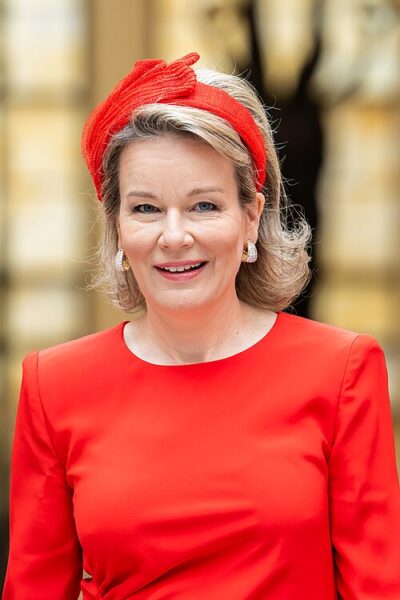
Queen Mathilde of Belgium
Queen Mathilde of Belgium is a Queen consort of Belgium. Born January 20, 1973, in Uccle. Positions held include Consort of the Belgians (2013–). Educated at UCLouvain and Institut libre Marie Haps. Awards include Grand Cross of the Order of the White Rose of Finland, Knight of the Order of the Elephant and Grand Cross Special Class of the Order of Merit of the Federal Republic of Germany.
Facts
37 facts · 1 confirmed by two sources · 15 cited · 21 from one source
Where this comes from
Papalocal keeps its own record. It started from these sources; what each one said is kept here as it was copied, so a change on their side never changes this page by itself. Tap one to read its version.
What Wikidata says · copied November 16, 2026 · revision 2569922686
- Described as
- Queen consort of Belgium
- Other names
- Mathilde d'Udekem d'Acoz, Jonkvrouw Mathilde d'Udekem d'Acoz, Jonkvrouw Mathilde Marie Christine Ghislaine d'Udekem d'Acoz, Mathilde Marie Christine Ghislaine d'Udekem d'Acoz, Mathilde, Duchess of Brabant, Mathilde of Belgium, H.R.H. Princess Mathilde of Belgium, Mathilde, Queen of the Belgians, H.M. Mathilde, Queen of Belgium, H.M. Queen Mathilde of Belgium, Mathilde of the Belgians
- Born
- January 20, 1973 · 5 references
- Born in
- Uccle
- Name at birth
- Jonkvrouw Mathilde Marie Christine Ghislaine d'Udekem d’Acoz · 1 reference
- Citizen of
- Belgium
- Occupation
- consort; speech and language therapist (1995–1999)
- Positions held
- Consort of the Belgians (2013–)
- Education
- UCLouvain (–2002); Institut libre Marie Haps
- Member of
- Philippe I of Belgium and Queen Mathilde
- Awards
- Grand Cross of the Order of the White Rose of Finland; Knight of the Order of the Elephant (2017) · 1 reference; Grand Cross Special Class of the Order of Merit of the Federal Republic of Germany (2016); Grand Cross of the Military Order of Christ · 1 reference; Grand Collar of the Order of Prince Henry · 1 reference; Grand Cordon of the Order of the Precious Crown (2016) · 1 reference; Order of the White Eagle · 1 reference; Supreme Order of the Renaissance · 1 reference; Grand Cross of the Order of Merit of the Republic of Poland; Grand Cordon of the Order of Leopold; Grand Cross of the Legion of Honour; Lady of the Collar in the Order of the Holy Sepulchre; honorary doctorate of Hasselt University (2023) · 1 reference; Dame Grand Cross of the Order of the Lion of the Netherlands · 1 reference; Knight Grand Cross of the Order of St. Olav (2003) · 1 reference
- Spouse
- Philippe of Belgium (1999–) · 2 references
- Children
- Princess Elisabeth, Duchess of Brabant · 1 reference; Prince Gabriel of Belgium · 1 reference; Prince Emmanuel of Belgium · 1 reference; Princess Éléonore of Belgium · 1 reference
- Father
- Count Patrick d'Udekem d'Acoz · 1 reference
- Mother
- Anna Maria Komorowska · 1 reference
- Siblings
- Jonkvrouw Marie-Alix d'Udekem d'Acoz; Countess Elisabeth d'Udekem d'Acoz; Countess Hélène d'Udekem d'Acoz; Count Charles-Henri d'Udekem d'Acoz
- Religion
- Catholic Church
- Wikipedias with a page
- 51
Wikidata item Q94334 (wikidata.org/wiki/Q94334), public domain (CC0). Copied November 16, 2026.
What Wikipedia says · copied November 16, 2026 · revision 1372415079
Mathilde Marie Christine Ghislaine d'Udekem d'Acoz (pronounced [matild dyd(ə)kɛm dakɔ]; born 20 January 1973) is Queen of the Belgians as the wife of King Philippe.
She is the first native-born Belgian queen, and has four children. She formerly worked as a speech therapist. She is involved with a range of organisations which address social issues including education, child poverty, intergenerational poverty, the position of women in society and literacy.
- Born, in its opening lines
- January 20, 1973
From the Wikipedia article “Queen Mathilde of Belgium” (en.wikipedia.org/wiki/Queen_Mathilde_of_Belgium), by its contributors, under CC BY-SA 4.0 (creativecommons.org/licenses/by-sa/4.0/). Copied November 16, 2026; not changed.
Confirmed Two sources agree. Cited One source, and it names where it got it. One source One source, without a reference of its own. Sources disagree The sources disagree. We show the best-supported value and keep theirs below.
