
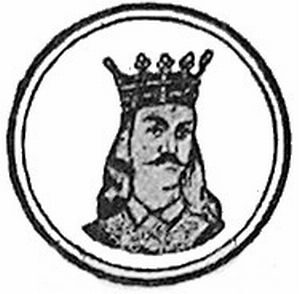
Radu cel Frumos
Radu cel Frumos was a Son of Vlad II Dracul. Died 1475, in Transylvania. Positions held include lord of Wallachia (1462–1475).
Facts
14 facts · 1 confirmed by two sources · 3 cited · 10 from one source
Where this comes from
Papalocal keeps its own record. It started from these sources; what each one said is kept here as it was copied, so a change on their side never changes this page by itself. Tap one to read its version.
What Wikidata says · copied November 16, 2026 · revision 2538025493
- Described as
- Son of Vlad II Dracul
- Other names
- Radu III of Wallachia
- Died
- 1475 · 1 reference
- Born in
- Sighișoara · 1 reference
- Died in
- Transylvania · 2 references
- Occupation
- prince; aristocrat; military personnel
- Positions held
- lord of Wallachia (1462–1475) · 2 references
- Spouse
- Doamna Maria Despina
- Children
- Maria Voichița · 1 reference
- Father
- Vlad II Dracul
- Siblings
- Vlad the Impaler; Mircea II of Wallachia; Vlad Călugărul
- Religion
- Eastern Orthodoxy
- Wikipedias with a page
- 28
Wikidata item Q535103 (wikidata.org/wiki/Q535103), public domain (CC0). Copied November 16, 2026.
What Wikipedia says · copied November 16, 2026 · revision 1385851504
Radu the Handsome (Romanian: Radu cel Frumos; c. 1438 – 1475) reigned as voivode (prince) of Wallachia on at least three separate occasions: first from 1462 to 1473, then from later in 1473 into 1474, before returning to power in the course of 1474. Radu was the youngest son of Vlad II Dracul, voivode of Wallachia. He entered Ottoman captivity alongside his brother, Vlad Dracula, either in 1442, when they were captured together with their father, or in 1444. From 1444 onwards, both brothers were held as hostages to secure the loyalty of their father, who had been restored to the Wallachian throne with Ottoman support. Caught between the competing interests of the Ottoman Empire and Hungary, their father sought to maintain a delicate balance between the two powers. In 1448, however, he was executed on the orders of John Hunyadi, governor of Hungary. Shortly thereafter, the Ottomans released Vlad Dracula to pursue his claim to the Wallachian throne, whilst Radu remained at the Ottoman court, where he became a favourite of the young Sultan Mehmed II and reportedly his lover.
Vlad Dracula's refusal to pay tribute to the Ottoman sultan and his raids into Ottoman territory prompted Mehmed II to launch a large-scale invasion of Wallachia in June 1462. Radu accompanied the sultan on the campaign as a claimant to the Wallachian throne. Although Mehmed eventually abandoned the punitive expedition, he left Radu at the Danubian port of Brăila to press his claim. Radu soon secured the support of most of the Wallachian boyars, forcing Vlad Dracula to flee to Hungary, where he was arrested and imprisoned on charges of treason by King Matthias Corvinus in November. Radu acknowledged the sultan's suzerainty and agreed to pay an annual tribute of 10,000 ducats in exchange for Ottoman protection and the preservation of Wallachia's internal autonomy. This arrangement served as a model for subsequent agreements between Wallachia and the Ottoman Empire over the following eight decades.
Radu subsequently came into conflict with Stephen the Great, voivode of Moldavia, over control of the ports of the Danube Delta. His attempt to capture Kiliia from the Moldavians proved unsuccessful, whilst Moldavian forces retaliated by destroying Brăila. Taking advantage of the Ottoman Empire's conflict with the Aq Qoyunlu in eastern Anatolia, Stephen invaded Wallachia in the autumn of 1473, forcing Radu to seek refuge in Ottoman territory and installing a rival claimant, Basarab Laiotă, on the Wallachian throne. With Ottoman support, Radu regained the throne in December of that year, but subsequently fell ill and was again driven from Wallachia by Basarab by August 1475. He recovered the throne for a second time by September, only to be forced into exile once more by another Moldavian invasion in October. Radu may have been restored to the throne for the final time during an Ottoman invasion of Moldavia in November or December 1474. If so, he subsequently fought alongside the Ottomans against Stephen at the Battle of Vaslui on 25 January 1475, which ended in a Moldavian victory. Radu died under uncertain circumstances in Transylvania.
- Born, in its opening lines
- 1438
- Died, in its opening lines
- 1475
From the Wikipedia article “Radu the Handsome” (en.wikipedia.org/wiki/Radu_the_Handsome), by its contributors, under CC BY-SA 4.0 (creativecommons.org/licenses/by-sa/4.0/). Copied November 16, 2026; not changed.
Confirmed Two sources agree. Cited One source, and it names where it got it. One source One source, without a reference of its own. Sources disagree The sources disagree. We show the best-supported value and keep theirs below.
