
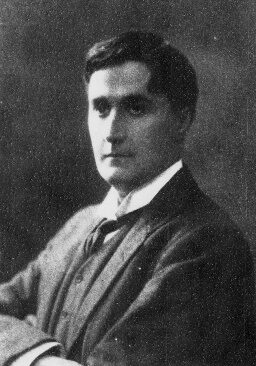
Ralph Vaughan Williams
Ralph Vaughan Williams was an English composer. Born October 12, 1872, in Down Ampney. Died August 26, 1958, in London. Known for Symphony No. 4, Symphony No. 5 and Sir John in Love. Educated at Trinity College and Royal College of Music. Awards include Royal Philharmonic Society Gold Medal, Albert Medal and Walter Willson Cobbett Medal.
Facts
45 facts · 2 confirmed by two sources · 9 cited · 34 from one source
Where this comes from
Papalocal keeps its own record. It started from these sources; what each one said is kept here as it was copied, so a change on their side never changes this page by itself. Tap one to read its version.
What Wikidata says · copied November 16, 2026 · revision 2563857735
- Described as
- English composer (1872-1958)
- Born
- October 12, 1872 · 13 references
- Died
- August 26, 1958 · 13 references
- Born in
- Down Ampney · 1 reference
- Died in
- London · 1 reference
- Buried in
- Westminster Abbey
- Citizen of
- United Kingdom
- Occupation
- conductor · 1 reference; classical composer; choreographer; organist; pedagogue; musicologist; film score composer; composer · 2 references
- Worked for
- Birkbeck, University of London
- Education
- Trinity College; Royal College of Music; Charterhouse School
- Member of
- American Academy of Arts and Sciences
- Genre
- classical music; opera; symphony
- Instrument
- organ
- Record label
- Decca; His Master's Voice
- Known for
- Symphony No. 4; Symphony No. 5; Sir John in Love; A Sea Symphony; The Lark Ascending; A Pastoral Symphony; Fantasia on a Theme by Thomas Tallis; A London Symphony
- Awards
- Royal Philharmonic Society Gold Medal (1930); Albert Medal (1955); Walter Willson Cobbett Medal (1930); Order of Merit; Honorary Member of the International Society for Contemporary Music
- Spouse
- Ursula Vaughan Williams (1953–) · 2 references; Adeline Maria Fisher (1897–) · 2 references
- Father
- Arthur Charles Vaughan Williams · 2 references
- Mother
- Margaret Vaughan Williams · 1 reference
- Siblings
- Hervey Wedgwood Williams
- Military branch
- British Army
- Website
- https://rvwsociety.com · 1 reference
- Wikipedias with a page
- 50
Wikidata item Q207947 (wikidata.org/wiki/Q207947), public domain (CC0). Copied November 16, 2026.
What Wikipedia says · copied November 16, 2026 · revision 1384407211
Ralph Vaughan Williams ( RAYF vawn WIL-yəmz; 12 October 1872 – 26 August 1958) was an English composer. His works include operas, ballets, chamber music, secular and religious vocal pieces and orchestral compositions including nine symphonies, written over sixty years. Strongly influenced by Tudor music and English folk-song, his output marked a decisive break in British music from its German-dominated style of the 19th century.
Vaughan Williams was born to a well-to-do family with strong moral views and a progressive social outlook. Throughout his life he sought to be of service to his fellow citizens, and believed in making music as available as possible to everybody. He wrote many works for amateur and student performance. He was musically a late developer, not finding his true voice until his late thirties; his studies in 1907–1908 with the French composer Maurice Ravel helped him clarify the textures of his music and free it from Teutonic influences.
Vaughan Williams is among the best-known British symphonists, noted for his very wide range of moods, from stormy and impassioned to tranquil, from mysterious to exuberant. Among the most familiar of his concert works are Fantasia on a Theme by Thomas Tallis (1910) and The Lark Ascending (1914). His vocal works include hymns, folk-song arrangements and large-scale choral pieces. He wrote eight works for stage performance between 1919 and 1951. Although none of his operas became popular repertoire pieces, his ballet Job: A Masque for Dancing (1930) was successful and has been frequently staged.
Two episodes made notably deep impressions in Vaughan Williams's personal life. The First World War, in which he served in the army, had a lasting emotional impact. Twenty years later, though in his sixties and devotedly married, he was reinvigorated by a love affair with a much younger woman, who later became his second wife. He went on composing through his 70s and 80s, producing his last symphony months before his death at the age of 85. His works have continued to be a staple of the British concert repertoire, and all his major compositions and many of the minor ones have been recorded.
- Born, in its opening lines
- October 12, 1872
- Died, in its opening lines
- August 26, 1958
From the Wikipedia article “Ralph Vaughan Williams” (en.wikipedia.org/wiki/Ralph_Vaughan_Williams), by its contributors, under CC BY-SA 4.0 (creativecommons.org/licenses/by-sa/4.0/). Copied November 16, 2026; not changed.
Confirmed Two sources agree. Cited One source, and it names where it got it. One source One source, without a reference of its own. Sources disagree The sources disagree. We show the best-supported value and keep theirs below.
