
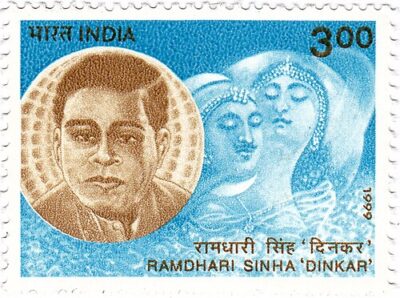
Ramdhari Singh Dinkar
Ramdhari Singh Dinkar was an Indian Hindi poet, essayist. Born September 23, 1908, in Simaria. Died April 24, 1974, in Chennai. Positions held include member of Rajya Sabha. Known for Sanskriti Ke Char Adhyaya. Educated at Patna College. Awards include Jnanpith Award, Sahitya Akademi Award and Padma Bhushan in Literature & Education.
Facts
22 facts · 2 confirmed by two sources · 2 cited · 18 from one source
Where this comes from
Papalocal keeps its own record. It started from these sources; what each one said is kept here as it was copied, so a change on their side never changes this page by itself. Tap one to read its version.
What Wikidata says · copied November 17, 2026 · revision 2566209577
- Described as
- Indian Hindi poet, essayist (1908-1974)
- Other names
- Ramdhari Singh, Rashtrakavi Dinkar, Ramdhari Singh 'Dinkar', R. S. Dinkar, Dinkar
- Born
- September 23, 1908 · 1 reference
- Died
- April 24, 1974 · 1 reference
- Born in
- Simaria
- Died in
- Chennai
- Buried in
- Bihar · 1 reference
- Citizen of
- British Raj (–1947); India (1950–); Dominion of India (1947–1950)
- Occupation
- translator; poet; politician; journalist; literary critic; writer; academic · 1 reference
- Positions held
- member of Rajya Sabha
- Education
- Patna College
- Known for
- Sanskriti Ke Char Adhyaya
- Awards
- Jnanpith Award (1972) · 1 reference; Sahitya Akademi Award (1959) · 1 reference; Padma Bhushan in Literature & Education (1959); honorary doctorate · 1 reference
- Wikipedias with a page
- 25
Wikidata item Q2992962 (wikidata.org/wiki/Q2992962), public domain (CC0). Copied November 17, 2026.
What Wikipedia says · copied November 17, 2026 · revision 1378881699
Ramdhari Singh (23 September 1908 – 24 April 1974), known by his pen name Dinkar, was an Indian Hindi language poet, essayist, freedom fighter, patriot and academic. He emerged as a poet of rebellion as a consequence of his nationalist poetry written in the days before Indian independence. His poetry exuded Veer Rasa (heroic sentiment), and he has been hailed as a Rashtrakavi ('national poet') and Yuga-Chāraṇa (Charan of the Era) on account of his inspiring patriotic compositions. He was a regular poet of Hindi Kavi Sammelan and is hailed to be as popular and connected to poetry lovers for Hindi speakers as Pushkin for Russians.
One of the notable modern Hindi poets, Dinkar was born in Simaria village of the Bengal Presidency, British India, now part of Begusarai district in Bihar state. The government honored him with the Padma Bhushan in 1959 and nominated him three times to the Rajya Sabha. Similarly, his political thought was greatly shaped by both Mahatma Gandhi and Karl Marx. Dinkar gained popularity in the pre-independence period through his nationalist poetry.
Dinkar initially supported the revolutionary movement during the Indian independence struggle, but later became a Gandhian. However, he used to call himself a "Bad Gandhian" because he supported the feelings of indignation and revenge among the youth. In Kurukshetra, he accepted that war is destructive but argued that it is necessary for the protection of freedom. He was close to prominent nationalists of the time such as Rajendra Prasad, Anugrah Narayan Sinha, Sri Krishna Sinha, Rambriksh Benipuri and Braj Kishore Prasad.
Dinkar was elected three times to the Rajya Sabha, and he was the member of this house from 3 April 1952 to 2 April 1964, and was awarded the Padma Bhushan in 1959. He was also the Vice-Chancellor of Bhagalpur University (Bhagalpur, Bihar) in the early 1960s.
During The Emergency, Jayaprakash Narayan had attracted a gathering of one lakh (100,000) people at the Ramlila grounds and recited Dinkar's famous poem: Singhasan Khaali Karo Ke Janata Aati Hai ('Vacate the throne, for the people are coming').
- Born, in its opening lines
- September 23, 1908
- Died, in its opening lines
- April 24, 1974
From the Wikipedia article “Ramdhari Singh Dinkar” (en.wikipedia.org/wiki/Ramdhari_Singh_Dinkar), by its contributors, under CC BY-SA 4.0 (creativecommons.org/licenses/by-sa/4.0/). Copied November 17, 2026; not changed.
Confirmed Two sources agree. Cited One source, and it names where it got it. One source One source, without a reference of its own. Sources disagree The sources disagree. We show the best-supported value and keep theirs below.
