
Jnanpith Award
Jnanpith Award is an award. It was created in 1961.
- Country
- India
- Created
- 1961
All 5 facts, and where they come from
Facts
5 facts · 0 confirmed by two sources · 0 cited · 5 from one source
Where this comes from
Papalocal keeps its own record. It started from these sources; what each one said is kept here as it was copied, so a change on their side never changes this page by itself. Tap one to read its version.
What Wikidata says · copied November 17, 2026 · revision 2550171300
- Described as
- award
- What it is
- award; literary award · 1 reference
- Created
- 1961
- Country
- India
- Official website
- http://jnanpith.net/index.html
- Wikipedias with a page
- 28
Wikidata item Q916783 (wikidata.org/wiki/Q916783), public domain (CC0). Copied 2026-11-17.
What Wikipedia says · copied November 17, 2026 · revision 1386187963
The Jnanpith Award is the oldest and the highest Indian literary award presented annually by the Bharatiya Jnanpith to an author for their "outstanding contribution towards literature". Instituted in 1961, the award is bestowed only on Indian writers writing in Indian languages included in the Eighth Schedule of the Constitution of India and English, with no posthumous conferral.
From 1965 till 1981, the award was given to the authors for their "most outstanding work" and consisted of a citation plaque, a cash prize and a bronze replica of Saraswati, the Hindu goddess of knowledge and wisdom. The first recipient was the Malayalam writer G. Sankara Kurup who received the award in 1965 for his collection of poems, Odakkuzhal (The Bamboo Flute), published in 1950. The rules were revised in subsequent years to consider only works published during the preceding twenty years, excluding the year for which the award was to be given. In 1981, the cash prize was increased to ₹1.5 lakh (equivalent to ₹33 lakh or US$36,000 in 2026).
As of 2015, the cash prize has been revised to ₹11 lakh (equivalent to ₹18 lakh or US$19,000 in 2026). The award has been conferred upon 65 writers including eight women authors. In 1976, Bengali novelist Ashapoorna Devi became the first woman to win the award, for the 1965 novel Prothom Protishruti (The First Promise), the first in a trilogy.
From the Wikipedia article “Jnanpith Award” (en.wikipedia.org/wiki/Jnanpith_Award), by its contributors, under CC BY-SA 4.0 (creativecommons.org/licenses/by-sa/4.0/). Copied 2026-11-17; not changed.
Confirmed Two sources agree. Cited One source, and it names where it got it. One source One source, without a reference of its own. Sources disagree The sources disagree. We show the best-supported value and keep theirs below.
People connected 8
Won it
 Gulzar (2023)Indian poet, lyricist and author (1933- Present)
 Krishna Sobti (2017)Indian writer (1925–2019)
 Girish Karnad (1998)Indian playwright, theatre personality (1938–2019)
 Mahasweta Devi (1996)Indian Bengali fiction writer and socio-political activist (1926-2016)
- QQurratulain Hyder (1989)Indian writer (1927–2007)
 Mahadevi Varma (1982)Indian Hindi writer and poet (1907-1987)
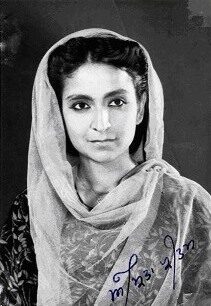 Amrita Pritam (1981)Indian novelist, poet, and essayist (in Hindi and Punjabi languages) (1919–2005)
 Kuvempu (1967)Indian poet, playwright, novelist, critic, and prolific thinker (1904–1994)
