
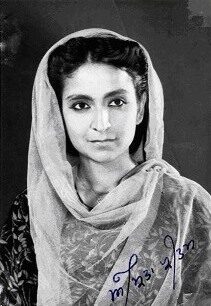
Amrita Pritam
Amrita Pritam was an Indian novelist, poet, and essayist (in Hindi and Punjabi languages). Born August 31, 1919, in Gujranwala. Died October 31, 2005, in Delhi. Positions held include member of Rajya Sabha (1986–1992). Known for Pinjar and Sunehde. Awards include Officer of Arts and Letters, Padma Vibhushan in Literature & Education and Padma Shri in Literature & Education.
Facts
24 facts · 2 confirmed by two sources · 8 cited · 14 from one source
Where this comes from
Papalocal keeps its own record. It started from these sources; what each one said is kept here as it was copied, so a change on their side never changes this page by itself. Tap one to read its version.
What Wikidata says · copied November 16, 2026 · revision 2568863049
- Described as
- Indian novelist, poet, and essayist (in Hindi and Punjabi languages) (1919–2005)
- Other names
- Amrit Kaur
- Born
- August 31, 1919 · 1 reference
- Died
- October 31, 2005 · 1 reference
- Born in
- Gujranwala
- Died in
- Delhi
- Citizen of
- British Raj (–1947); Dominion of India; India (1950–)
- Occupation
- politician; autobiographer; poet; writer · 1 reference; journalist · 1 reference; novelist
- Positions held
- member of Rajya Sabha (1986–1992)
- Genre
- poetry · 1 reference
- Known for
- Pinjar · 1 reference; Sunehde
- Awards
- Officer of Arts and Letters (1987); Padma Vibhushan in Literature & Education (2004) · 1 reference; Padma Shri in Literature & Education (1969) · 1 reference; Sahitya Akademi Award in Punjabi (1956) · 2 references; Jnanpith Award (1981) · 1 reference; Punjab Rattan Award · 1 reference; Fellow of the Sahitya Akademi (2004) · 1 reference
- Wikipedias with a page
- 56
Wikidata item Q1705018 (wikidata.org/wiki/Q1705018), public domain (CC0). Copied November 16, 2026.
What Wikipedia says · copied November 16, 2026 · revision 1385871622
Amrita Pritam ([əm.mɾɪt̪ɑː pɾiːt̪əm] ; 31 August 1919 – 31 October 2005) was an Indian novelist, essayist and poet, who wrote in Punjabi and Hindi. A prominent figure in Punjabi literature, she is the recipient of the 1956 Sahitya Akademi Award. Her body of work comprised over 100 books of poetry, fiction, biographies, essays, a collection of Punjabi folk songs and an autobiography that were all translated into several Indian and foreign languages.
Pritam is best remembered for her poignant poem, Ajj aakhaan Waris Shah nu (Today I invoke Waris Shah – "Ode to Waris Shah"), an elegy to the 18th-century Punjabi poet, and an expression of her anguish over massacres during the partition of British India. As a novelist, her most noted work was Pinjar ("The Skeleton", 1950), in which she created her memorable character, Puro, an epitome of violence against women, loss of humanity and ultimate surrender to existential fate; the novel was made into an award-winning film, Pinjar (2003).
When British India was partitioned into the independent states of India and Pakistan in 1947, she migrated from Lahore to India, though she remained equally popular in Pakistan throughout her life.
Pritam's magnum opus, the long poem Sunehade, won her the 1956 Sahitya Akademi Award, making her the first and the only woman to have been given the award for a work in Punjabi. She received the Jnanpith Award, one of India's highest literary awards, in 1982 for Kagaz Te Canvas ("The Paper and the Canvas"). She was awarded the Padma Shri in 1969, and the Padma Vibhushan, India's second highest civilian award, in 2004. In that same year she was honoured with India's highest literary award given by the Sahitya Akademi (India's Academy of Letters), the Sahitya Akademi Fellowship, awarded to the "immortals of literature" for lifetime achievement.
- Born, in its opening lines
- August 31, 1919
- Died, in its opening lines
- October 31, 2005
From the Wikipedia article “Amrita Pritam” (en.wikipedia.org/wiki/Amrita_Pritam), by its contributors, under CC BY-SA 4.0 (creativecommons.org/licenses/by-sa/4.0/). Copied November 16, 2026; not changed.
Confirmed Two sources agree. Cited One source, and it names where it got it. One source One source, without a reference of its own. Sources disagree The sources disagree. We show the best-supported value and keep theirs below.
