
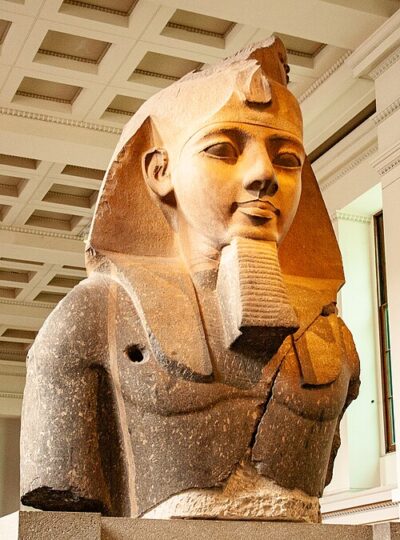
Ramesses II
Ramesses II was an Egyptian third pharaoh of the Nineteenth Dynasty. Born 1303 BC. Died 1213 BC, in Pi-Ramesses. Positions held include pharaoh (-1279–-1212), Saqqara king and Pharaoh of the Nineteenth Dynasty of Egypt.
Facts
35 facts · 0 confirmed by two sources · 2 cited · 33 from one source
Where this comes from
Papalocal keeps its own record. It started from these sources; what each one said is kept here as it was copied, so a change on their side never changes this page by itself. Tap one to read its version.
What Wikidata says · copied November 16, 2026 · revision 2567826596
- Described as
- Egyptian third pharaoh of the Nineteenth Dynasty
- Other names
- Ramses, Ozymandias, Rameses, Ramesses the Great, Ramses II, Ramses the Great
- Born
- 1303 BC
- Died
- 1213 BC
- Died in
- Pi-Ramesses
- Buried in
- KV7
- Cause of death
- atherosclerosis
- Citizen of
- Ancient Egypt
- Occupation
- statesperson; pharaoh · 1 reference
- Positions held
- pharaoh (-1279–-1212) · 2 references; Saqqara king; Pharaoh of the Nineteenth Dynasty of Egypt
- Spouse
- Nefertari; Isetnofret; Maathorneferure; Bintanath; Henutmire; Nebettawy
- Children
- Merneptah; Ramesses; Meryatum · 1 reference; Khaemweset; Henuttawy; Ramesses-Meryamun-Nebweben; Meritamen; Bintanath; Nebettawy; Pareherwenemef; Meryamun · 1 reference; Amun-her-khepeshef · 1 reference
- Father
- Seti I
- Mother
- Tuya
- Siblings
- Nebchasetnebet; Tia · 1 reference; Henutmire · 1 reference
- Height
- 1.90 m (6 ft 3 in)
- Wikipedias with a page
- 105
Wikidata item Q1523 (wikidata.org/wiki/Q1523), public domain (CC0). Copied November 16, 2026.
What Wikipedia says · copied November 16, 2026 · revision 1385810247
Ramesses II (; Ancient Egyptian: rꜥ-ms-sw, Rīꜥa-masē-sə, Ancient Egyptian pronunciation: [ɾiːʕamaˈseːsə]; c. 1303 BC – 1213 BC), commonly known as Ramesses the Great, was the third pharaoh of the Nineteenth Dynasty of Egypt. Ramesses II is often regarded as the greatest, most celebrated, and most powerful pharaoh of the New Kingdom, which itself was the most powerful period of ancient Egypt. He is also widely considered one of ancient Egypt's most successful warrior pharaohs, conducting no fewer than 15 military campaigns, all resulting in victories except the Battle of Kadesh, which is generally considered a stalemate. His 66-year rule was also the longest recorded reign of any pharaoh (and one of the longest in history), possibly alongside Pepi II, who lived 1,000 years earlier and is said to have reigned for over 90 years.
In ancient Greek sources, he is called Ozymandias, derived from the first part of his Egyptian-language regnal name: Usermaatre Setepenre. Contemporary documents, particularly cuneiform letters discovered at Hattusa indicate that the name Ramesses was pronounced Riamessesa and the full titulary was pronounced Wasmuriya Satepnaria Riamessesa Maiamana. Ramesses was also referred to as the "Great God" by successor pharaohs, who prayed to enjoy his longevity and glory.
Ramesses ascended to the throne at age 25, and for the early part of his reign, he focused on building cities, temples, and monuments. After establishing the city of Pi-Ramesses in the Nile Delta, he designated it as Egypt's new capital and used it as the main staging point for his campaigns in Syria. Ramesses led several military expeditions into the Levant, where he reasserted Egyptian control over Canaan and Phoenicia; he also led a number of expeditions into Nubia, all commemorated in inscriptions at Beit el-Wali and Gerf Hussein. He celebrated an unprecedented thirteen or fourteen Sed festivals—more than any other pharaoh.
Estimates of his age at death vary, although 90 or 91 is considered to be the most likely figure. Upon his death, he was buried in a tomb (KV7) in the Valley of the Kings; his body was later moved to the Royal Cache, where it was discovered by archaeologists in 1881. Ramesses' mummy is now on display at the National Museum of Egyptian Civilization, located in the city of Cairo. Ramesses II was one of the few pharaohs who was worshipped as a deity during his lifetime.
Scholars dispute Ramesses II's association with the popular and contemporary depiction of him as the pharaoh of The Exodus, including former Secretary-General of Egypt's Supreme Council of Antiquities Mostafa Wazir and Jewish historian Lester L. Grabbe.
From the Wikipedia article “Ramesses II” (en.wikipedia.org/wiki/Ramesses_II), by its contributors, under CC BY-SA 4.0 (creativecommons.org/licenses/by-sa/4.0/). Copied November 16, 2026; not changed.
Confirmed Two sources agree. Cited One source, and it names where it got it. One source One source, without a reference of its own. Sources disagree The sources disagree. We show the best-supported value and keep theirs below.
