
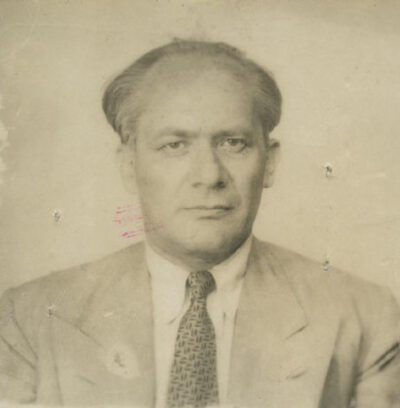
Raphael Lemkin
Raphael Lemkin was a Polish Jewish lawyer. Born June 24, 1900, in Biazvodna. Died August 28, 1959, in New York City. Positions held include prosecutor. Educated at Law Faculty of Lviv University and Heidelberg University. Awards include Cross of the Order of Merit of the Federal Republic of Germany and Four Freedoms Award – Freedom of Worship.
Facts
24 facts · 2 confirmed by two sources · 7 cited · 15 from one source
Where this comes from
Papalocal keeps its own record. It started from these sources; what each one said is kept here as it was copied, so a change on their side never changes this page by itself. Tap one to read its version.
What Wikidata says · copied November 13, 2026 · revision 2567172759
- Described as
- Polish Jewish lawyer (1900–1959)
- Other names
- Rafał Lemkin, Rafael Lemkin
- Born
- June 24, 1900 · 2 references
- Died
- August 28, 1959 · 2 references
- Born in
- Biazvodna
- Died in
- New York City · 1 reference
- Buried in
- Mount Hebron Cemetery
- Cause of death
- myocardial infarction
- Citizen of
- Russian Empire; Poland · 1 reference; United States · 2 references
- Occupation
- lawyer · 1 reference; peace and conflict researcher; prosecutor; jurist · 2 references; university teacher · 1 reference
- Positions held
- prosecutor
- Worked for
- Yale University; Duke University
- Education
- Law Faculty of Lviv University; Heidelberg University; Lviv University
- Awards
- Cross of the Order of Merit of the Federal Republic of Germany; Four Freedoms Award – Freedom of Worship (1989) · 1 reference
- Field
- international criminal law; genocide
- Wikipedias with a page
- 43
Wikidata item Q505586 (wikidata.org/wiki/Q505586), public domain (CC0). Copied November 13, 2026.
What Wikipedia says · copied November 13, 2026 · revision 1383564114
Raphael Lemkin (Polish: Rafał Lemkin, IPA: [ˈrafaw ˈlɛmkʲin]; 24 June 1900 – 28 August 1959) was a Polish Jewish lawyer who is known for coining the term "genocide" and for campaigning to establish the Genocide Convention, which legally defines the act. Following the German invasion of Poland in 1939, he fled the country and sought asylum in the United States, where he became an academic at Duke University and campaigned vigorously to raise international awareness of the atrocities that the Axis powers were committing across occupied Europe. It was amidst this environment of World War II that Lemkin coined the term "genocide" to describe Nazi Germany's extermination policy.
As a young Jewish law student who was deeply conscious of antisemitism and the persecution of Jews, Lemkin learned about the Ottoman genocide of the Armenian people during World War I and was deeply disturbed by the absence of international provisions to charge, punish, and hold accountable those who were responsible for organizing and executing it. In his view, the suffering of the Jewish people was part of a larger pattern of like-minded atrocities occurring around the world and throughout history, such as the Holodomor.
In either 1943 or 1944, Lemkin coined the term "genocide" from two words: genos (Greek: γένος, 'family, clan, tribe, race, stock, kin') and -cide (Latin: -cidium, 'killing'). It was included in the 1944 work of research Axis Rule in Occupied Europe, wherein he documented the mass killings of the peoples that had been deemed "sub-human" (German: Untermenschen) by the Nazi Party. The concept of genocide was defined by Lemkin to refer to the various extermination campaigns that Nazi Germany conducted in an attempt to wipe out entire ethnic groups, including the Holocaust, in which he personally lost 49 family members.
Lemkin's original definition of genocide is distinct from its modern legal definition. The Genocide Convention restricted his initially broad definition to five specific acts. He describes, "Generally speaking, genocide does not necessarily mean the immediate destruction of a nation, except when accomplished by mass killings of all members of a nation. It is intended rather to signify a coordinated plan of different actions aiming at the destruction of essential foundations of the life of national groups, with the aim of annihilating the groups themselves. The objectives of such a plan would be disintegration of the political and social institutions, of culture, language, national feelings, religion, and the economic existence of national groups, and the destruction of the personal security, liberty, health, dignity, and even the lives of the individuals belonging to such groups."
After World War II, Lemkin worked on the legal team of American jurist Robert H. Jackson, who served as the chief U.S. prosecutor among the Allied powers at the Nuremberg trials. The now-defined concept of genocide was non-existent in any form of international laws at the time, and this became one of the reasons for Lemkin's view that the trials did not serve complete justice on prosecuting Nazi atrocities against racial, ethnic, and religious groups. Lemkin committed the rest of his life to preventing the rise of "future Hitlers" by pushing for an appropriate international convention. On 9 December 1948, the United Nations approved the Genocide Convention, with many of its clauses based on Lemkin's proposals.
- Born, in its opening lines
- June 24, 1900
- Died, in its opening lines
- August 28, 1959
From the Wikipedia article “Raphael Lemkin” (en.wikipedia.org/wiki/Raphael_Lemkin), by its contributors, under CC BY-SA 4.0 (creativecommons.org/licenses/by-sa/4.0/). Copied November 13, 2026; not changed.
Confirmed Two sources agree. Cited One source, and it names where it got it. One source One source, without a reference of its own. Sources disagree The sources disagree. We show the best-supported value and keep theirs below.
