
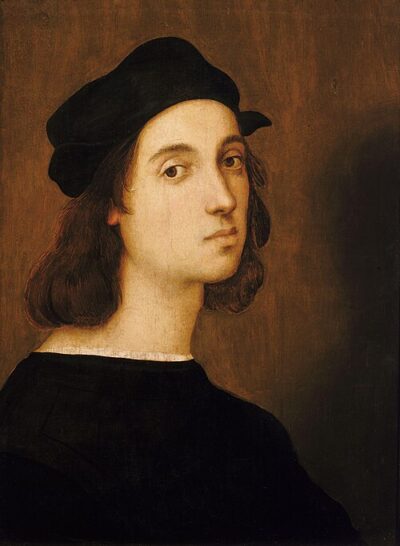
Raphael
Raphael was an Italian painter and architect. Born April 6, 1483, in Urbino. Died April 6, 1520, in Rome. Known for La fornarina, The School of Athens and Raphael Rooms. Awards include Order of the Golden Spur.
Facts
35 facts · 2 confirmed by two sources · 17 cited · 15 from one source · 1 where the sources disagree
What’s different
- Born: we show April 6, 1483 (Confirmed). Wikidata also lists March 28, 1483
- Died: we show April 6, 1520 (Confirmed). Wikidata also lists April 7, 1520
- Buried in: we show Pantheon (Sources disagree). Wikidata also lists Tomb of Raphael
Where this comes from
Papalocal keeps its own record. It started from these sources; what each one said is kept here as it was copied, so a change on their side never changes this page by itself. Tap one to read its version.
What Wikidata says · copied November 16, 2026 · revision 2567792143
- Described as
- Italian painter and architect (1483–1520)
- Other names
- Santi Raphael, Rafael Sanzio, Raffaello Sanzio da Urbino, Raffale Sanzio
- Born
- April 6, 1483 · 3 references; March 28, 1483 · 3 references
- Died
- April 6, 1520 · 6 references; April 7, 1520 · 1 reference
- Born in
- Urbino · 3 references
- Died in
- Rome · 5 references
- Buried in
- Pantheon · 1 reference; Tomb of Raphael
- Cause of death
- heart failure
- Citizen of
- Holy Roman Empire
- Occupation
- painter · 6 references; sculptor · 4 references; architect · 4 references; draftsperson · 3 references; architectural drafter · 1 reference; designer · 2 references; fresco painter · 2 references; court painter · 2 references
- Genre
- history painting · 2 references; portrait painting · 1 reference; portrait · 1 reference; allegory · 1 reference; religious art · 1 reference; mythological painting · 1 reference
- Known for
- La fornarina; The School of Athens; Raphael Rooms; Resurrection of Christ; Madonna and Child with the Book; The Marriage of the Virgin; Madonna del Granduca; Madonna of the Goldfinch; Madonna del Prato; The Deposition
- Awards
- Order of the Golden Spur · 1 reference
- Father
- Giovanni Santi · 1 reference
- Mother
- Magia di Battista Ciarla · 1 reference
- Religion
- Catholic Church
- Wikipedias with a page
- 195
Wikidata item Q5597 (wikidata.org/wiki/Q5597), public domain (CC0). Copied November 16, 2026.
What Wikipedia says · copied November 16, 2026 · revision 1370412674
Raffaello Sanzio da Urbino (Italian: [raffaˈɛllo ˈsantsjo da urˈbiːno]; March 28 or 6 April 1483 – 6 April 1520), now generally known in English as Raphael (UK: RAF-ay-əl, US: RAF-ee-əl, RAY-fee-, RAH-fy-EL), was an Italian painter and architect of the High Renaissance. His work is admired for its clarity of form, ease of composition, and visual achievement of the Neoplatonic ideal of human grandeur. Together with Leonardo da Vinci and Michelangelo, he forms the traditional trinity of great masters of that period.
His father Giovanni Santi was court painter to the ruler of the small but highly cultured city of Urbino. He died when Raphael was eleven, and Raphael seems to have played a role in managing the family workshop from this point. He probably trained in the workshop of Pietro Perugino, and was described as a fully trained "master" by 1500. He worked in or for several cities in north Italy until in 1508 he moved to Rome at the invitation of Pope Julius II, to work on the Apostolic Palace at the Vatican. He was given a series of important commissions there and elsewhere in the city, and began to work as an architect. He was still at the height of his powers at his death in 1520.
Raphael was enormously productive, running an unusually large workshop and, despite his early death at 37, leaving a large body of work. His career falls naturally into three phases and three styles, first described by Giorgio Vasari: his early years in Umbria, then a period of about four years (1504–1508) absorbing the artistic traditions of Florence, followed by his last hectic and triumphant twelve years in Rome, working for two popes and their close associates. Many of his works are found in the Vatican Palace, where the frescoed Raphael Rooms were the central, and the largest, work of his career. The best known work is The School of Athens in the Vatican Stanza della Segnatura. After his early years in Rome, much of his work was executed by his workshop from his drawings, with considerable loss of quality. He was extremely influential in his lifetime, though outside Rome his work was mostly known from his collaborative printmaking.After his death, the influence of his great rival Michelangelo exceeded his until the 18th and 19th centuries, when Raphael's more serene and harmonious qualities were again regarded as the highest models. Thanks to the influence of art historian Johann Joachim Winckelmann, his work became a formative influence on Neoclassical painting, but his techniques would later be explicitly and emphatically rejected by groups such as the Pre-Raphaelite Brotherhood.
- Born, in its opening lines
- April 6, 1483
- Died, in its opening lines
- April 6, 1520
From the Wikipedia article “Raphael” (en.wikipedia.org/wiki/Raphael), by its contributors, under CC BY-SA 4.0 (creativecommons.org/licenses/by-sa/4.0/). Copied November 16, 2026; not changed.
Confirmed Two sources agree. Cited One source, and it names where it got it. One source One source, without a reference of its own. Sources disagree The sources disagree. We show the best-supported value and keep theirs below.
