
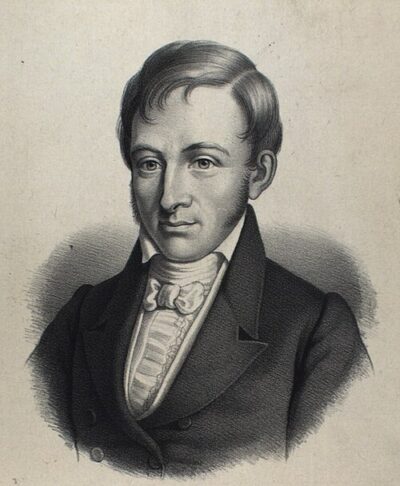
Rasmus Rask
Rasmus Rask was a Danish linguist. Born November 22, 1787, in Brændekilde. Died November 14, 1832, in Copenhagen. Known for Grimm's law. Educated at University of Copenhagen.
Facts
23 facts · 2 confirmed by two sources · 10 cited · 11 from one source
Where this comes from
Papalocal keeps its own record. It started from these sources; what each one said is kept here as it was copied, so a change on their side never changes this page by itself. Tap one to read its version.
What Wikidata says · copied November 16, 2026 · revision 2555983011
- Described as
- Danish linguist
- Other names
- Erasmus Rask, Erasmus Christian Rask, Rasmus Kristian Nielsen Rask, Rasmus Kristian Rask, Rasmus Christian Rask, Rasmus Rasch, Rasmus Christian Nielsen Rasch
- Born
- November 22, 1787 · 10 references
- Died
- November 14, 1832 · 10 references
- Born in
- Brændekilde · 1 reference
- Died in
- Copenhagen · 1 reference
- Buried in
- Assistens Cemetery
- Citizen of
- Kingdom of Denmark · 1 reference
- Occupation
- linguist · 2 references; university teacher; historical linguist · 1 reference; philologist · 1 reference
- Worked for
- University of Copenhagen
- Education
- University of Copenhagen
- Member of
- Royal Danish Academy of Sciences and Letters; Royal Swedish Academy of Letters, History and Antiquities; Royal Danish Society for Fatherland History · 1 reference
- Known for
- Grimm's law
- Field
- German studies; oriental studies; linguistics · 1 reference; Germanic philology · 1 reference; Slavic philology · 2 references
- Father
- Niels Hansen Rasch
- Mother
- Birthe Rasmusdatter
- Wikipedias with a page
- 50
Wikidata item Q310958 (wikidata.org/wiki/Q310958), public domain (CC0). Copied November 16, 2026.
What Wikipedia says · copied November 16, 2026 · revision 1379643905
Rasmus Kristian Rask (Danish: [ˈʁɑsmus ˈkʰʁestjæn ˈʁɑsk]; born Rasmus Christian Nielsen Rasch; 22 November 1787 – 14 November 1832) was a Danish linguist, philologist and a principal founder of the science of comparative linguistics. In 1818, he first showed that, in their consonant sounds, words in the Germanic languages vary with a certain regularity from their equivalents in the other Indo-European languages. What Rask observed proved to be the basis of a fundamental law of comparative linguistics (Grimm's law), which was formally set forth in 1822 by Jacob Grimm.
Rask traveled extensively to study languages, first to Iceland, where he wrote the first grammar of Icelandic, and later to Russia, Persia, India, and Ceylon (now Sri Lanka). Shortly before his death, he was hired as professor of Eastern languages at the University of Copenhagen. Rask is especially known for his contributions to comparative linguistics, including an early formulation of what would later be known as Grimm's Law. He was elected as a member to the American Philosophical Society in 1829.
- Born, in its opening lines
- November 22, 1787
- Died, in its opening lines
- November 14, 1832
From the Wikipedia article “Rasmus Rask” (en.wikipedia.org/wiki/Rasmus_Rask), by its contributors, under CC BY-SA 4.0 (creativecommons.org/licenses/by-sa/4.0/). Copied November 16, 2026; not changed.
Confirmed Two sources agree. Cited One source, and it names where it got it. One source One source, without a reference of its own. Sources disagree The sources disagree. We show the best-supported value and keep theirs below.
