
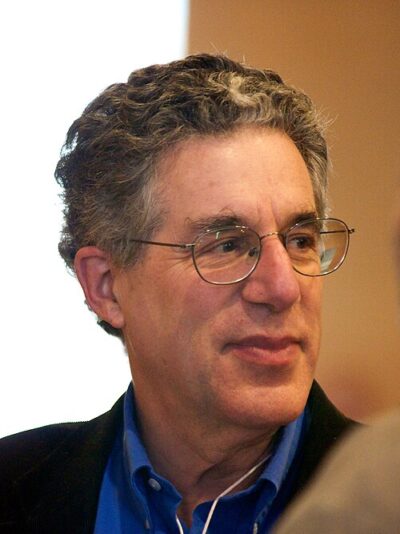
Ray Jackendoff is an American linguist and philosophy professor. Born January 23, 1945. Positions held include president of the Linguistic Society of America. Educated at Massachusetts Institute of Technology. Awards include Guggenheim Fellowship, Rumelhart Prize and Jean Nicod Prize.
Facts
21 facts · 1 confirmed by two sources · 5 cited · 15 from one source
Where this comes from
Papalocal keeps its own record. It started from these sources; what each one said is kept here as it was copied, so a change on their side never changes this page by itself. Tap one to read its version.
What Wikidata says · copied November 18, 2026 · revision 2515904491
- Described as
- American linguist and philosophy professor
- Born
- January 23, 1945
- Citizen of
- United States
- Occupation
- linguist · 1 reference; university teacher; clarinetist · 1 reference; music arranger · 1 reference
- Positions held
- president of the Linguistic Society of America
- Worked for
- Brandeis University; Santa Fe Institute; Tufts University · 1 reference
- Education
- Massachusetts Institute of Technology
- Member of
- American Academy of Arts and Sciences; American Association for the Advancement of Science
- Awards
- Guggenheim Fellowship · 1 reference; Rumelhart Prize (2014); Jean Nicod Prize (2003) · 1 reference; Fellow of the Cognitive Science Society; Fellow of the American Association for the Advancement of Science; Fellow of the American Academy of Arts and Sciences
- Field
- generative grammar · 1 reference; linguistics
- Wikipedias with a page
- 18
Wikidata item Q1392229 (wikidata.org/wiki/Q1392229), public domain (CC0). Copied November 18, 2026.
What Wikipedia says · copied November 18, 2026 · revision 1380591889
Ray Jackendoff (born January 23, 1945) is an American linguist. He is professor of philosophy, Seth Merrin Chair in the Humanities and was, with Daniel Dennett, co-director of the Center for Cognitive Studies at Tufts University. His work straddles the boundary between generative linguistics and cognitive linguistics, committed to both the existence of an innate universal grammar (an important thesis of generative linguistics) and to giving an account of language that is consistent with the current understanding of the human mind and cognition (the main purpose of cognitive linguistics).
Jackendoff's research deals with the semantics of natural language, its bearing on the formal structure of cognition, and its lexical and syntactic expression. He has conducted extensive research on the relationship between conscious awareness and the computational theory of mind, on syntactic theory, and, with Fred Lerdahl, on musical cognition, culminating in their generative theory of tonal music. His theory of conceptual semantics developed into a comprehensive theory on the foundations of language, which indeed is the title of a monograph (2002): Foundations of Language. Brain, Meaning, Grammar, Evolution. In his 1983 Semantics and Cognition, he was one of the first linguists to integrate the visual faculty into his account of meaning and human language.
Jackendoff studied under linguists Noam Chomsky and Morris Halle at the Massachusetts Institute of Technology, where he received his PhD in linguistics in 1969. Before moving to Tufts in 2005, Jackendoff was professor of linguistics and chair of the linguistics program at Brandeis University from 1971 to 2005. During the 2009 spring semester, he was an external professor at the Santa Fe Institute. Jackendoff was awarded the Jean Nicod Prize in 2003. He received the 2014 David E. Rumelhart Prize. He has also been granted honorary degrees by the Université du Québec à Montréal (2010), the National Music University of Bucharest (2011), the Music Academy of Cluj-Napoca (2011), the Ohio State University (2012), and Tel Aviv University (2013).
- Born, in its opening lines
- January 23, 1945
From the Wikipedia article “Ray Jackendoff” (en.wikipedia.org/wiki/Ray_Jackendoff), by its contributors, under CC BY-SA 4.0 (creativecommons.org/licenses/by-sa/4.0/). Copied November 18, 2026; not changed.
Confirmed Two sources agree. Cited One source, and it names where it got it. One source One source, without a reference of its own. Sources disagree The sources disagree. We show the best-supported value and keep theirs below.
