
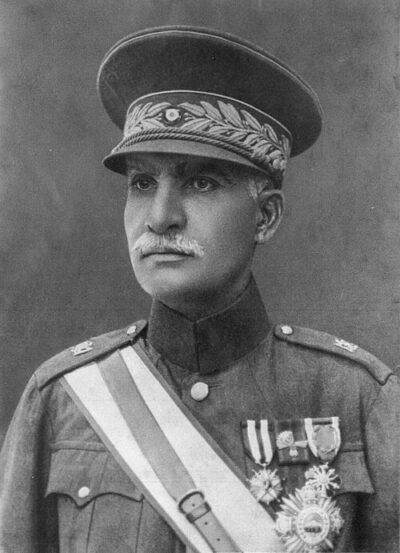
Reza Shah
Reza Shah was a Shah of Iran from 1925 to 1941 and founder of the Pahlavi Dynasty. Born March 15, 1878, in Alasht. Died July 26, 1944, in Johannesburg. Positions held include shah (1925–1941) and Prime Minister of Iran (1923–1925). Awards include Grand Cross of the Legion of Honour, Order of Isabella the Catholic and Order of the White Eagle.
Facts
37 facts · 2 confirmed by two sources · 5 cited · 30 from one source
Where this comes from
Papalocal keeps its own record. It started from these sources; what each one said is kept here as it was copied, so a change on their side never changes this page by itself. Tap one to read its version.
What Wikidata says · copied November 16, 2026 · revision 2565534593
- Described as
- Shah of Iran from 1925 to 1941 and founder of the Pahlavi Dynasty
- Other names
- Rezā Khan, Reza Shah Pahlavi, Rezā Shāh, Rezā Šāh
- Born
- March 15, 1878 · 2 references
- Died
- July 26, 1944 · 3 references
- Born in
- Alasht
- Died in
- Johannesburg · 1 reference
- Buried in
- Reza Shah Mausoleum
- Cause of death
- cardiovascular disease
- Citizen of
- Iran
- Occupation
- politician; military personnel
- Positions held
- shah (1925–1941); Prime Minister of Iran (1923–1925)
- Awards
- Grand Cross of the Legion of Honour; Order of Isabella the Catholic; Order of the White Eagle; Order of the Lion and the Sun First class · 1 reference; Order of the Most Holy Annunciation · 1 reference; Knight of the Order of the Elephant (1937); Knight grand cross of the order of the crown of Italy (1939)
- Spouse
- Tadj ol-Molouk of Iran (1916–1944) · 1 reference; Mariam Savadkukhi (1895–1911); Turan Amirsoleimani (1922–1923); Esmat Dowlatshahi (1923–1944)
- Children
- Hamdamsaltaneh Pahlavi; Ahmad Reza Pahlavi; Mohammad Reza I of Iran · 1 reference; Ashraf Pahlavi · 1 reference; Fatemeh Pahlavi; Shams Pahlavi · 1 reference; Abdul Reza Pahlavi; Prince Ali Reza Pahlavi · 1 reference; Gholam Reza Pahlavi; Hamid Reza Pahlavi; Mahmoud Reza Pahlavi
- Father
- Abbas Ali Khan
- Mother
- Noush-Afarin
- Religion
- Shia Islam
- Military rank
- brigadier general
- Wikipedias with a page
- 84
Wikidata item Q182921 (wikidata.org/wiki/Q182921), public domain (CC0). Copied November 16, 2026.
What Wikipedia says · copied November 16, 2026 · revision 1383830470
Reza Shah Pahlavi (previously Reza Khan; 15 March 1878 – 26 July 1944) was Shah of Iran from 1925 to 1941 and founder of the Pahlavi dynasty. Originally an army officer, he became a politician, serving as minister of war and prime minister of Iran, and was elected shah following the deposition of Ahmad Shah, the last monarch of the Qajar dynasty.
Joining the Persian Cossack Brigade at age 14, he rose through the ranks, becoming a brigadier-general by 1921. In February 1921, as leader of the entire Cossack Brigade based in Qazvin province, he marched towards Tehran and seized the capital. He forced the dissolution of the government and installed Zia ol Din Tabatabaee as the new prime minister. Reza Khan's first role in the new government was commander-in-chief of the army and the minister of war. Two years after the coup, Reza Pahlavi became Iran's prime minister, backed by the compliant national assembly of Iran. In 1925, the constituent assembly deposed Ahmad Shah and amended Iran's 1906 constitution to allow the election of Reza Pahlavi as the Shah of Iran. He founded the Pahlavi dynasty that lasted until it was overthrown in 1979 by the Iranian Revolution.
In an effort to reduce British and Russian influence, Reza Shah initially sought partnerships with the United States and Weimar Germany until 1931. Thereafter, he turned to the First Republic of Czechoslovakia and Denmark, drawing on the Czech industrial firm Škoda Works and Scandinavian engineering consortium Kampsax to advance the development of Iran’s infrastructure, military, and industry during the 1930s. Reza Shah's reign ended when he was forced to abdicate after the Anglo-Soviet invasion of Iran in 1941, during the Second World War; he was succeeded by his eldest son, Mohammad Reza Shah. A modernizer, Reza Shah clashed with the Shia clergy and introduced social, economic, and political reforms during his reign, ultimately laying the foundations of the modern Iranian state. Therefore, he is regarded by many as the founder of modern Iran.
His legacy remains controversial to this day. His defenders say that he was an essential reunifying and modernising force for Iran, while his detractors (particularly the Islamic Republic of Iran) assert that his reign was often despotic, with his failure to modernise Iran's large peasant population eventually sowing the seeds for the Iranian Revolution nearly four decades later, which ended over 2,500 years of Iranian monarchy. Moreover, his insistence on ethnic nationalism and cultural unitarism, along with forced detribalisation and sedentarisation, resulted in the suppression of several ethnic and social groups. Although he was of Iranian Mazanderani descent, his government carried out an extensive policy of Persianization trying to create a single, united and largely homogeneous nation, similar to Mustafa Kemal Atatürk's policy of Turkification in Turkey after the fall of the Ottoman Empire. In the spring of 1950, he was posthumously named as Reza Shah the Great (رضا شاه بزرگ) by Iran's National Consultative Assembly.
- Born, in its opening lines
- March 15, 1878
- Died, in its opening lines
- July 26, 1944
From the Wikipedia article “Reza Shah” (en.wikipedia.org/wiki/Reza_Shah), by its contributors, under CC BY-SA 4.0 (creativecommons.org/licenses/by-sa/4.0/). Copied November 16, 2026; not changed.
Confirmed Two sources agree. Cited One source, and it names where it got it. One source One source, without a reference of its own. Sources disagree The sources disagree. We show the best-supported value and keep theirs below.
