
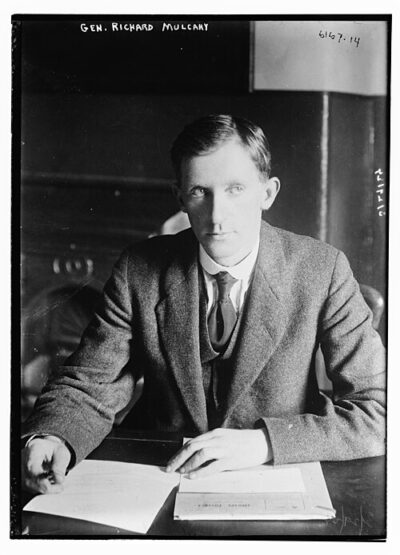
Richard Mulcahy
Richard Mulcahy was an Irish politician. Born May 10, 1886, in Waterford. Died December 16, 1971, in Dublin. Positions held include Minister for Defence (2 times) (1919–1924), Minister for Education (Ireland) (2 times) (1948–1957) and Leader of the Opposition (1944–1948). Educated at University College Dublin.
Facts
26 facts · 2 confirmed by two sources · 4 cited · 20 from one source
Where this comes from
Papalocal keeps its own record. It started from these sources; what each one said is kept here as it was copied, so a change on their side never changes this page by itself. Tap one to read its version.
What Wikidata says · copied November 18, 2026 · revision 2562961596
- Described as
- Irish politician (1886-1971)
- Other names
- Richard James Mulcahy
- Born
- May 10, 1886 · 3 references
- Died
- December 16, 1971 · 3 references
- Born in
- Waterford
- Died in
- Dublin
- Buried in
- Littleton · 1 reference
- Name at birth
- Richard James Mulcahy
- Citizen of
- Ireland; Irish Republic; Irish Free State; United Kingdom of Great Britain and Ireland
- Occupation
- politician · 1 reference
- Positions held
- Minister for Defence (2 times) (1919–1924); Minister for Education (Ireland) (2 times) (1948–1957); Leader of the Opposition (1944–1948); Minister for Housing, Local Government and Heritage (1927–1932); Leader of Fine Gael (1944–1959); member of the 31st Parliament of the United Kingdom (1918–1922) · 1 reference; Teachta Dála (1919–1961) · 1 reference; senator of Ireland (2 times) (1938–1944) · 1 reference; Minister for Children, Disability and Equality (1956)
- Political party
- Fine Gael; Irish Republican Brotherhood
- Education
- University College Dublin · 1 reference
- Spouse
- Josephine Ryan
- Religion
- Catholic Church
- Military rank
- general
- Wikipedias with a page
- 20
Wikidata item Q560499 (wikidata.org/wiki/Q560499), public domain (CC0). Copied November 18, 2026.
What Wikipedia says · copied November 18, 2026 · revision 1384359396
Richard James Mulcahy (10 May 1886 – 16 December 1971) was an Irish Fine Gael politician and army general who served as Minister for Education from 1948 to 1951 and 1954 to 1957, Minister for the Gaeltacht from June 1956 to October 1956, Leader of the Opposition from 1944 to 1948, Leader of Fine Gael from 1944 to 1959, Minister for Local Government and Public Health from 1927 to 1932 and Minister for Defence from January to April 1919 and 1922 to 1924. He served as a Teachta Dála (TD) from 1918 to 1938 and from 1943 to 1961 and a Senator from March 1938 to June 1938 and 1943 to 1944. He served in the cabinets of W. T. Cosgrave and John A. Costello.
He fought in the 1916 Easter Rising, served as chief of staff of the Irish Republican Army during the War of Independence and became commander-in-chief of the National Army in the Irish Civil War after the death of Michael Collins. Mulcahy earned notoriety through his order that anti-Treaty activists captured carrying arms were liable for execution and for his failure to punish Free State army soldiers for atrocities. In later years this legacy prevented him from becoming Taoiseach in a coalition government.
- Born, in its opening lines
- May 10, 1886
- Died, in its opening lines
- December 16, 1971
From the Wikipedia article “Richard Mulcahy” (en.wikipedia.org/wiki/Richard_Mulcahy), by its contributors, under CC BY-SA 4.0 (creativecommons.org/licenses/by-sa/4.0/). Copied November 18, 2026; not changed.
Confirmed Two sources agree. Cited One source, and it names where it got it. One source One source, without a reference of its own. Sources disagree The sources disagree. We show the best-supported value and keep theirs below.
