
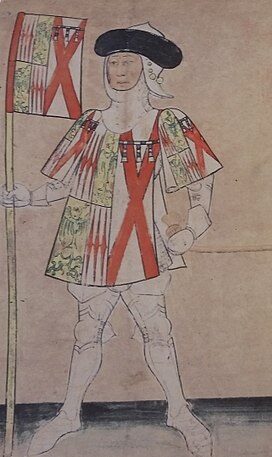
Richard Neville, 5th Earl of Salisbury
Richard Neville, 5th Earl of Salisbury was an English Earl. Born 1400, in Raby Castle. Died December 30, 1460, in Battle of Wakefield. Positions held include member of the House of Lords and Lord Chamberlain (1460). Awards include Knight of the Garter.
Facts
36 facts · 1 confirmed by two sources · 18 cited · 16 from one source · 1 where the sources disagree
What’s different
- Died: we show December 30, 1460 (Sources disagree). Wikipedia says December 31, 1460
Where this comes from
Papalocal keeps its own record. It started from these sources; what each one said is kept here as it was copied, so a change on their side never changes this page by itself. Tap one to read its version.
What Wikidata says · copied November 18, 2026 · revision 2564294811
- Described as
- English Earl
- Born
- 1400 · 3 references
- Died
- December 30, 1460
- Born in
- Raby Castle · 1 reference
- Died in
- Battle of Wakefield
- Buried in
- Bisham Abbey
- Cause of death
- decapitation
- Citizen of
- Kingdom of England
- Occupation
- jurist; judge
- Positions held
- member of the House of Lords; Lord Chamberlain (1460)
- Member of
- Order of the Garter (1438–)
- Awards
- Knight of the Garter (1438) · 1 reference
- Spouse
- Alice Montacute, 5th Countess of Salisbury · 2 references
- Children
- John Neville, 1st Marquess of Montagu · 1 reference; Richard Neville · 1 reference; Cecily Neville, Duchess of Warwick · 2 references; Alice Neville · 1 reference; George Neville · 2 references; Katherine Neville, Baroness Hastings · 1 reference; Eleanor Neville · 2 references; Lady Margaret Neville · 3 references; Thomas Neville · 1 reference; Lady Joan Neville · 1 reference
- Father
- Ralph Neville, 1st Earl of Westmorland · 1 reference
- Mother
- Joan Beaufort, Countess of Westmorland · 1 reference
- Siblings
- William Neville, Earl of Kent; Edward Neville, 3rd Baron Bergavenny · 1 reference; George Neville, 1st Baron Latimer; Robert Neville; Alice Neville; Cecily Neville, Duchess of York · 1 reference; Katherine Neville, Duchess of Norfolk · 1 reference; Eleanor Percy, Countess of Northumberland · 1 reference; Anne Neville, Duchess of Buckingham · 1 reference; Philippa Neville
- Wikipedias with a page
- 22
Wikidata item Q384856 (wikidata.org/wiki/Q384856), public domain (CC0). Copied November 18, 2026.
What Wikipedia says · copied November 18, 2026 · revision 1383576804
Richard Neville, jure uxoris 5th Earl of Salisbury (c. 1400 – 31 December 1460) was a fifteenth-century English northern magnate. He was the eldest son by the second wife of Ralph Neville, 1st Earl of Westmorland, from whom he inherited vast estates in Yorkshire, which he augmented by marriage to Alice Montagu, daughter and heiress of Thomas Montagu, Earl of Salisbury, from where he received his title. He was a loyal Lancastrian for most of his life, serving the King, Henry VI, in France, on the border with Scotland, and in many of the periodic crises of the reign. This included the fall of Humphrey, Duke of Gloucester, the fall of the Duke of Suffolk, Jack Cade's rebellion, and the revolt of the King's cousin Richard of York. He was also closely involved in an internecine feud with the senior branch of his family over the division of Ralph's estates from the late 1420s to the 1440s, and in the early 1450s his family and that of the powerful northern Percy family indulged in a violent local war, during which period Salisbury was a royal councillor.
Salisbury finally joined York in his last rebellion in the late 1450s and became a Yorkist leader during the early parts of the Wars of the Roses, joining the Duke in fighting at the First Battle of St Albans, where the King's force was defeated. In 1458, he participated in the Loveday, an attempt at reconciliation held in London. He was notably successful in the Battle of Blore Heath, but after the Yorkist army collapsed in the Rout of Ludford Bridge, Salisbury escaped to Calais, having been specifically excluded from a royal pardon. He returned to England with York in 1460, and took part in the disastrous Battle of Wakefield on 30 December that year. This resulted in a crushing Yorkist defeat at which his second-eldest son Thomas was slain on the field. Salisbury escaped the carnage but was captured the following day and executed in Pontefract Castle, where he was buried. Alice died around 1462, and two years later Salisbury was reinterred with her in the Montagu Mausoleum in Bisham Priory.
- Born, in its opening lines
- c. 1400
- Died, in its opening lines
- December 31, 1460
From the Wikipedia article “Richard Neville, 5th Earl of Salisbury” (en.wikipedia.org/wiki/Richard_Neville,_5th_Earl_of_Salisbury), by its contributors, under CC BY-SA 4.0 (creativecommons.org/licenses/by-sa/4.0/). Copied November 18, 2026; not changed.
Confirmed Two sources agree. Cited One source, and it names where it got it. One source One source, without a reference of its own. Sources disagree The sources disagree. We show the best-supported value and keep theirs below.
