
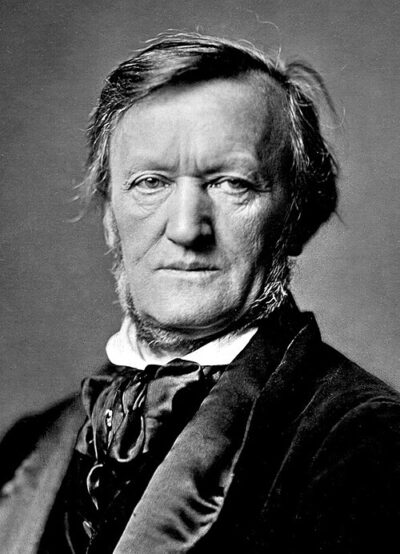
Richard Wagner
Richard Wagner was a German composer. Born May 22, 1813, in Leipzig. Died February 13, 1883, in Venice. Known for The Flying Dutchman, Tristan und Isolde and Tannhäuser. Educated at Leipzig University and Kreuzschule. Awards include Bavarian Maximilian Order for Science and Art.
Facts
50 facts · 2 confirmed by two sources · 13 cited · 35 from one source
Where this comes from
Papalocal keeps its own record. It started from these sources; what each one said is kept here as it was copied, so a change on their side never changes this page by itself. Tap one to read its version.
What Wikidata says · copied November 16, 2026 · revision 2568870965
- Described as
- German composer (1813–1883)
- Other names
- Wagner, Wilhelm Richard Wagner
- Born
- May 22, 1813 · 22 references
- Died
- February 13, 1883 · 23 references
- Born in
- Leipzig · 6 references
- Died in
- Venice · 5 references
- Buried in
- Wahnfried
- Cause of death
- myocardial infarction
- Name at birth
- Wilhelm Richard Wagner
- Citizen of
- Kingdom of Saxony; Germany · 1 reference; Switzerland · 1 reference; Italy · 1 reference
- Occupation
- composer · 4 references; librettist; conductor; essayist; theatre director; autobiographer; poet; pianist
- Worked for
- University of Music and Performing Arts Vienna
- Education
- Leipzig University; Kreuzschule; Thomasschule zu Leipzig
- Member of
- Royal Swedish Academy of Music; Corps Saxonia Leipzig · 1 reference
- Genre
- opera; choral symphony; classical music
- Instrument
- piano
- Known for
- The Flying Dutchman; Tristan und Isolde; Tannhäuser; Das Rheingold; Lohengrin; Der Ring des Nibelungen
- Awards
- Bavarian Maximilian Order for Science and Art (1873)
- Field
- opera; Musikdrama
- Spouse
- Cosima Wagner · 2 references; Minna Planer · 2 references
- Children
- Siegfried Wagner · 1 reference; Isolde Wagner
- Father
- Carl Friedrich Wagner · 2 references
- Mother
- Johanna Rosina Wagner-Geyer · 2 references
- Siblings
- Rosalie Wagner · 1 reference; Ottilie Brockhaus · 1 reference; Louise Wagner · 1 reference; Cäcilie Avenarius; Albert Wagner
- Religion
- Lutheranism
- Wikipedias with a page
- 207
Wikidata item Q1511 (wikidata.org/wiki/Q1511), public domain (CC0). Copied November 16, 2026.
What Wikipedia says · copied November 16, 2026 · revision 1385642015
Wilhelm Richard Wagner ( VAHG-nər; German: [ˈvɪlˌhɛlm ˈʁɪçaʁt ˈvaːɡnɐ] ; 22 May 1813 – 13 February 1883) was a German composer, theatre director, essayist, and conductor, best known for his operas, although his mature works are often referred to as music dramas. Unlike most composers, Wagner wrote both the libretti and the music for all of his stage works. He first achieved recognition with works in the Romantic tradition of Carl Maria von Weber and Giacomo Meyerbeer, but revolutionised the genre through his concept of the Gesamtkunstwerk ("total work of art"), which sought to unite poetic, musical, visual, and dramatic elements. In that approach, the drama unfolds as a continuously sung narrative, with the music evolving organically from the text rather than alternating between arias and recitatives. Wagner outlined those ideas in a series of essays published between 1849 and 1852, most fully realising them in the first half of his four-opera cycle Der Ring des Nibelungen (The Ring of the Nibelung).
Wagner's compositions, particularly in his later period, have complex textures, rich harmonies and orchestration, and elaborate leitmotifs—musical phrases associated with individual characters, places, ideas, or plot elements. His advances in musical language, such as extreme chromaticism and quickly shifting tonal centres, greatly influenced the development of classical music; his Tristan und Isolde is regarded as an important precursor to modernist music. Later in life, he softened his ideological stance against traditional operatic forms (e.g., arias, ensembles and choruses), reintroducing them into his last few stage works, including Die Meistersinger von Nürnberg (The Mastersingers of Nuremberg) and Parsifal.
To fully realise his artistic vision, Wagner had his own opera house built to his specifications: the Bayreuth Festspielhaus, which featured many innovations designed to immerse the audience in the drama. It hosted the premieres of The Ring and Parsifal, and remains entirely devoted to staging his mature works at the annual Bayreuth Festival. After Wagner's death, his wife Cosima assumed leadership; it has since remained under the management of their descendants.
Wagner's unorthodox operas, provocative essays, and contentious personal conduct engendered considerable controversy during his lifetime, and continue to do so. Declared a "genius" by some and a "disease" by others, his views on religion, politics, and society remain debated—most notably the extent to which his antisemitism finds expression in his stage and prose works. Despite this, his operas and music remain central to the repertoire of major opera houses and concert halls worldwide. His ideas can be traced across many art forms throughout the 20th century; his influence extended beyond composition into conducting, philosophy, literature, the visual arts, and theatre.
- Born, in its opening lines
- May 22, 1813
- Died, in its opening lines
- February 13, 1883
From the Wikipedia article “Richard Wagner” (en.wikipedia.org/wiki/Richard_Wagner), by its contributors, under CC BY-SA 4.0 (creativecommons.org/licenses/by-sa/4.0/). Copied November 16, 2026; not changed.
Confirmed Two sources agree. Cited One source, and it names where it got it. One source One source, without a reference of its own. Sources disagree The sources disagree. We show the best-supported value and keep theirs below.
