
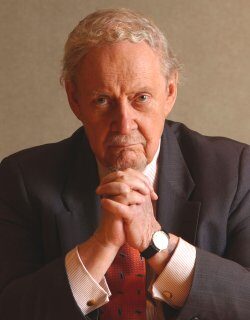
Robert Bork
Robert Bork was an American lawyer and judge. Born March 1, 1927, in Pittsburgh. Died December 19, 2012, in Arlington County. Positions held include Solicitor General of the United States (1973–1977), United States Attorney General (1973–1974) and Judge of the United States Court of Appeals for the D.C. Circuit. Educated at University of Chicago Law School and Hotchkiss School. Awards include Francis Boyer Award.
Facts
24 facts · 2 confirmed by two sources · 5 cited · 17 from one source
Where this comes from
Papalocal keeps its own record. It started from these sources; what each one said is kept here as it was copied, so a change on their side never changes this page by itself. Tap one to read its version.
What Wikidata says · copied November 16, 2026 · revision 2567376287
- Described as
- American lawyer and judge (1927–2012)
- Other names
- Robert Heron Bork
- Born
- March 1, 1927 · 5 references
- Died
- December 19, 2012 · 5 references
- Born in
- Pittsburgh · 1 reference
- Died in
- Arlington County · 1 reference
- Cause of death
- cardiovascular disease
- Citizen of
- United States
- Occupation
- lawyer; judge · 1 reference; pedagogue; politician · 1 reference; jurist · 1 reference
- Positions held
- Solicitor General of the United States (1973–1977); United States Attorney General (1973–1974) · 1 reference; Judge of the United States Court of Appeals for the D.C. Circuit
- Political party
- Republican Party
- Worked for
- Yale Law School; University of Richmond · 1 reference
- Education
- University of Chicago Law School; Hotchkiss School · 1 reference
- Member of
- American Academy of Arts and Sciences; Phi Beta Kappa Society
- Awards
- Francis Boyer Award (1984) · 1 reference
- Children
- R. H. Bork
- Military branch
- United States Marine Corps
- Wikipedias with a page
- 23
Wikidata item Q1365780 (wikidata.org/wiki/Q1365780), public domain (CC0). Copied November 16, 2026.
What Wikipedia says · copied November 16, 2026 · revision 1384410462
Robert Heron Bork (March 1, 1927 – December 19, 2012) was an American legal scholar who served as solicitor general of the United States from 1973 until 1977. A law professor by training, he was acting United States Attorney General from 1973 to 1974 and a judge on the U.S. Court of Appeals for the D.C. Circuit from 1982 to 1988. In 1987, President Ronald Reagan nominated Bork to the U.S. Supreme Court, but the Senate rejected his nomination after a contentious and highly publicized confirmation hearing.
Bork was born in Pittsburgh, Pennsylvania, and received both his undergraduate and legal education at the University of Chicago. After working at the law firms of Kirkland & Ellis and Willkie Farr & Gallagher, he served as a professor at Yale Law School. He became a prominent advocate of originalism, calling for judges to adhere to the original understanding of the United States Constitution, and an influential antitrust scholar, arguing that consumers often benefited from corporate mergers and that antitrust law should focus on consumer welfare rather than on ensuring competition. Bork wrote several books, including a scholarly work titled The Antitrust Paradox and a work of cultural criticism titled Slouching Towards Gomorrah.
From 1973 to 1977, he served as Solicitor General under Presidents Richard Nixon and Gerald Ford, successfully arguing several cases before the Supreme Court. During the October 1973 Saturday Night Massacre, Bork became acting U.S. Attorney General after his superiors in the U.S. Justice Department chose to resign rather than fire Special Prosecutor Archibald Cox, who was investigating the Watergate scandal. Following an order from President Nixon, Bork fired Cox as his first assignment as Acting Attorney General. Bork served as Acting Attorney General until January 4, 1974, and was succeeded by Ohio U.S. Senator William B. Saxbe.
In 1982, President Reagan appointed Bork to the Court of Appeals for the District of Columbia Circuit. In 1987, Reagan nominated Bork to replace retiring Supreme Court Justice Lewis Powell. His nomination attracted unprecedented media attention and efforts by interest groups to mobilize opposition to his confirmation, primarily due to his outspoken criticism of the Warren and Burger Courts and his role in the Saturday Night Massacre. His nomination was ultimately rejected in the Senate, 42–58, and the vacancy was filled by Anthony Kennedy. Bork resigned from his judgeship in 1988, taking up a career as an author. He served as a professor at various institutions, including the George Mason University School of Law. He advised presidential candidate Mitt Romney, and was a fellow at the American Enterprise Institute and at the Hudson Institute.
- Born, in its opening lines
- March 1, 1927
- Died, in its opening lines
- December 19, 2012
From the Wikipedia article “Robert Bork” (en.wikipedia.org/wiki/Robert_Bork), by its contributors, under CC BY-SA 4.0 (creativecommons.org/licenses/by-sa/4.0/). Copied November 16, 2026; not changed.
Confirmed Two sources agree. Cited One source, and it names where it got it. One source One source, without a reference of its own. Sources disagree The sources disagree. We show the best-supported value and keep theirs below.
