
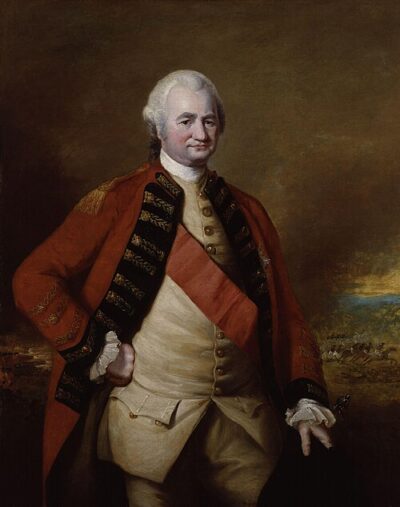
Robert Clive
Robert Clive was a British military officer and East India Company official. Born September 29, 1725, in Shropshire. Died November 22, 1774, in London. Positions held include member of the 11th Parliament of Great Britain, member of the 12th Parliament of Great Britain and member of the 13th Parliament of Great Britain. Educated at Merchant Taylors' School. Awards include Fellow of the Royal Society and Order of the Bath.
Facts
36 facts · 2 confirmed by two sources · 14 cited · 19 from one source · 1 where the sources disagree
What’s different
- Born in: we show Shropshire (Sources disagree). Wikidata also lists Kingdom of Great Britain
Where this comes from
Papalocal keeps its own record. It started from these sources; what each one said is kept here as it was copied, so a change on their side never changes this page by itself. Tap one to read its version.
What Wikidata says · copied November 16, 2026 · revision 2564301120
- Described as
- British military officer and East India Company official (1725-1774)
- Other names
- Robert Clive, Baron Clive, Baron Robert Clive, Robert, 1st Baron Clive of Plassey Clive, Clive of India, Robert Clive, 1st Baron Clive, Robert, Baron Clive
- Born
- September 29, 1725 · 1 reference
- Died
- November 22, 1774 · 12 references
- Born in
- Shropshire; Kingdom of Great Britain
- Died in
- London
- Buried in
- Shropshire
- Cause of death
- exsanguination
- Citizen of
- Kingdom of Great Britain
- Occupation
- politician; military officer; soldier · 1 reference; military personnel · 1 reference
- Positions held
- member of the 11th Parliament of Great Britain; member of the 12th Parliament of Great Britain; member of the 13th Parliament of Great Britain; member of the 14th Parliament of Great Britain; Lord Lieutenant of Shropshire (1772–1774); Lord Lieutenant of Montgomeryshire (1773–1774)
- Education
- Merchant Taylors' School
- Member of
- Royal Society of London
- Awards
- Fellow of the Royal Society; Order of the Bath · 1 reference
- Spouse
- Margaret Clive (1753–) · 2 references
- Children
- Edward Clive, 1st Earl of Powis · 1 reference; Richard Clive · 1 reference; Jane Clive · 1 reference; Rebecca Clive · 1 reference; Charlotte Clive · 1 reference; Margaret Clive · 1 reference; Elizabeth Clive · 1 reference; Robert Clive · 1 reference
- Father
- Richard Clive · 2 references
- Mother
- Rebecca Gaskell · 2 references
- Siblings
- William Clive · 1 reference; Rebecca Clive
- Military branch
- infantry
- Military rank
- major general
- Wikipedias with a page
- 56
Wikidata item Q162296 (wikidata.org/wiki/Q162296), public domain (CC0). Copied November 16, 2026.
What Wikipedia says · copied November 16, 2026 · revision 1384867824
Robert Clive, 1st Baron Clive (29 September 1725 – 22 November 1774), also known as Clive of India, was the first British Governor of the Bengal Presidency. Clive has been widely credited for laying the foundation of the British East India Company (EIC) rule in Bengal.
He began as a "writer" (the term used then in India for an office clerk) for the EIC in 1744; however, after being caught up in military action during the fall of Madras, Clive joined the EIC's private army. Clive rapidly rose through the military ranks of the EIC and was eventually credited with establishing Company rule in Bengal by winning the Battle of Plassey in 1757. In return for supporting the Nawab Mir Jafar as ruler of Bengal, Clive was guaranteed a jagir of £90,000 (equivalent to £9,300,000 in 2025) per year, which was the rent the EIC would otherwise pay to the Nawab for their tax-farming concession. When Clive left India in January 1767 he had a fortune of £401,102 (equivalent to £62,200,000 in 2025) which he remitted through the Dutch East India Company.
Blocking impending French mastery of India, Clive improvised a 1751 military expedition that ultimately enabled the EIC to adopt the French strategy of indirect rule via puppet government. In 1755 he was hired by the EIC to return to India, where he secured the company's trade interests by overthrowing the ruler of Bengal, the richest state in India. Back in England from 1760 to 1765, he used the wealth accumulated from India to obtain an Irish barony from the Prime Minister, Thomas Pelham-Holles, and a seat in Parliament via Henry Herbert, 1st Earl of Powis, representing the Whig party in Shrewsbury, Shropshire (1761–1774), as he had previously done in Mitchell, Cornwall (1754–1755).
Clive's actions on behalf of the EIC have made him one of Britain's most controversial colonial figures. His achievements included checking French imperialist ambitions on the Coromandel Coast and establishing EIC control over Bengal, thereby furthering the establishment of the British Raj, though he worked only as an agent of the East India Company, not of the British government.
- Born, in its opening lines
- September 29, 1725
- Died, in its opening lines
- November 22, 1774
From the Wikipedia article “Robert Clive” (en.wikipedia.org/wiki/Robert_Clive), by its contributors, under CC BY-SA 4.0 (creativecommons.org/licenses/by-sa/4.0/). Copied November 16, 2026; not changed.
Confirmed Two sources agree. Cited One source, and it names where it got it. One source One source, without a reference of its own. Sources disagree The sources disagree. We show the best-supported value and keep theirs below.
