
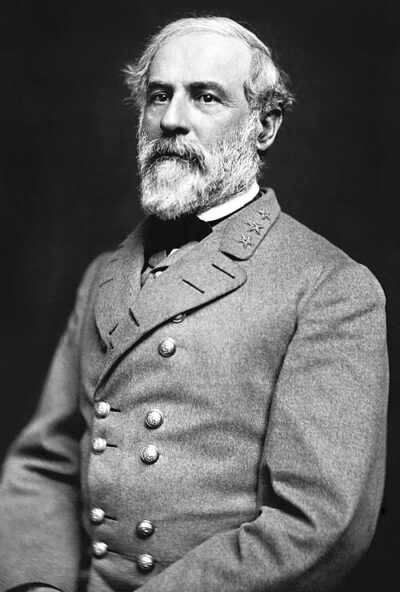
Robert E. Lee
Robert E. Lee was a Confederate States general. Born January 19, 1807, in Stratford Hall. Died October 12, 1870, in Lexington. Positions held include General in Chief of the Armies of the Confederate States (1865) and Superintendent of the United States Military Academy (1852–1855). Educated at United States Military Academy.
Facts
35 facts · 2 confirmed by two sources · 18 cited · 15 from one source
Where this comes from
Papalocal keeps its own record. It started from these sources; what each one said is kept here as it was copied, so a change on their side never changes this page by itself. Tap one to read its version.
What Wikidata says · copied November 13, 2026 · revision 2558225908
- Described as
- Confederate States general (1807–1870)
- Other names
- Gen. Robert Edward Lee, Robert E Lee, R. E. Lee, General R. E. Lee, General Robert E. Lee, General Lee, Robert E., General Lee, Robert Edward Lee, Robert Lee
- Born
- January 19, 1807 · 10 references
- Died
- October 12, 1870 · 11 references
- Born in
- Stratford Hall
- Died in
- Lexington · 1 reference
- Buried in
- Lee Chapel
- Cause of death
- pneumonia
- Name at birth
- Robert Edward Lee
- Citizen of
- United States (2 times) (1861–); Confederate States of America (1861–1865)
- Occupation
- military officer; military personnel · 1 reference; army officer; cartographer · 1 reference; soldier · 1 reference
- Positions held
- General in Chief of the Armies of the Confederate States (1865); Superintendent of the United States Military Academy (1852–1855)
- Worked for
- Washington and Lee University (1865–1870)
- Education
- United States Military Academy (1825–1829) · 1 reference
- Spouse
- Mary Anna Custis Lee (1831–) · 3 references
- Children
- William Henry Fitzhugh Lee · 1 reference; Robert E. Lee, Jr. · 1 reference; George Washington Custis Lee · 2 references; Mary Custis Lee · 1 reference; Anne Carter Lee · 1 reference; Eleanor Agnes Lee · 1 reference; Mildred Childe Lee · 1 reference
- Father
- Henry Lee III · 1 reference
- Mother
- Anne Hill Carter Lee · 1 reference
- Siblings
- Henry Lee IV; Sydney Smith Lee
- Religion
- Episcopal Church · 1 reference
- Military branch
- Confederate States Army (1861–1865) · 1 reference; United States Army
- Military rank
- general in chief; general · 1 reference
- Wikipedias with a page
- 103
Wikidata item Q165557 (wikidata.org/wiki/Q165557), public domain (CC0). Copied November 13, 2026.
What Wikipedia says · copied November 13, 2026 · revision 1384451240
Robert Edward Lee (January 19, 1807 – October 12, 1870) was a Confederate general whose early actions in the American Civil War led to his appointment as the overall commander of the Confederate States Army near the end of the war. He led the Army of Northern Virginia, the Confederacy's most powerful army, from 1862 until its surrender in 1865, earning a reputation as one of the war's most skilled tacticians.
A son of Revolutionary War officer Henry "Light Horse Harry" Lee III, of the Lee family of Virginia, Lee was a top graduate of the United States Military Academy and an exceptional officer and military engineer in the United States Army for 32 years. He served across the United States, distinguished himself during the Mexican–American War, and was Superintendent of the United States Military Academy. He married Mary Anna Custis, great-granddaughter of George Washington's wife Martha. While he stated that he opposed slavery from a philosophical perspective, he supported its legality and enslaved hundreds. When Virginia declared its secession from the Union in 1861, Lee chose to follow his home state, despite his desire for the country to remain intact and an offer of a senior Union command. During the first year of the Civil War, he served in minor combat operations and as a senior military adviser to Confederate president Jefferson Davis.
Lee took command of the Army of Northern Virginia in June 1862 during the Peninsula campaign following the wounding of Joseph E. Johnston. He succeeded in driving the Union Army of the Potomac under George B. McClellan away from the Confederate capital of Richmond during the Seven Days Battles, but he was unable to destroy McClellan's army. Lee then overcame Union forces under John Pope at the Second Battle of Bull Run in August. His invasion of Maryland that September ended with the inconclusive Battle of Antietam, after which he retreated to Virginia. Lee won two major victories at Fredericksburg and Chancellorsville before launching a second invasion of the North in the summer of 1863, where he was decisively defeated at the Battle of Gettysburg by the Army of the Potomac under George Meade. He led his army in the minor and inconclusive Bristoe campaign that fall before General Ulysses S. Grant took command of Union armies in the spring of 1864. Grant engaged Lee's army in bloody but inconclusive battles at the Wilderness and Spotsylvania before the lengthy Siege of Petersburg, which was followed in April 1865 by the capture of Richmond and the destruction of most of Lee's army, which he finally surrendered to Grant at Appomattox Court House.
In 1865, Lee became president of Washington College, now Washington and Lee University, in Lexington, Virginia; as president of the college, he supported reconciliation between the North and South. Lee accepted the termination of slavery provided for by the Thirteenth Amendment, but opposed racial equality for African Americans. After his death in 1870, Lee became a cultural icon in the South and is largely hailed as one of the Civil War's greatest generals. As commander of the Army of Northern Virginia, he fought most of his battles against armies of significantly larger size, and managed to win many of them. Lee built up a collection of talented subordinates, most notably James Longstreet, Stonewall Jackson, and J. E. B. Stuart, who along with Lee were critical to the Confederacy's battlefield success. However, his two major offensives into Union territory ended in failure, and his aggressive and risky tactics, especially at Gettysburg, resulted in high casualties at a time when the Confederacy had a shortage of manpower. His battlefield record, his views on race and slavery, and his legacy have been the subject of continuing debate and historical controversy.
- Born, in its opening lines
- January 19, 1807
- Died, in its opening lines
- October 12, 1870
From the Wikipedia article “Robert E. Lee” (en.wikipedia.org/wiki/Robert_E._Lee), by its contributors, under CC BY-SA 4.0 (creativecommons.org/licenses/by-sa/4.0/). Copied November 13, 2026; not changed.
Confirmed Two sources agree. Cited One source, and it names where it got it. One source One source, without a reference of its own. Sources disagree The sources disagree. We show the best-supported value and keep theirs below.
