
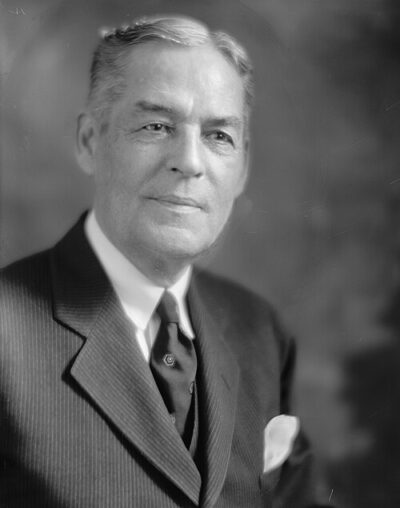
Robert Latham Owen
Robert Latham Owen was an American politician. Born February 2, 1856, in Lynchburg. Died July 19, 1947, in Washington, D.C.. Positions held include United States senator (1907–1925) and senator. Educated at Washington and Lee University.
Facts
15 facts · 2 confirmed by two sources · 6 cited · 7 from one source
Where this comes from
Papalocal keeps its own record. It started from these sources; what each one said is kept here as it was copied, so a change on their side never changes this page by itself. Tap one to read its version.
What Wikidata says · copied November 18, 2026 · revision 2571419763
- Described as
- American politician (1856-1947)
- Other names
- 0x8cf4a8bedc2c8ceefe5beb54376d0609e406c4b6
- Born
- February 2, 1856 · 3 references
- Died
- July 19, 1947 · 3 references
- Born in
- Lynchburg · 1 reference
- Died in
- Washington, D.C. · 1 reference
- Buried in
- Spring Hill Cemetery · 1 reference
- Citizen of
- United States; Cherokee Nation
- Occupation
- politician · 1 reference; lawyer
- Positions held
- United States senator (1907–1925) · 1 reference; senator · 1 reference
- Political party
- Democratic Party
- Education
- Washington and Lee University
- Father
- Robert L. Owen Sr.
- Mother
- Narcissa Chisholm Owen
- Wikipedias with a page
- 16
Wikidata item Q456154 (wikidata.org/wiki/Q456154), public domain (CC0). Copied November 18, 2026.
What Wikipedia says · copied November 18, 2026 · revision 1386160350
Robert Latham Owen Jr. (Cherokee: ᎠᎦᏅᏍᏔᏔ, romanized: Oconostota; February 2, 1856 – July 19, 1947) was one of the first two United States Senate members from Oklahoma. He served in the Senate between 1907 and 1925.
Born into affluent circumstances in antebellum Lynchburg, Virginia, the son of a railroad company president, Owen suffered financial ruin by the Panic of 1873 and his father died while he was still in his teens.
Owen, who was Cherokee on his mother's side, responded by heading west to Indian Territory, where he built a new life as, in turn, a schoolteacher working with Cherokee orphans; a lawyer, administrator and journalist; a federal Indian agent; and the founder and first president of a community bank. Among the achievements that brought him to wider public notice, and helped pave the way for his election to the U.S. Senate in 1907 when Oklahoma (incorporating the former Indian Territory) achieved statehood, was his success as a lawyer in 1906 in winning a major court case on behalf of the Eastern Cherokees seeking compensation from the U.S. Government for eastern lands the Cherokees had lost at the time of the Indian removals.
A Democrat active in many progressive causes, including efforts to strengthen public control of government, and the fight against child labor, Owen is especially remembered as the Senate sponsor of the Glass-Owen Federal Reserve Act of 1913, which created the Federal Reserve System. In discussions at the time, he resisted a campaign to put the Federal Reserve formally under the control of the banking industry, and the 1913 Act emerged broadly in line with Owen's compromise proposal, creating a central Federal Reserve Board nominated by the Government alongside twelve regional Federal Reserve Banks dominated by the larger banks. Owen subsequently became highly critical of what he saw as the Federal Reserve's bias towards deflationary policies during the early 1920s and again in the early 1930s, which he attributed to excessive influence by the largest banks upon the Fed, and which he identified as largely responsible for causing the Great Depression: a minority view at the time, but one that has, in recent decades, gained wide acceptance among conservative economists (having been popularized by Milton Friedman in the 1960s). In 1920 Owen unsuccessfully sought the Democratic Party's nomination for the presidency.
- Born, in its opening lines
- February 2, 1856
- Died, in its opening lines
- July 19, 1947
From the Wikipedia article “Robert L. Owen” (en.wikipedia.org/wiki/Robert_L._Owen), by its contributors, under CC BY-SA 4.0 (creativecommons.org/licenses/by-sa/4.0/). Copied November 18, 2026; not changed.
Confirmed Two sources agree. Cited One source, and it names where it got it. One source One source, without a reference of its own. Sources disagree The sources disagree. We show the best-supported value and keep theirs below.
