
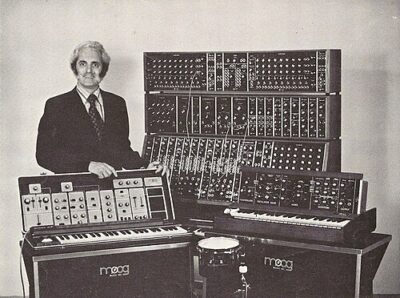
Robert Moog
Robert Moog was an American electronic music pioneer and inventor. Born May 23, 1934, in New York City. Died August 21, 2005, in Asheville. Known for synthesizer. Educated at Queens College and Cornell University. Awards include Grammy Trustees Award, National Inventors Hall of Fame and Polar Music Prize.
Facts
22 facts · 2 confirmed by two sources · 7 cited · 13 from one source
Where this comes from
Papalocal keeps its own record. It started from these sources; what each one said is kept here as it was copied, so a change on their side never changes this page by itself. Tap one to read its version.
What Wikidata says · copied November 13, 2026 · revision 2567121297
- Described as
- American electronic music pioneer and inventor (1934-2005)
- Other names
- Bob Moog, Robert Arthur Moog
- Born
- May 23, 1934 · 7 references
- Died
- August 21, 2005 · 7 references
- Born in
- New York City · 2 references
- Died in
- Asheville · 2 references
- Buried in
- Asheville
- Cause of death
- brain cancer
- Citizen of
- United States · 1 reference
- Occupation
- inventor; university teacher; musician · 2 references; musical instrument maker · 2 references
- Education
- Queens College; Cornell University; Cornell University College of Engineering; Fu Foundation School of Engineering and Applied Science; Berklee College of Music; Bronx High School of Science
- Known for
- synthesizer
- Awards
- Grammy Trustees Award (1970); National Inventors Hall of Fame (2013) · 1 reference; Polar Music Prize (2001) · 1 reference
- Field
- electronic music
- Wikipedias with a page
- 52
Wikidata item Q200883 (wikidata.org/wiki/Q200883), public domain (CC0). Copied November 13, 2026.
What Wikipedia says · copied November 13, 2026 · revision 1385315087
Robert Arthur Moog ( MOHG; May 23, 1934 – August 21, 2005) was an American electronics engineer and electronic music pioneer. He was the founder of the synthesizer manufacturer Moog Music and the inventor of the first commercially-successful synthesizer, the Moog synthesizer, which debuted in 1964. In 1970, Moog released a more portable model, the Minimoog, described as the most famous and influential synthesizer in history. Among Moog's honors are a Technical Grammy Award, received in 2002, and an induction into the National Inventors Hall of Fame.
By 1963, Moog had been designing and selling theremins for several years while working toward a PhD in engineering physics at Cornell University. He developed his synthesizer in response to demand for more practical and affordable electronic-music equipment, guided by suggestions and requests from composers. Moog's principal innovation was the voltage-controlled oscillator, which uses voltage to control pitch. He also introduced fundamental synthesizer concepts such as modularity, envelope generation and the pitch wheel. He is credited with introducing synthesizers to a wider audience and influencing the development of popular music.
Moog pursued his work as a hobby, and he is regarded as a poor businessman. His only patent was on his transistor ladder filter design; commentators have speculated that he would have become extremely wealthy had he patented his other innovations, but that their availability in the public domain helped the synthesizer industry flourish.
In 1971, Moog sold Moog Music to Norlin Musical Instruments, where he remained as a designer until 1977. In 1978, he founded the company Big Briar, and in 2002 he renamed it Moog Music after reacquiring the rights to the name. In later years, Moog taught at the University of North Carolina at Asheville and continued designing instruments for the revived Moog Music. He died at the age of 71 in Asheville from a brain tumor.
- Born, in its opening lines
- May 23, 1934
- Died, in its opening lines
- August 21, 2005
From the Wikipedia article “Robert Moog” (en.wikipedia.org/wiki/Robert_Moog), by its contributors, under CC BY-SA 4.0 (creativecommons.org/licenses/by-sa/4.0/). Copied November 13, 2026; not changed.
Confirmed Two sources agree. Cited One source, and it names where it got it. One source One source, without a reference of its own. Sources disagree The sources disagree. We show the best-supported value and keep theirs below.
