
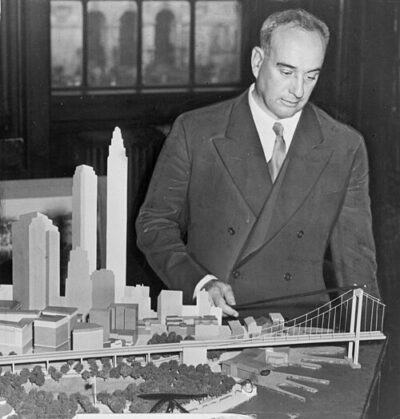
Robert Moses
Robert Moses was an American urban planner. Born December 18, 1888, in New Haven. Died July 29, 1981, in West Islip. Positions held include Secretary of State of New York (1927–1929) and New York City Commissioner of Parks and Recreation (1934–1960). Educated at Yale University and Wadham College. Awards include Pugsley Medal and honorary doctor of the Hofstra University.
Facts
22 facts · 2 confirmed by two sources · 5 cited · 15 from one source
Where this comes from
Papalocal keeps its own record. It started from these sources; what each one said is kept here as it was copied, so a change on their side never changes this page by itself. Tap one to read its version.
What Wikidata says · copied November 15, 2026 · revision 2558226913
- Described as
- American urban planner (1888–1981)
- Born
- December 18, 1888 · 9 references
- Died
- July 29, 1981 · 8 references
- Born in
- New Haven · 3 references
- Died in
- West Islip · 3 references
- Buried in
- Woodlawn Cemetery · 1 reference
- Cause of death
- heart disease
- Citizen of
- United States
- Occupation
- architect · 2 references; independent politician; urban planner · 3 references; engineer · 1 reference
- Positions held
- Secretary of State of New York (1927–1929); New York City Commissioner of Parks and Recreation (1934–1960)
- Political party
- independent politician
- Education
- Yale University; Wadham College; Columbia University; Dwight School · 1 reference
- Awards
- Pugsley Medal (1936); honorary doctor of the Hofstra University
- Field
- architecture; urban planning
- Wikipedias with a page
- 30
Wikidata item Q1111386 (wikidata.org/wiki/Q1111386), public domain (CC0). Copied November 15, 2026.
What Wikipedia says · copied November 15, 2026 · revision 1384910895
Robert Moses (December 18, 1888 – July 29, 1981) was an American urban planner and public official who worked in the New York metropolitan area during the early to mid-20th century. Moses is regarded as one of the most powerful and influential people in the history of New York City and the state of New York. Moses's construction projects transformed the New York area and revolutionized the way urban areas across the United States were designed and built. His philosophy of urban development influenced a generation of engineers, architects, and urban planners across the United States.
Never elected to any office, Moses held myriad positions throughout his more-than-40-year career including New York City Parks Commissioner and chairman of the Long Island State Park Commission. At various points, Moses held as many as 12 titles simultaneously. Working closely with New York governor Al Smith early in his career, Moses became an expert in writing laws and influencing the operations of state government.
As head of the Triborough Bridge Authority, Moses was instrumental in the construction of major transportation arteries including the Cross Bronx Expressway, the Brooklyn-Queens Expressway, and the Long Island Expressway, as well as major crossings and transportation infrastructure projects such as the Triborough Bridge, the Verrazzano-Narrows Bridge, the Bronx-Whitestone Bridge, the Throgs Neck Bridge, the Brooklyn-Battery Tunnel, and the Queens-Midtown Tunnel. These highways, roadways, and bridges, alongside other urban renewal efforts, often sacrificed large swaths of low-income housing and replaced them with public housing projects.
As President of the Long Island State Park Commission, Moses oversaw the construction of Jones Beach State Park, the most visited public beach in the United States, and was the primary architect of the New York State Parkway System.
Moses wielded enormous power as he had near-complete control of tolls collected on the various bridge, tunnel, and roadway projects, which he then used to fund additional projects.
Moses's reputation declined throughout the 1960s and 1970s, in part because of his plan for a Lower Manhattan Expressway, which would have significantly changed the shape and character of SoHo and the Lower East Side. Community activists, notably Jane Jacobs, and elected officials began to cast doubt over the purported benefits of many of Moses's projects. Robert Caro's Pulitzer Prize-winning biography The Power Broker (1974) further characterized Moses's practices as controlling, overly focused on car dependency, and having a disproportionately negative effect on poor and minority communities. In large part because of The Power Broker, Moses has come to be regarded as a controversial figure in the history of New York City, New York State, and the urban planning field.
- Born, in its opening lines
- December 18, 1888
- Died, in its opening lines
- July 29, 1981
From the Wikipedia article “Robert Moses” (en.wikipedia.org/wiki/Robert_Moses), by its contributors, under CC BY-SA 4.0 (creativecommons.org/licenses/by-sa/4.0/). Copied November 15, 2026; not changed.
Confirmed Two sources agree. Cited One source, and it names where it got it. One source One source, without a reference of its own. Sources disagree The sources disagree. We show the best-supported value and keep theirs below.
