
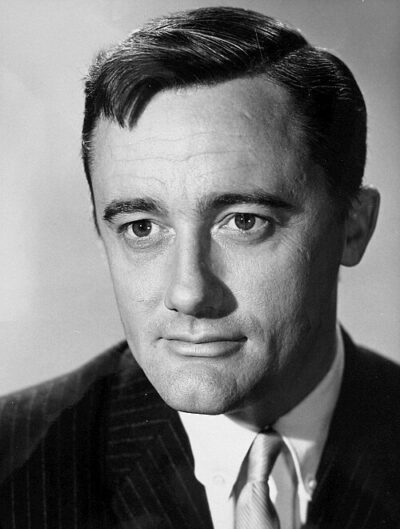
Robert Vaughn
Robert Vaughn was an American actor. Born November 22, 1932, in New York City. Died November 11, 2016, in Danbury. Educated at University of Minnesota and California State University, Los Angeles. Awards include Primetime Emmy Award for Outstanding Supporting Actor in a Drama Series and star on Hollywood Walk of Fame.
Facts
22 facts · 2 confirmed by two sources · 4 cited · 16 from one source
Where this comes from
Papalocal keeps its own record. It started from these sources; what each one said is kept here as it was copied, so a change on their side never changes this page by itself. Tap one to read its version.
What Wikidata says · copied November 13, 2026 · revision 2546594997
- Described as
- American actor (1932–2016)
- Other names
- Robert Francis Vaughn
- Born
- November 22, 1932 · 8 references
- Died
- November 11, 2016 · 7 references
- Born in
- New York City · 2 references
- Died in
- Danbury · 1 reference
- Cause of death
- leukemia
- Citizen of
- United States
- Occupation
- actor · 1 reference; stage actor; television actor; film actor; voice actor
- Political party
- Democratic Party
- Education
- University of Minnesota; California State University, Los Angeles; University of Southern California; Los Angeles City College; North Community High School
- Genre
- Western
- Awards
- Primetime Emmy Award for Outstanding Supporting Actor in a Drama Series (1978); star on Hollywood Walk of Fame · 1 reference
- Children
- Matthew Vaughn · 1 reference
- Website
- http://www.officialrobertvaughn.com
- Wikipedias with a page
- 46
Wikidata item Q314834 (wikidata.org/wiki/Q314834), public domain (CC0). Copied November 13, 2026.
What Wikipedia says · copied November 13, 2026 · revision 1384904310
Robert Francis Vaughn (November 22, 1932 – November 11, 2016) was an American actor and political activist, whose career in film, television and theater spanned nearly six decades and who was best known for his role as the secret agent Napoleon Solo on The Man from U.N.C.L.E. (1964–68). He was a Primetime Emmy Award winner, and was nominated for the Academy Award, the BAFTA Award, two Laurel Awards, and four times for the Golden Globe Award. Vaughn also has a star on the Hollywood Walk of Fame.
Vaughn had his breakthrough role as disabled, drunken war veteran Chester A. Gwynn in The Young Philadelphians, earning him a 1960 Oscar nomination for Best Supporting Actor. He subsequently appeared in scores of films, notably as gunman Lee in The Magnificent Seven (1960), Walter Chalmers in Bullitt (1968), Major Paul Krueger in The Bridge at Remagen (1969), the voice of Proteus IV in Demon Seed (1977) and Ross Webster in Superman III (1983).
To television audiences, in addition to his role as Solo, Vaughn was known for his roles as private detective Harry Rule on The Protectors (1972–74), Morgan Wendell in the miniseries Centennial (1978–79), and Albert Stroller on the BBC Television drama Hustle (2004–12). He won an Emmy Award for Outstanding Supporting Actor in a Drama Series for his portrayal of the White House Chief of Staff in the miniseries Washington: Behind Closed Doors. He also appeared in the British soap opera Coronation Street as Milton Fanshaw from January until February 2012.
Aside from his acting career, Vaughn was active in Democratic Party politics. He was chair of the California Democratic State Central Committee speakers bureau during the 1960s, and publicly campaigned against the Vietnam War as a member of the peace group Another Mother for Peace. In 1970, Vaughn earned a PhD in communications. His doctoral thesis, "The Influence of the House Committee on Un-American Activities on the American Theater 1938–58", is considered "the most complete and intelligent treatment of the virulent practice of blacklisting now available."
- Born, in its opening lines
- November 22, 1932
- Died, in its opening lines
- November 11, 2016
From the Wikipedia article “Robert Vaughn” (en.wikipedia.org/wiki/Robert_Vaughn), by its contributors, under CC BY-SA 4.0 (creativecommons.org/licenses/by-sa/4.0/). Copied November 13, 2026; not changed.
Confirmed Two sources agree. Cited One source, and it names where it got it. One source One source, without a reference of its own. Sources disagree The sources disagree. We show the best-supported value and keep theirs below.
