
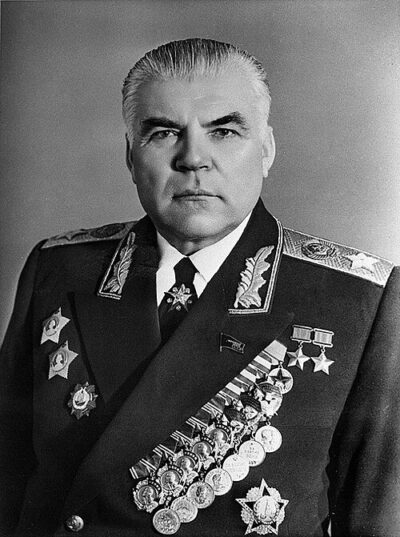
Rodion Malinovsky
Rodion Malinovsky was a Soviet military commander. Born November 10, 1898, in Odesa. Died March 31, 1967, in Moscow. Positions held include Minister of Defence (1957–1967) and deputy of the Supreme Soviet of the Soviet Union. Educated at M.V. Frunze Military Academy. Awards include Grand Officer of the Legion of Honour, Order of Lenin (4 times) and Medal "For the Victory over Japan".
Facts
39 facts · 1 confirmed by two sources · 5 cited · 32 from one source · 1 where the sources disagree
What’s different
- Born: we show November 10, 1898 (Sources disagree). Wikipedia says November 23, 1898
Where this comes from
Papalocal keeps its own record. It started from these sources; what each one said is kept here as it was copied, so a change on their side never changes this page by itself. Tap one to read its version.
What Wikidata says · copied November 16, 2026 · revision 2564795237
- Described as
- Soviet military commander
- Other names
- Rodion Yakovlevich Malinovsky
- Born
- November 10, 1898
- Died
- March 31, 1967 · 9 references
- Born in
- Odesa · 2 references
- Died in
- Moscow · 2 references
- Buried in
- Kremlin Wall Necropolis · 1 reference
- Cause of death
- cancer
- Name at birth
- Радион Малиновский · 1 reference
- Citizen of
- Russian Empire; Soviet Union
- Occupation
- politician · 1 reference; military officer; writer; marshal · 1 reference
- Positions held
- Minister of Defence (1957–1967); deputy of the Supreme Soviet of the Soviet Union
- Political party
- Communist Party of the Soviet Union (1926–1967)
- Education
- M.V. Frunze Military Academy (1927–1930)
- Member of
- Central Committee of the Communist Party of the Soviet Union
- Awards
- Grand Officer of the Legion of Honour (1945); Order of Lenin (4 times) (1937, 1941, 1945, 1958); Medal "For the Victory over Japan"; Medal "For the Victory over Germany in the Great Patriotic War 1941–1945"; Order of the Red Banner (3 times) (1937, 1944, 1950); Hero of the Soviet Union (2 times) (1945, 1958); People's Hero of Yugoslavia; Order of Victory (1945); Chief Commander of the Legion of Merit (1946); Jubilee Medal "XX Years of the Workers' and Peasants' Red Army"; Order of Suvorov, 1st class (2 times) (1943, 1944); Order of Kutuzov, 1st class (1943); Medal "For the Defence of Stalingrad"; Medal "For the Capture of Budapest"; Medal "For the Capture of Vienna"
- Children
- Natalia Malinovskaya
- Military branch
- Imperial Russian Army (1914–1917); Red Army (1919–)
- Military rank
- Marshal of the Soviet Union (1944–); colonel (1936–); kombrig (1938–)
- Wikipedias with a page
- 58
Wikidata item Q204338 (wikidata.org/wiki/Q204338), public domain (CC0). Copied November 16, 2026.
What Wikipedia says · copied November 16, 2026 · revision 1377797430
Rodion Yakovlevich Malinovsky (Russian: Родио́н Я́ковлевич Малино́вский; Ukrainian: Родіо́н Я́кович Малино́вський, romanized: Rodion Yakovych Malynovskyi; 23 November [O.S. 11 November] 1898 – 31 March 1967) was a Soviet military commander and Marshal of the Soviet Union. He served as Minister of Defence of the Soviet Union from 1957 to 1967, during which he oversaw the strengthening of the Soviet Army.
Born to an impoverished Ukrainian household in Odessa, Malinovsky volunteered for the Imperial Russian Army during the First World War and served with distinction in both the German Front and the Western Front. He was serving in the Russian Legion in France on the outbreak of the October Revolution, after which he returned to Russia and joined the Red Army in the Russian Civil War. After graduating from the Frunze Military Academy, Malinovsky volunteered to fight on the Republican side during the Spanish Civil War, where he again served with great distinction and was later awarded the Order of Lenin and the Order of the Red Banner in recognition of his service.
Malinovsky emerged as one of the few competent Soviet generals in the opening phase of the German invasion. He played a crucial role in the Soviet victory at Stalingrad in December 1942, and helped drive German troops out of Ukraine following the Dnieper–Carpathian offensive. He then commanded the Soviet drive into the Balkans, forcing Romania to switch to the Allied side, for which he was made a Marshal of the Soviet Union by Joseph Stalin. He further took part in the liberation of Budapest, Vienna and Prague, cementing Soviet military supremacy in Central Europe. After the German surrender in May 1945, Malinovsky was transferred to the Far East, where he defeated the Japanese Kwantung Army in the Soviet invasion of Manchuria. He received the Soviet Union's highest distinction, the title Hero of the Soviet Union, as a reward.
After the war, Malinovsky remained in the Far East and held a succession of important commands. After Stalin's death, Nikita Khrushchev recalled Malinovsky to Moscow and named him commander-in-chief of the Soviet Ground Forces. In 1957, he replaced the ousted Georgy Zhukov as Minister of Defence, a position he served until his death. Malinovsky was a strong advocate for the importance of conventional forces, and maintained a delicate balance with Khrushchev's missile-based approach regarding Soviet military policy. He retained considerable autonomy in military affairs following the fall of Khrushchev in 1964. Malinovsky died in March 1967 from pancreatic cancer, and is remembered as one of the most important military leaders in Russian and Soviet history.
- Born, in its opening lines
- November 23, 1898
- Died, in its opening lines
- March 31, 1967
From the Wikipedia article “Rodion Malinovsky” (en.wikipedia.org/wiki/Rodion_Malinovsky), by its contributors, under CC BY-SA 4.0 (creativecommons.org/licenses/by-sa/4.0/). Copied November 16, 2026; not changed.
Confirmed Two sources agree. Cited One source, and it names where it got it. One source One source, without a reference of its own. Sources disagree The sources disagree. We show the best-supported value and keep theirs below.
