
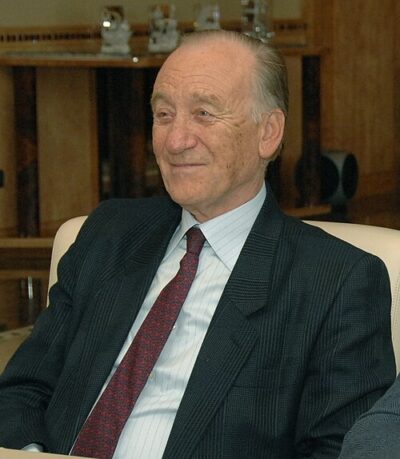
Rodion Shchedrin
Rodion Shchedrin was a Soviet and Russian composer and pianist. Born December 16, 1932, in Moscow. Died August 29, 2025, in Munich. Known for Ancient melodies of Russian songs, Sonata for cello and piano and The Lady with the Dog. Educated at Moscow Conservatory and Central Music School. Awards include USSR State Prize, Golden Medal for Merit to Culture and People's Artist of the USSR.
Facts
54 facts · 2 confirmed by two sources · 8 cited · 44 from one source
Where this comes from
Papalocal keeps its own record. It started from these sources; what each one said is kept here as it was copied, so a change on their side never changes this page by itself. Tap one to read its version.
What Wikidata says · copied November 16, 2026 · revision 2568764220
- Described as
- Soviet and Russian composer and pianist
- Other names
- Rodion Konstantinovich Shchedrin
- Born
- December 16, 1932 · 8 references
- Died
- August 29, 2025 · 1 reference
- Born in
- Moscow · 3 references
- Died in
- Munich · 1 reference
- Buried in
- Aleksin (2025); Novodevichy Cemetery (2026)
- Cause of death
- heart failure
- Citizen of
- Soviet Union; Lithuania (1991–2025); Russia; Germany
- Occupation
- composer · 1 reference; pianist · 2 references; music educator; librettist; university teacher; film score composer · 1 reference; music arranger · 1 reference; musician · 1 reference
- Worked for
- Moscow Conservatory
- Education
- Moscow Conservatory (1950–1955); Central Music School (1941–2025)
- Member of
- Union of Soviet Composers; Association of Filmmakers of the USSR; Academy of Arts of the GDR; Academy of Arts, Berlin; Bavarian Academy of Fine Arts
- Genre
- opera; symphony; ballet
- Instrument
- piano
- Known for
- Ancient melodies of Russian songs; Sonata for cello and piano; The Lady with the Dog; Lolita
- Awards
- USSR State Prize (1972); Golden Medal for Merit to Culture; People's Artist of the USSR (1981); Lenin Prize (1984); State Prize of the Russian Federation (1992); Order "For Merit to the Fatherland", 2nd class; Order of Lenin; Order of the Red Banner of Labour; Order of the Badge of Honour; Order of Saint Anna, 3rd class; People's Artist of the RSFSR; Honored art worker of the Russian Soviet Federative Socialist Republic; Order of Honour; Golden Mask; Order "For Merit to the Fatherland", 1st class · 1 reference
- Field
- music · 1 reference; music education · 1 reference
- Spouse
- Maya Plisetskaya (1958–2015)
- Website
- http://www.shchedrin.de
- Wikipedias with a page
- 41
Wikidata item Q165706 (wikidata.org/wiki/Q165706), public domain (CC0). Copied November 16, 2026.
What Wikipedia says · copied November 16, 2026 · revision 1376514515
Rodion Konstantinovich Shchedrin (Russian: Родион Константинович Щедрин, IPA: [rədʲɪˈon kənstɐnʲˈtʲinəvʲɪtɕ ɕːɪˈdrʲin]; 16 December 1932 – 29 August 2025) was a Soviet and Russian composer, pianist, and music teacher. He wrote in a wide range of genres, including operas such as Lolita and The Left-Hander, and ballets such as the Carmen Suite, created for his wife, the ballerina Maya Plisetskaya of the Bolshoi Theatre. His orchestral works includes five concertos for orchestra and six piano concertos, in which he often appeared as soloist. He also composed vocal works such as The Sealed Angel, as well as chamber music and film scores, including Anna Karenina. His works have been widely performed and commissioned internationally, particularly in the United States and Western Europe. Shchedrin is regarded as one of the leading composers of the late Soviet period and an important figure in Russian contemporary music in the decades that followed.
- Born, in its opening lines
- December 16, 1932
- Died, in its opening lines
- August 29, 2025
From the Wikipedia article “Rodion Shchedrin” (en.wikipedia.org/wiki/Rodion_Shchedrin), by its contributors, under CC BY-SA 4.0 (creativecommons.org/licenses/by-sa/4.0/). Copied November 16, 2026; not changed.
Confirmed Two sources agree. Cited One source, and it names where it got it. One source One source, without a reference of its own. Sources disagree The sources disagree. We show the best-supported value and keep theirs below.
