
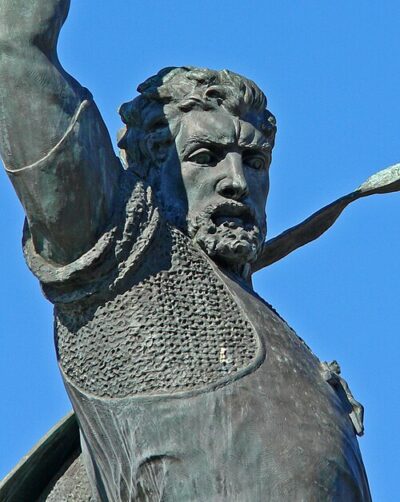
Rodrigo Díaz de Villarreal
Rodrigo Díaz de Villarreal was the 11th century Castilian nobleman and military leader. Died 1099, in City of Valencia. Positions held include seigneur.
Facts
21 facts · 1 confirmed by two sources · 10 cited · 10 from one source
What’s different
- Died: we show 1099 (Confirmed). Wikidata also lists July 10, 1099
Where this comes from
Papalocal keeps its own record. It started from these sources; what each one said is kept here as it was copied, so a change on their side never changes this page by itself. Tap one to read its version.
What Wikidata says · copied November 16, 2026 · revision 2568996499
- Described as
- 11th century Castilian nobleman and military leader
- Other names
- El Cid Campeador, El Campeador
- Died
- 1099; July 10, 1099 · 1 reference
- Born in
- Vivar del Cid · 1 reference
- Died in
- City of Valencia
- Buried in
- Tomb of El Cid (1921–)
- Name at birth
- Ruderico Didaz
- Citizen of
- Kingdom of Castile
- Occupation
- knight · 1 reference; mercenary; military personnel · 1 reference; politician · 1 reference; military leader · 1 reference
- Positions held
- seigneur
- Field
- politics · 1 reference; military affairs · 1 reference
- Spouse
- Jimena Díaz (1074–1099) · 1 reference
- Children
- Cristina Rodríguez · 1 reference; Diego Rodríguez · 1 reference; María Rodríguez · 1 reference
- Father
- Diego Flaínez
- Mother
- Doña Rodríguez · 1 reference
- Military rank
- knight
- Wikipedias with a page
- 81
Wikidata item Q43958 (wikidata.org/wiki/Q43958), public domain (CC0). Copied November 16, 2026.
What Wikipedia says · copied November 16, 2026 · revision 1379714824
Rodrigo Díaz de Vivar (c. 1043 – 10 July 1099) was a Castilian knight and ruler in medieval Spain. Fighting with both Christian and Muslim armies during his lifetime, he earned the Arabic honorific as-Sayyid (السّیّد, "the Lord" or "the Master"), which would evolve into El Çid (Spanish: [el ˈθið], Old Spanish: [el ˈts̻id]), and the Spanish honorific El Campeador ("the Champion"). He was born in Vivar, a village near the city of Burgos.
As the head of his loyal knights, he came to dominate the Levante of the Iberian Peninsula at the end of the 11th century. He reclaimed the Taifa of Valencia from Moorish control for a brief period, ruling the Principality of Valencia from 17 June 1094 until his death in 1099. His wife, Jimena Díaz, inherited the city and maintained it until 1102, when it was reconquered by the Moors.
Díaz de Vivar became well known for his service in the armies of both Christian and Muslim rulers. After his death, El Cid became Spain's most celebrated national hero and the protagonist of the most significant medieval Spanish epic poem, El Cantar de mio Cid, which presents him as the ideal medieval knight: strong, valiant, loyal, just, and pious.
There are various theories on his family history, which remains uncertain; however, he was the grandfather of García Ramírez de Pamplona, King of Navarre, who was the first son of his daughter Cristina Rodríguez. To this day, El Cid remains a popular Spanish folk hero and national icon, with his life and deeds remembered in popular culture.
- Born, in its opening lines
- c. 1043
- Died, in its opening lines
- July 10, 1099
From the Wikipedia article “El Cid” (en.wikipedia.org/wiki/El_Cid), by its contributors, under CC BY-SA 4.0 (creativecommons.org/licenses/by-sa/4.0/). Copied November 16, 2026; not changed.
Confirmed Two sources agree. Cited One source, and it names where it got it. One source One source, without a reference of its own. Sources disagree The sources disagree. We show the best-supported value and keep theirs below.
