
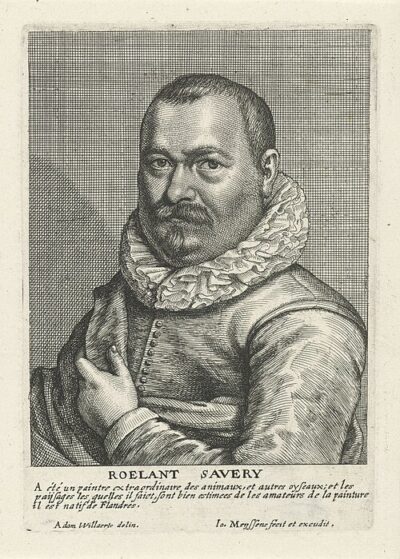
Roelant Savery
Roelant Savery was a Flemish painter and printmaker. Born 1576, in Kortrijk. Died February 25, 1639, in Utrecht. Known for The poet crowned by two apes at the feast of the animals, Elijah fed by the ravens and Landscape with ruins, cattle and deer.
Facts
16 facts · 0 confirmed by two sources · 9 cited · 7 from one source
Where this comes from
Papalocal keeps its own record. It started from these sources; what each one said is kept here as it was copied, so a change on their side never changes this page by itself. Tap one to read its version.
What Wikidata says · copied November 17, 2026 · revision 2570356108
- Described as
- Flemish painter and printmaker (1576–1639)
- Other names
- Roelandt Savery, Rowland Savery, Roland Savory, Roelandt Savrij, Roelandt Jacobsz. Saverij, Roelandt Zavereij, Roelandt Savrije, Roland Savery, Roelandt Saverij, Roland Savary, Roelandt Savory, Roelandt Jacobsz. Savery
- Born
- 1576 · 24 references
- Died
- February 25, 1639 · 1 reference
- Born in
- Kortrijk · 1 reference
- Died in
- Utrecht · 1 reference
- Citizen of
- Habsburg Netherlands; Dutch Republic
- Occupation
- painter · 4 references; draftsperson · 3 references; printmaker · 2 references; court painter · 1 reference
- Genre
- still life
- Known for
- The poet crowned by two apes at the feast of the animals; Elijah fed by the ravens; Landscape with ruins, cattle and deer; The Dodo
- Siblings
- Jacob Savery · 1 reference
- Wikipedias with a page
- 27
Wikidata item Q142710 (wikidata.org/wiki/Q142710), public domain (CC0). Copied November 17, 2026.
What Wikipedia says · copied November 17, 2026 · revision 1383562304
Roelant Savery (or Roeland(t) Maertensz Saverij, or de Savery, or many variants; 1576 – buried 25 February 1639) was a Flanders-born Dutch Golden Age painter.
From the Wikipedia article “Roelant Savery” (en.wikipedia.org/wiki/Roelant_Savery), by its contributors, under CC BY-SA 4.0 (creativecommons.org/licenses/by-sa/4.0/). Copied November 17, 2026; not changed.
Confirmed Two sources agree. Cited One source, and it names where it got it. One source One source, without a reference of its own. Sources disagree The sources disagree. We show the best-supported value and keep theirs below.
