
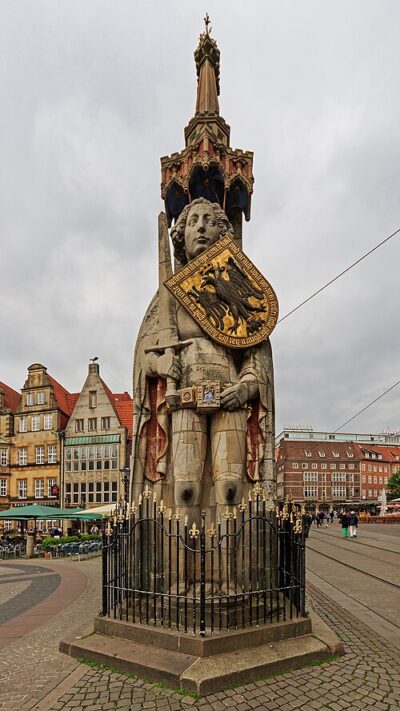
Roland
Roland was a Frankish knight. Born 737. Died August 15, 778, in Roncevaux Pass. Positions held include Prefect of the Breton March (–778).
Facts
6 facts · 1 confirmed by two sources · 0 cited · 5 from one source
Where this comes from
Papalocal keeps its own record. It started from these sources; what each one said is kept here as it was copied, so a change on their side never changes this page by itself. Tap one to read its version.
What Wikidata says · copied November 16, 2026 · revision 2555619918
- Described as
- Frankish knight
- Other names
- Roland the Valiant
- Born
- 737
- Died
- August 15, 778 · 1 reference
- Died in
- Roncevaux Pass
- Citizen of
- Francia
- Occupation
- knight
- Positions held
- Prefect of the Breton March (–778)
- Wikipedias with a page
- 60
Wikidata item Q207535 (wikidata.org/wiki/Q207535), public domain (CC0). Copied November 16, 2026.
What Wikipedia says · copied November 16, 2026 · revision 1379808672
Roland (French pronunciation: [ʁɔ.lɑ̃]; Old Frankish: *Hrōþiland; Medieval Latin: Hruodlandus or Rotholandus; Italian: Orlando or Rolando; died 15 August 778) was a Frankish military leader under Charlemagne who became an epic hero and one of the principal figures in the literary cycle known as the Matter of France. The historical Roland was military governor of the Breton March, responsible for defending Francia's frontier against the Bretons. His only historical attestation is in Einhard's Vita Karoli Magni, which notes he was part of the Frankish rearguard killed in retribution by the Basques in Iberia at the Battle of Roncevaux Pass.
The story of Roland's death at Roncevaux Pass was embellished in later medieval and Renaissance literature. The first and most famous of these epic treatments was the Old French Chanson de Roland of the 11th century.
Two masterpieces of Italian Renaissance poetry, the Orlando Innamorato and Orlando Furioso (by Matteo Maria Boiardo and Ludovico Ariosto, respectively), are even further detached from history than the earlier Chansons, similarly to the later Morgante by Luigi Pulci. Roland is poetically associated with his sword Durendal, his horse Veillantif, and his oliphant horn.
In the late 17th century, French Baroque composer Jean-Baptiste Lully wrote an opera titled Roland, based on the story of the title character.
- Died, in its opening lines
- August 15, 778
From the Wikipedia article “Roland” (en.wikipedia.org/wiki/Roland), by its contributors, under CC BY-SA 4.0 (creativecommons.org/licenses/by-sa/4.0/). Copied November 16, 2026; not changed.
Confirmed Two sources agree. Cited One source, and it names where it got it. One source One source, without a reference of its own. Sources disagree The sources disagree. We show the best-supported value and keep theirs below.
