
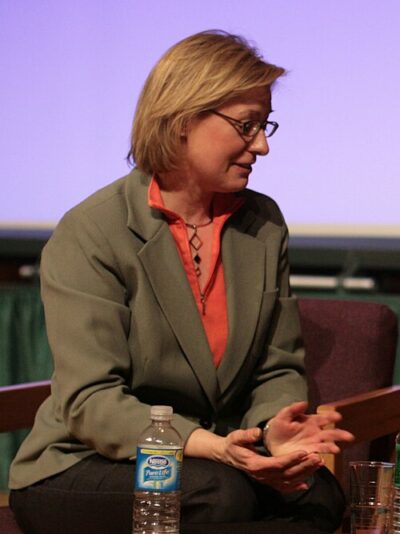
Rosalind Picard
Rosalind Picard is an American computer scientist. Born May 17, 1962, in Massachusetts. Educated at Georgia Tech and Berry College. Awards include IEEE Fellow and ACM Fellow.
Facts
17 facts · 0 confirmed by two sources · 5 cited · 12 from one source
Where this comes from
Papalocal keeps its own record. It started from these sources; what each one said is kept here as it was copied, so a change on their side never changes this page by itself. Tap one to read its version.
What Wikidata says · copied November 16, 2026 · revision 2568856753
- Described as
- American computer scientist
- Other names
- Rosalind Wright Picard
- Born
- May 17, 1962
- Born in
- Massachusetts
- Citizen of
- United States
- Occupation
- computer scientist; engineer; university teacher; artificial intelligence researcher; media scholar · 1 reference
- Worked for
- Massachusetts Institute of Technology
- Education
- Georgia Tech; Berry College; Massachusetts Institute of Technology (–1991) · 2 references
- Member of
- Institute of Electrical and Electronics Engineers; Association for Computing Machinery (2022–) · 1 reference; National Academy of Engineering (2019–) · 1 reference
- Awards
- IEEE Fellow; ACM Fellow (2021) · 1 reference
- Wikipedias with a page
- 23
Wikidata item Q14109 (wikidata.org/wiki/Q14109), public domain (CC0). Copied November 16, 2026.
What Wikipedia says · copied November 16, 2026 · revision 1383613161
Rosalind Wright Picard (born 1962) is an American electrical engineer and computer scientist who is the Grover M. Hermann Professor of Health Sciences and Technology at the Massachusetts Institute of Technology (MIT). She is the founder and director of the Affective Computing Research Group at the MIT Media Lab, and co-founder of the startups Affectiva and Empatica.
Prior to joining the MIT faculty, Picard worked from 1984-1987 as a Member of the Technical Staff at AT&T Bell Labs in Holmdel Township, New Jersey, first developing new VLSI-scale computer architectures for future high-speed signal processing chips and later researching new kinds of algorithms for image compression.
She has received many recognitions for her research and inventions in wearable and affective computing. In 2005, she was named a Fellow of the Institute of Electrical and Electronics Engineers for contributions to image and video analysis and affective computing. In 2019 she received one of the highest professional honors accorded an engineer, election to the National Academy of Engineering for her contributions on affective computing and wearable computing. In 2021 she was recognized as a Fellow of the ACM for contributions to physiological signal sensing for individual health and wellbeing. In 2021 she was elected to the National Academy of Inventors, which recognizes outstanding inventions that have made a tangible impact on quality of life, economic development and the welfare of society. In 2022 she was awarded the International Lombardy Prize for Computer Science Research, which carries a €1 million award, which she donated to support digital health and neurology research to help save the lives of people with epilepsy and children susceptible to sudden infant death syndrome. In 2026, she received one of the Institute of Electrical and Electronics Engineers's highest honors, the
IEEE Medal for Innovations in Healthcare Technology for pioneering wearable affective computing.
Picard is credited with starting the branch of computer science known as affective computing with her 1997 book of the same name. This book described the importance of emotion in intelligence, the vital role human emotion communication has to relationships between people, how robots and wearable computers might perform emotion recognition and other skills of emotional intelligence, and concerns raised by this new technology. Her work in this field has led to an expansion into autism research and developing devices that could help humans recognize nuances in human emotions and provide objective data for improving healthcare.With Jonathan Klein, she also published a presentation and discussion of many potential uses, together with concerns and objections, regarding the deployment of affective technology to address emotional needs; in particular, they called out concerns about the potential misuse of technology to manipulate people.
From the Wikipedia article “Rosalind Picard” (en.wikipedia.org/wiki/Rosalind_Picard), by its contributors, under CC BY-SA 4.0 (creativecommons.org/licenses/by-sa/4.0/). Copied November 16, 2026; not changed.
Confirmed Two sources agree. Cited One source, and it names where it got it. One source One source, without a reference of its own. Sources disagree The sources disagree. We show the best-supported value and keep theirs below.
