
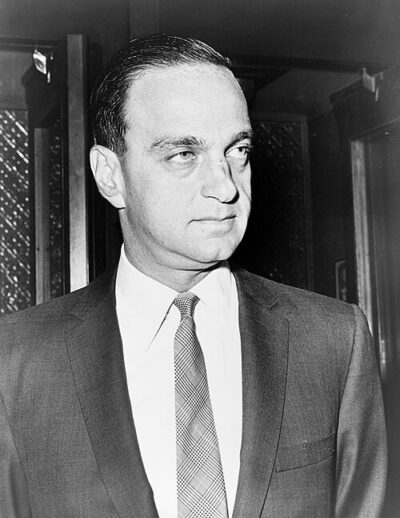
Roy Cohn
Roy Cohn was an American lawyer. Born February 20, 1927, in New York City. Died August 2, 1986, in Bethesda. Educated at Columbia University and Columbia Law School.
Facts
19 facts · 2 confirmed by two sources · 5 cited · 12 from one source
Where this comes from
Papalocal keeps its own record. It started from these sources; what each one said is kept here as it was copied, so a change on their side never changes this page by itself. Tap one to read its version.
What Wikidata says · copied November 15, 2026 · revision 2567394606
- Described as
- American lawyer (1927–1985)
- Other names
- Roy Marcus Cohn
- Born
- February 20, 1927 · 3 references
- Died
- August 2, 1986 · 3 references
- Born in
- New York City · 1 reference
- Died in
- Bethesda · 1 reference
- Buried in
- Union Field Cemetery · 1 reference
- Cause of death
- death from AIDS-related complications
- Citizen of
- United States
- Occupation
- lawyer; writer; biographer; businessperson · 1 reference; politician; jurist · 1 reference
- Political party
- Democratic Party · 1 reference
- Education
- Columbia University; Columbia Law School; Horace Mann School; Ethical Culture Fieldston School · 1 reference
- Father
- Albert C. Cohn
- Wikipedias with a page
- 32
Wikidata item Q942923 (wikidata.org/wiki/Q942923), public domain (CC0). Copied November 15, 2026.
What Wikipedia says · copied November 15, 2026 · revision 1385299448
Roy Marcus Cohn ( KOHN; February 20, 1927 – August 2, 1986) was an American lawyer, prosecutor, and conservative political activist. He first gained fame as a prosecutor of Julius and Ethel Rosenberg in their trials (1952–1953) and as Senator Joseph McCarthy's chief counsel during the Army–McCarthy hearings in 1954. Cohn had been assisting McCarthy's investigations of suspected communists. In the 1970s and during the 1980s, he became a prominent legal and political fixer in New York City. He represented and mentored Donald Trump during Trump's early business career.
Cohn was born in the Bronx in New York City and educated at Columbia University. He rose to prominence as a U.S. Department of Justice prosecutor at the espionage trial of Julius and Ethel Rosenberg, where he successfully prosecuted the Rosenbergs, which led to their conviction and execution in 1953. After his time as prosecuting chief counsel during the McCarthy trials, his reputation deteriorated during the late 1950s to late 1970s as he settled in New York City and became a private lawyer to many clients, including real estate magnates, political operatives, Catholic clergy and organized crime.
In 1986, Cohn was disbarred by the Appellate Division of the New York State Supreme Court for unethical conduct after attempting to defraud a dying client by forcing him to sign a will amendment leaving his fortune to Cohn. Cohn died five weeks later from AIDS-related complications, having vehemently denied that he was HIV-positive. Cohn has been the subject of many media portrayals before and since his death.
- Born, in its opening lines
- February 20, 1927
- Died, in its opening lines
- August 2, 1986
From the Wikipedia article “Roy Cohn” (en.wikipedia.org/wiki/Roy_Cohn), by its contributors, under CC BY-SA 4.0 (creativecommons.org/licenses/by-sa/4.0/). Copied November 15, 2026; not changed.
Confirmed Two sources agree. Cited One source, and it names where it got it. One source One source, without a reference of its own. Sources disagree The sources disagree. We show the best-supported value and keep theirs below.
