
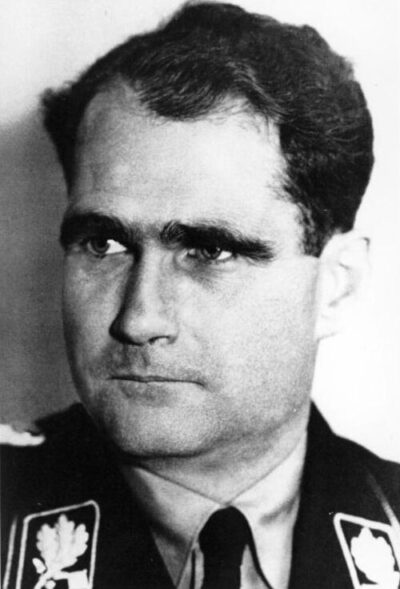
Rudolf Hess
Rudolf Hess was a German Nazi leader and Reich Minister without Portfolio. Born April 26, 1894, in Alexandria. Died August 17, 1987, in Spandau Prison. Positions held include member of the Reichstag of the Weimar Republic, member of the Reichstag of Nazi Germany and Deputy Führer (1933–). Educated at LMU Munich. Awards include Grand Cross of the Imperial Order of the Red Arrows, Golden Party Badge and Iron Cross (1914), 2nd class.
Facts
37 facts · 2 confirmed by two sources · 16 cited · 18 from one source · 1 where the sources disagree
What’s different
- Buried in: we show Wunsiedel (–2011) (Sources disagree). Wikidata also lists North Sea
Where this comes from
Papalocal keeps its own record. It started from these sources; what each one said is kept here as it was copied, so a change on their side never changes this page by itself. Tap one to read its version.
What Wikidata says · copied November 16, 2026 · revision 2568735279
- Described as
- German Nazi leader and Reich Minister without Portfolio (1894–1987)
- Other names
- Rudolf Walter Richard Heß, Conscience of the Party, Rudolf Walther Richard Hess, Alfred Horn, Rudolf Walter Richard Hess
- Born
- April 26, 1894 · 12 references
- Died
- August 17, 1987 · 12 references
- Born in
- Alexandria · 5 references
- Died in
- Spandau Prison
- Buried in
- North Sea; Wunsiedel (–2011) · 1 reference
- Cause of death
- asphyxia
- Name at birth
- Rudolf Walter Richard Heß · 1 reference
- Citizen of
- German Reich · 1 reference
- Occupation
- politician · 2 references; aircraft pilot · 1 reference; merchant · 1 reference
- Positions held
- member of the Reichstag of the Weimar Republic; member of the Reichstag of Nazi Germany; Deputy Führer (1933–) · 1 reference; Reichsminister (1933–) · 1 reference
- Political party
- Nazi Party (1920–1941) · 1 reference; German Workers' Party · 1 reference
- Education
- LMU Munich
- Member of
- Thule Society
- Awards
- Grand Cross of the Imperial Order of the Red Arrows (1938) · 1 reference; Golden Party Badge; Iron Cross (1914), 2nd class · 1 reference; Blood Order · 1 reference; Nazi Party Long Service Award · 1 reference
- Field
- military personnel · 1 reference; politician · 1 reference; activist · 1 reference; essayist · 1 reference
- Spouse
- Ilse Hess (1927–) · 2 references
- Children
- Wolf Rüdiger Hess · 1 reference
- Father
- Fritz Hess · 1 reference
- Mother
- Clara Münch · 1 reference
- Siblings
- Alfred Hess · 1 reference
- Religion
- Lutheranism · 1 reference
- Military branch
- infantry; artillery branch
- Military rank
- lieutenant
- Wikipedias with a page
- 87
Wikidata item Q75866 (wikidata.org/wiki/Q75866), public domain (CC0). Copied November 16, 2026.
What Wikipedia says · copied November 16, 2026 · revision 1384437086
Rudolf Walter Richard Hess (Heß in German; 26 April 1894 – 17 August 1987) was a German politician, a leading member of the Nazi Party in Germany, and a convicted criminal of World War II. Appointed Deputy to the Führer (Stellvertreter des Führers) in 1933, Hess held that position until 1941, when he flew solo to Scotland in an attempt to negotiate the United Kingdom's exit from the Second World War. He was taken prisoner and eventually convicted of crimes against peace and conspiracy. He was still serving his life sentence at age 93 when he committed suicide in 1987.
Hess enlisted as an infantryman in the Imperial German Army at the outbreak of World War I. He was wounded several times during the war and was awarded the Iron Cross, 2nd Class, in 1915. Shortly before the war ended, he enrolled to train as an aviator, but he saw no action in that role. He left the armed forces in December 1918 with the rank of Leutnant der Reserve. In 1919, he enrolled at the Ludwig-Maximilians-Universität München (LMU), where he studied geopolitics under Karl Haushofer, a proponent of the concept of Lebensraum ('living space'), which became one of the pillars of Nazi ideology. He joined the Nazi Party on 1 July 1920 and was at Hitler's side on 8 November 1923 for the Beer Hall Putsch, a failed Nazi attempt to seize control of the government of Bavaria. While serving a prison sentence for this attempted coup, he assisted Hitler with Mein Kampf, which became a foundation of the political platform of the Nazi Party.
After Hitler became Chancellor in January 1933, Hess was appointed Deputy Führer of the Nazi Party in April of the same year. He was elected to the Reichstag in the March elections, was made a Reichsleiter of the Nazi Party in June, and in December 1933, he became Minister without Portfolio in Hitler's cabinet. In addition to appearing on Hitler's behalf at speaking engagements and rallies, Hess signed into law much of the government's legislation, including the 1935 Nuremberg Laws, which stripped the Jews of Germany of their rights in the lead-up to the Holocaust. Hess was also appointed in 1938 to the Secret Cabinet Council and to the Council of Ministers for the Defence of the Reich in August 1939. Hitler decreed on the outbreak of war on 1 September 1939 that Hermann Göring was his official successor, and named Hess as next in line.
By the start of the war, Hess was sidelined from most important decisions, and many in Hitler's inner circle thought him to be mad. On 10 May 1941, Hess made a solo flight to Scotland, where he hoped to arrange peace talks with the Duke of Hamilton, whom he believed to be a prominent opponent of the British government's war policy. The British authorities arrested Hess immediately on his arrival and held him in custody until the end of the war, when he was returned to Germany to stand trial at the 1946 Nuremberg trials of major war criminals. During much of his trial, he claimed to be suffering from amnesia, but he later admitted to the tribunal that this had been a ruse. The tribunal convicted him of crimes against peace and of conspiracy with other German leaders to commit crimes. He served a life sentence in Spandau Prison; the Soviet Union blocked repeated attempts by family members and prominent politicians to procure his early release. While still in custody as the only prisoner in Spandau, he hanged himself in 1987 at the age of 93.
After his death, the prison was demolished to prevent it from becoming a neo-Nazi shrine. His grave, bearing the inscription "Ich habs gewagt" ("I dared to do it"), became a site of regular pilgrimage and demonstrations by neo-Nazis. In 2011, authorities refused to renew the lease on the gravesite, so his remains were exhumed and cremated, and the gravestone was destroyed.
- Born, in its opening lines
- April 26, 1894
- Died, in its opening lines
- August 17, 1987
From the Wikipedia article “Rudolf Hess” (en.wikipedia.org/wiki/Rudolf_Hess), by its contributors, under CC BY-SA 4.0 (creativecommons.org/licenses/by-sa/4.0/). Copied November 16, 2026; not changed.
Confirmed Two sources agree. Cited One source, and it names where it got it. One source One source, without a reference of its own. Sources disagree The sources disagree. We show the best-supported value and keep theirs below.
