
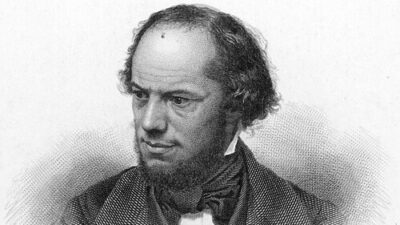
Rufus Wilmot Griswold
Rufus Wilmot Griswold was an American editor, literary critic, anthologist, and writer. Born February 13, 1815, in Benson. Died August 27, 1857, in Manhattan. Positions held include editor-in-chief.
Facts
18 facts · 2 confirmed by two sources · 5 cited · 11 from one source
Where this comes from
Papalocal keeps its own record. It started from these sources; what each one said is kept here as it was copied, so a change on their side never changes this page by itself. Tap one to read its version.
What Wikidata says · copied November 15, 2026 · revision 2555439331
- Described as
- American editor, literary critic, anthologist, and writer (1815–1857)
- Other names
- Ludwig, Rufus W. Griswold
- Born
- February 13, 1815 · 1 reference
- Died
- August 27, 1857 · 5 references
- Born in
- Benson
- Died in
- Manhattan
- Buried in
- Green-Wood Cemetery
- Cause of death
- tuberculosis
- Citizen of
- United States · 1 reference
- Occupation
- journalist; anthologist · 1 reference; literary critic · 1 reference; poet; writer · 2 references; publisher · 1 reference
- Positions held
- editor-in-chief
- Political party
- Whig Party
- Genre
- anthology · 1 reference
- Children
- W. M. Griswold
- Father
- Rufus Griswold · 1 reference
- Wikipedias with a page
- 25
Wikidata item Q1990139 (wikidata.org/wiki/Q1990139), public domain (CC0). Copied November 15, 2026.
What Wikipedia says · copied November 15, 2026 · revision 1372903733
Rufus Wilmot Griswold (February 13, 1815 – August 27, 1857) was an American anthologist, editor, poet, and critic. Born in Vermont, Griswold left home when he was 15 years old. He worked as a journalist, editor, and critic in Philadelphia, New York City, and elsewhere. He built a strong literary reputation, in part due to his 1842 collection The Poets and Poetry of America. This anthology, the most comprehensive of its time, included what he deemed the best examples of American poetry. He produced revised versions and similar anthologies for the remainder of his life, although many of the poets he promoted have since faded into obscurity. Many writers hoped to have their work included in one of these editions, although they commented harshly on Griswold's abrasive character. Griswold was married three times: his first wife died young, his second marriage ended in a public and controversial divorce, and his third wife left him after the previous divorce was almost repealed.
Edgar Allan Poe, whose poetry had been included in Griswold's anthology, published a critical response that questioned which poets were included. This began a rivalry which grew when Griswold succeeded Poe as editor of Graham's Magazine at a salary higher than Poe's. Later, the two competed for the attention of poet Frances Sargent Osgood. They never reconciled their differences, and after Poe's mysterious death in 1849, Griswold wrote an unsympathetic obituary. Claiming to be Poe's chosen literary executor, he began a campaign to harm Poe's reputation that lasted until his own death eight years later.
Griswold considered himself an expert in American poetry and was an early proponent of its inclusion on the school curriculum. He also supported the introduction of copyright legislation, speaking to Congress on behalf of the publishing industry, but he was not above infringing the copyright of other people's work. A fellow editor remarked "even while haranguing the loudest, [he] is purloining the fastest".
- Born, in its opening lines
- February 13, 1815
- Died, in its opening lines
- August 27, 1857
From the Wikipedia article “Rufus Wilmot Griswold” (en.wikipedia.org/wiki/Rufus_Wilmot_Griswold), by its contributors, under CC BY-SA 4.0 (creativecommons.org/licenses/by-sa/4.0/). Copied November 15, 2026; not changed.
Confirmed Two sources agree. Cited One source, and it names where it got it. One source One source, without a reference of its own. Sources disagree The sources disagree. We show the best-supported value and keep theirs below.
