
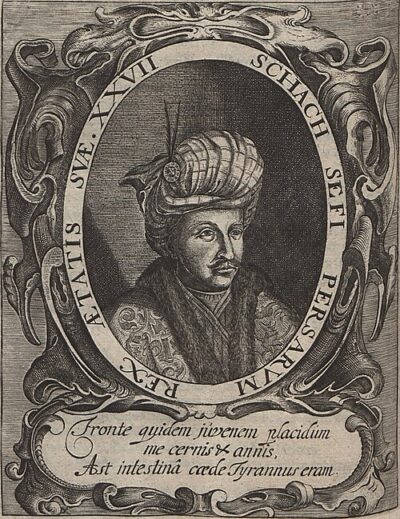
Safi of Persia
Safi of Persia was The sixth Safavid king. Born 1611, in Isfahan. Died May 11, 1642, in Kashan. Positions held include list of Safavid monarchs (1629–1642).
Facts
17 facts · 1 confirmed by two sources · 0 cited · 15 from one source · 1 where the sources disagree
What’s different
- Died: we show May 11, 1642 (Sources disagree). Wikipedia says May 12, 1642
Where this comes from
Papalocal keeps its own record. It started from these sources; what each one said is kept here as it was copied, so a change on their side never changes this page by itself. Tap one to read its version.
What Wikidata says · copied November 16, 2026 · revision 2558929892
- Described as
- The sixth Safavid king (1629–1642)
- Other names
- Safi of Safavi
- Born
- 1611 · 1 reference
- Died
- May 11, 1642
- Born in
- Isfahan
- Died in
- Kashan
- Buried in
- Fatima Masumeh Shrine
- Cause of death
- drug overdose
- Citizen of
- Safavid Iran
- Occupation
- shah; politician; monarch
- Positions held
- list of Safavid monarchs (1629–1642)
- Spouse
- Princess Tinatin of Kakheti (1634–); Anna Khanum
- Children
- Abbas II of Persia · 1 reference
- Father
- Mohammad Baqer Mirza
- Mother
- Dilaram Khanum · 1 reference
- Religion
- Islam
- Wikipedias with a page
- 42
Wikidata item Q355327 (wikidata.org/wiki/Q355327), public domain (CC0). Copied November 16, 2026.
What Wikipedia says · copied November 16, 2026 · revision 1377037141
Sam Mirza (Persian: سام میرزا; 1611 – 12 May 1642), known by his regnal name of Shah Safi (Persian: شاه صفی), was the sixth shah of Safavid Iran, ruling from 1629 to 1642. Abbas the Great was succeeded by his grandson, Safi. A reclusive and passive character, Safi was unable to fill the power vacuum which his grandfather had left behind. His officials undermined his authority and revolts constantly broke out across the realm. The continuing war with the Ottoman Empire, started with initial success during Abbas the Great's reign, but ended with the defeat of Iran and the Treaty of Zuhab, which returned much of Iran's conquests in Mesopotamia to the Ottomans.
In order to assert his authority, Safi purged every potential claimant to his throne, including the sons of the Safavid princesses, and the sons of Abbas the Great, who were blinded and thus were unqualified to rule. The purge also saw the deaths of the leading figures of the realm. An example of Safi's cruelty occurred on the night of 20 February 1632, also known as the Bloody Ma'bas (named after Ma'bas), in which he had forty women of the Safavid imperial harem put to death. The last act of his bloodshed was the killing of his grand vizier, Mirza Taleb Khan Ordubadi, who was replaced with a ghulam (military slave) named Mirza Mohammad Taqi Khan, more famously known as Saru Taqi.
As a eunuch, Saru Taqi had access to the royal harem, and used this ability to forge relations with the shah's concubines. He influenced Safi, persuading him to increase the royal domains by passing the Fars province to the crown demesne. He imposed heavy taxes throughout the realm, especially on Isfahan's Armenian population, and investigated the revenue flows of the previous governor of Gilan. He was described as greedy and was accused by Western observers of accepting bribes. In 1634, Saru Taqi appointed his brother, Mohammad Saleh Beg, as the governor of Mazandaran to counteract the Mar'ashi Sayyid line. Saru Taqi's family held the province's governorship until the end of Safi's reign.
Safi died from excessive drinking on 12 May 1642, leaving behind a country smaller than it was when he inherited it. A weak-minded man lacking charisma, Safi manifested many problems that later plagued the Safavid empire during its decline, one of them being not preparing the crown prince for rule. He excluded the Qizilbash influence in Safavid bureaucracy, and instead allowed a coalition of concubines, eunuchs and ghulams to hold power during the last decade of his reign.
- Born, in its opening lines
- 1611
- Died, in its opening lines
- May 12, 1642
From the Wikipedia article “Safi of Persia” (en.wikipedia.org/wiki/Safi_of_Persia), by its contributors, under CC BY-SA 4.0 (creativecommons.org/licenses/by-sa/4.0/). Copied November 16, 2026; not changed.
Confirmed Two sources agree. Cited One source, and it names where it got it. One source One source, without a reference of its own. Sources disagree The sources disagree. We show the best-supported value and keep theirs below.
