
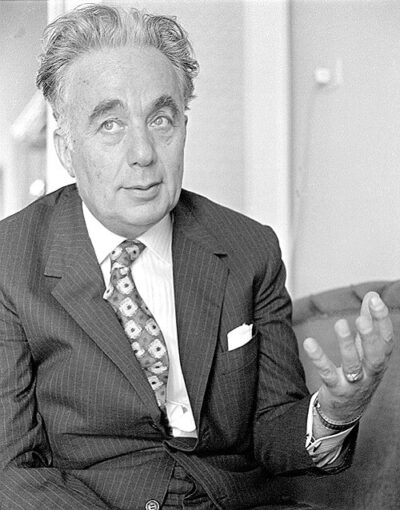
Said Akl
Said Akl was a Lebanese poet and language reformer. Born July 4, 1912, in Zahlé. Died November 28, 2014, in Beirut.
Facts
13 facts · 1 confirmed by two sources · 2 cited · 9 from one source · 1 where the sources disagree
What’s different
- Born: we show July 4, 1912 (Sources disagree). Wikipedia says July 4, 1911
- Died: we show November 28, 2014 (Confirmed). Wikidata also lists November 26, 2014
Where this comes from
Papalocal keeps its own record. It started from these sources; what each one said is kept here as it was copied, so a change on their side never changes this page by itself. Tap one to read its version.
What Wikidata says · copied November 18, 2026 · revision 2567395332
- Described as
- Lebanese poet and language reformer (1911–2014)
- Other names
- Saeed Akl, Saïd Akl, Said Aql
- Born
- July 4, 1912 · 2 references
- Died
- November 28, 2014 · 1 reference; November 26, 2014 · 1 reference
- Born in
- Zahlé · 1 reference
- Died in
- Beirut · 1 reference
- Citizen of
- Lebanon
- Occupation
- poet; politician; theologian; historian; professor; journalist; philosopher · 1 reference
- Political party
- Guardians of the Cedars
- Wikipedias with a page
- 24
Wikidata item Q2226193 (wikidata.org/wiki/Q2226193), public domain (CC0). Copied November 18, 2026.
What Wikipedia says · copied November 18, 2026 · revision 1383511897
Said Akl (Arabic: سعيد عقل, romanized: Saʿīd ʿAql; 4 July 1911 – 28 November 2014) was a Lebanese poet, linguist, philosopher, writer, playwright and language reformer. He is considered one of the most important Lebanese poets of the modern era. He is most famous for his advocacy on behalf of codifying the spoken Lebanese Arabic language as completely distinct from Standard Arabic, to be written in a modern modified Roman script consisting of 36 symbols that he deemed an evolution of the Phoenician alphabet. Despite this, he contributed to several literary movements (primarily, symbolism) in Modern Standard Arabic, producing some of the masterpieces of modern Arabic belle lettres.
Akl aligned himself with Lebanese nationalism, and was one of the founding members of the Lebanese Renewal Party in 1972. The party, characterized by its pro-Phoenicianism stance, aimed to distance Lebanon from Pan-Arabism. His views found support within the Guardians of the Cedars movement.
His writings include poetry and prose both in Lebanese Arabic and in Classical Arabic. He has also written theatre pieces and authored lyrics for many popular songs, such as "Meshwar" ("Trip"), and the classical "Shal" ("Scarf"), the latter of which was composed by the Rahbani brothers and sung by Fairuz, and which Egyptian composer and singer Abdel Wahab described as "the most beautiful poem composed into a song in Arabic music".
- Born, in its opening lines
- July 4, 1911
- Died, in its opening lines
- November 28, 2014
From the Wikipedia article “Said Akl” (en.wikipedia.org/wiki/Said_Akl), by its contributors, under CC BY-SA 4.0 (creativecommons.org/licenses/by-sa/4.0/). Copied November 18, 2026; not changed.
Confirmed Two sources agree. Cited One source, and it names where it got it. One source One source, without a reference of its own. Sources disagree The sources disagree. We show the best-supported value and keep theirs below.
