
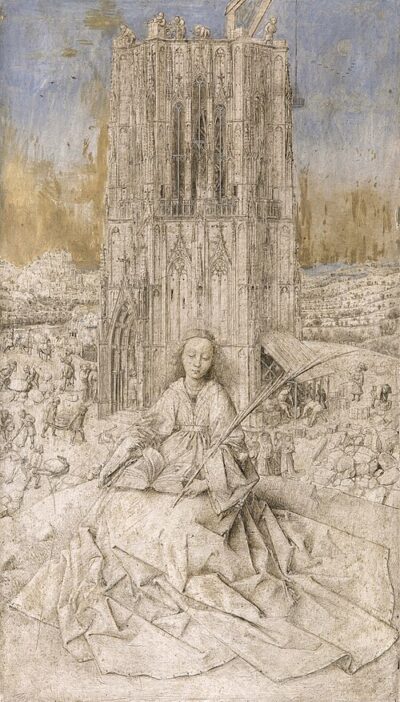
Saint Barbara
Saint Barbara was an early Christian saint and martyr, from Nicomedia. Born 273, in Nicomedia. Died 306, in Nicomedia.
Facts
8 facts · 0 confirmed by two sources · 1 cited · 7 from one source
Where this comes from
Papalocal keeps its own record. It started from these sources; what each one said is kept here as it was copied, so a change on their side never changes this page by itself. Tap one to read its version.
What Wikidata says · copied November 16, 2026 · revision 2568730732
- Described as
- early Christian saint and martyr, from Nicomedia (273-306)
- Other names
- Great Martyr Barbara, Barbara of Nicomedia, St. Barbara, Barbe, St Barbara
- Born
- 273 · 1 reference
- Died
- 306
- Born in
- Nicomedia
- Died in
- Nicomedia
- Cause of death
- decapitation
- Occupation
- thaumaturge; prisoner
- Religion
- Catholic Church
- Wikipedias with a page
- 64
Wikidata item Q192816 (wikidata.org/wiki/Q192816), public domain (CC0). Copied November 16, 2026.
What Wikipedia says · copied November 16, 2026 · revision 1382714382
Saint Barbara (Ancient Greek: Ἁγία Βαρβάρα; Coptic: Ϯⲁⲅⲓⲁ Ⲃⲁⲣⲃⲁⲣⲁ; Church Slavonic: Великомученица Варва́ра Илиопольская; Arabic: القديسة الشهيدة بربارة), known in the Eastern Orthodox Church as the Great Martyr Barbara, was an early Christian and martyr of Phoenician origin from Heliopolis (modern-day Baalbek, Lebanon).
Saint Barbara is often portrayed with miniature chains and a tower to symbolize her father imprisoning her. As one of the Fourteen Holy Helpers, Barbara is a popular saint, perhaps best known as the patroness saint of armourers, artillerymen, military engineers, miners and others who work with explosives because of her legend's association with lightning.
She is also a patroness saint of mathematicians. A 15th-century French version of her story credits her with thirteen miracles, many of which reflect the security she offered that her devotees would not die before getting to make confession and receiving extreme unction.
Legends detailing her life do not appear until the 7th century. Veneration of her was common, especially in the East, from the 9th century. Because of doubts about the historicity of her legend, she was removed from the General Roman Calendar in the 1969 revision, though not from the Catholic Church's list of saints.
From the Wikipedia article “Saint Barbara” (en.wikipedia.org/wiki/Saint_Barbara), by its contributors, under CC BY-SA 4.0 (creativecommons.org/licenses/by-sa/4.0/). Copied November 16, 2026; not changed.
Confirmed Two sources agree. Cited One source, and it names where it got it. One source One source, without a reference of its own. Sources disagree The sources disagree. We show the best-supported value and keep theirs below.
