
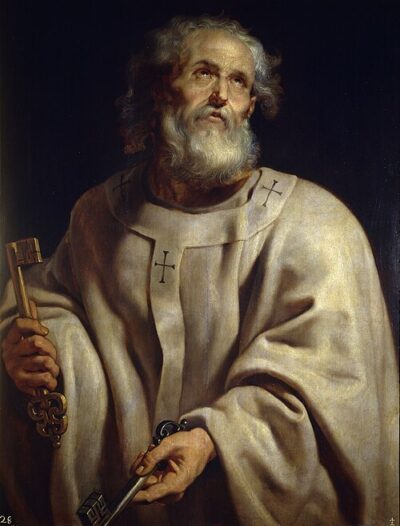
Saint Peter
Saint Peter was an apostle of Jesus Christ. Born 1 BC, in Bethsaida. Died 65, in ancient Roma. Positions held include Pope (33–67), apostle and Patriarch of Antioch (37–54).
Facts
20 facts · 0 confirmed by two sources · 7 cited · 13 from one source
Where this comes from
Papalocal keeps its own record. It started from these sources; what each one said is kept here as it was copied, so a change on their side never changes this page by itself. Tap one to read its version.
What Wikidata says · copied November 16, 2026 · revision 2564376807
- Described as
- apostle of Jesus Christ
- Other names
- Saint Peter the Apostle, St. Peter, Pope Peter, Cephas, Peter, Peter the Apostle, Shimoun Bar Younah, Petrus, Peter, the Apostle, Saint, Kipa, Simon, Apostle Peter
- Born
- 1 BC · 1 reference
- Died
- 65 · 1 reference
- Born in
- Bethsaida
- Died in
- ancient Roma · 1 reference
- Buried in
- Vatican Necropolis
- Cause of death
- crucifixion
- Occupation
- fisher · 2 references; Catholic bishop · 1 reference; apostle · 1 reference
- Positions held
- Pope (33–67); apostle; Patriarch of Antioch (37–54)
- Spouse
- Perpetua
- Father
- Jonas
- Siblings
- Andrew the Apostle
- Religion
- Jewish Christian
- Lived in
- Jerusalem; Antioch; Rome; Capernaum · 1 reference
- Wikipedias with a page
- 155
Wikidata item Q33923 (wikidata.org/wiki/Q33923), public domain (CC0). Copied November 16, 2026.
What Wikipedia says · copied November 16, 2026 · revision 1385790584
Saint Peter (born Simon bar Jonah; c. 1 BC – AD 64/68), also known as Peter the Apostle, Simon Peter, or Cephas, was one of the Twelve Apostles of Jesus and one of the first leaders of the early Christian Church. He appears repeatedly and prominently in all four New Testament gospels, as well as the Acts of the Apostles. Catholic and Orthodox tradition treats Peter as the first bishop of Rome (or pope) and also as the first bishop of Antioch. According to Christian tradition, Peter was crucified upside down in Rome under Emperor Nero.
The ancient Christian churches venerate Peter as a major saint and the founder of the Church of Antioch and the Church of Rome, but they differ in their attitudes regarding the authority of his successors. According to Catholic teaching, Jesus promised Peter a special position in the church. In the New Testament, the name "Simon Peter" is found 19 times. He is the brother of Andrew, and they both were fishermen. The Gospel of Mark, in particular, is traditionally thought to show the influence of Peter's preaching and eyewitness accounts. He is also mentioned as Peter or Cephas in Paul's First Letter to the Corinthians and the Epistle to the Galatians. The New Testament also includes two general epistles, First Peter and Second Peter, which are traditionally attributed to him, but modern scholarship generally rejects the Petrine authorship of both.
Outside of the New Testament, several apocryphal books were later attributed to him, in particular the Acts of Peter, Gospel of Peter, the Preaching of Peter, Apocalypse of Peter, and Judgment of Peter, although scholars believe these works to be pseudepigrapha.
Although the New Testament does not explicitly identify Peter as the first bishop of Rome or detail his journey there, early Church Fathers and historians, including Irenaeus, Tertullian, Hegesippus, Clement of Alexandria, Lactantius, and Eusebius attest that Peter spent his closing years in Rome, and along with Paul founded the Church in Rome and conferred the episcopal office upon Linus. These accounts also maintain that Peter was martyred in Rome, traditionally on Vatican Hill during Nero's reign. The late second-century writer Caius further testified that the monuments of Peter were located at the Vatican.
From the Wikipedia article “Saint Peter” (en.wikipedia.org/wiki/Saint_Peter), by its contributors, under CC BY-SA 4.0 (creativecommons.org/licenses/by-sa/4.0/). Copied November 16, 2026; not changed.
Confirmed Two sources agree. Cited One source, and it names where it got it. One source One source, without a reference of its own. Sources disagree The sources disagree. We show the best-supported value and keep theirs below.
