
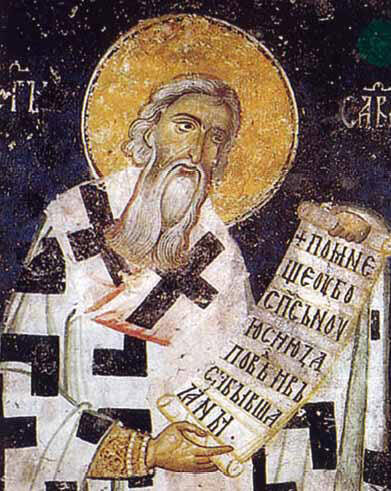
Saint Sava
Saint Sava was a first archbishop of Serbs. Born 1169, in Stari Ras. Died January 14, 1235, in Veliko Tarnovo. Positions held include archbishop. Known for Karyes Typicon, Zakonopravilo and Life of Stefan Nemanja.
Facts
24 facts · 0 confirmed by two sources · 2 cited · 20 from one source · 2 where the sources disagree
What’s different
- Born: we show 1169 (Sources disagree). Wikidata also lists 1174 and 1175
- Died: we show January 14, 1235 (Sources disagree). Wikidata also lists January 14, 1236
Where this comes from
Papalocal keeps its own record. It started from these sources; what each one said is kept here as it was copied, so a change on their side never changes this page by itself. Tap one to read its version.
What Wikidata says · copied November 16, 2026 · revision 2563075747
- Described as
- first archbishop of Serbs
- Born
- 1169 · 1 reference; 1174; 1175
- Died
- January 14, 1235; January 14, 1236
- Born in
- Stari Ras
- Died in
- Veliko Tarnovo
- Buried in
- Holy Forty Martyrs Church · 1 reference
- Cause of death
- pneumonia
- Name at birth
- Растислав Немањић
- Citizen of
- Kingdom of Serbia; Grand Principality of Serbia
- Occupation
- hagiographer; writer; diplomat; Eastern Orthodox priest; patriarch · 1 reference; monk · 1 reference
- Positions held
- archbishop
- Known for
- Karyes Typicon; Zakonopravilo; Life of Stefan Nemanja
- Father
- Stefan Nemanja
- Mother
- Anastasia of Serbia
- Siblings
- Stefan the First-Crowned; Vukan Nemanjić of Serbia
- Religion
- Eastern Orthodoxy
- Wikipedias with a page
- 47
Wikidata item Q138465 (wikidata.org/wiki/Q138465), public domain (CC0). Copied November 16, 2026.
What Wikipedia says · copied November 16, 2026 · revision 1383431825
Saint Sava (Serbian Cyrillic: Свети Сава, romanized: Sveti Sava, Serbian pronunciation: [sʋɛ̂ːtiː sǎːʋa]; 1169 or 1174 – 14 January 1235), known as the Enlightener or the Illuminator, was a Serbian prince and Eastern Orthodox monk who became the first Archbishop of the autocephalous Serbian Church. He was also a writer, diplomat, and the founder of Serbian law.
Sava, born as Rastko Nemanjić (Serbian Cyrillic: Растко Немањић), was the youngest son of Serbian Grand Prince Stefan Nemanja (founder of the Nemanjić dynasty), and ruled the appanage of Zachlumia briefly in 1190–92. He then left for Mount Athos, where he became a monk and took the monastic name Sava (Sabbas). At Athos he established the monastery of Hilandar, which became one of the most important cultural and religious centres of the Serbian people. In 1219, the Patriarchate exiled in Nicea recognized him as the first Serbian Archbishop, and in the same year, he authored the oldest known constitution of Serbia, the Zakonopravilo nomocanon, thus securing full religious and political independence. Sava is regarded as the greatest figure of Serbian medieval literature and author of the first Serbian "biography". Specifically, he wrote the life of his father, the Serbian ruler Stefan Nemanja.
He is widely considered one of the most important figures in Serbian history. Saint Sava is venerated by the Eastern Orthodox Church on January 27 [O.S. January 14]. Many artistic works from the Middle Ages to modern times have interpreted his life. He is the patron saint of Serbia, Serbs, Serbian education, and medicine. The Church of Saint Sava in Belgrade is dedicated to him, built on the site where the Ottomans burnt his relics in 1594, during an uprising in which Serbs used icons of Sava as their war flags; the church is one of the largest church buildings in the world.
To distinguish him from other saints and canonized Serbian archbishops of the same name, he is also posthumously titled Saint Sava I of Serbia.
From the Wikipedia article “Saint Sava” (en.wikipedia.org/wiki/Saint_Sava), by its contributors, under CC BY-SA 4.0 (creativecommons.org/licenses/by-sa/4.0/). Copied November 16, 2026; not changed.
Confirmed Two sources agree. Cited One source, and it names where it got it. One source One source, without a reference of its own. Sources disagree The sources disagree. We show the best-supported value and keep theirs below.
