
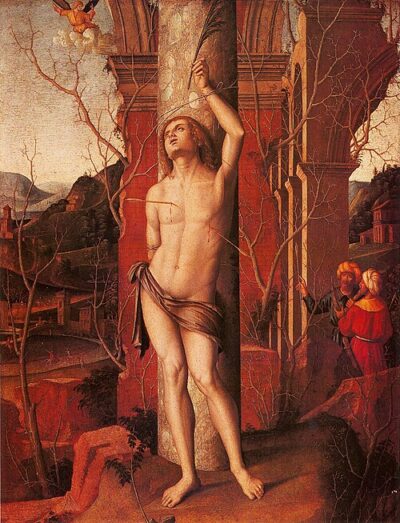
Saint Sebastian
Saint Sebastian was a Christian saint and martyr. Born 255, in Narbonne. Died January 20, 287, in Rome.
Facts
12 facts · 0 confirmed by two sources · 4 cited · 8 from one source
Where this comes from
Papalocal keeps its own record. It started from these sources; what each one said is kept here as it was copied, so a change on their side never changes this page by itself. Tap one to read its version.
What Wikidata says · copied November 16, 2026 · revision 2568741811
- Described as
- Christian saint and martyr (256–288)
- Other names
- St. Sebastian, St Sebastian
- Born
- 255 · 1 reference
- Died
- January 20, 287 · 1 reference
- Born in
- Narbonne · 1 reference
- Died in
- Rome · 1 reference
- Buried in
- San Sebastiano fuori le mura · 1 reference
- Cause of death
- flagellation
- Citizen of
- Ancient Rome
- Occupation
- soldier · 1 reference; military officer · 1 reference
- Religion
- Catholic Church
- Military branch
- Roman army · 1 reference
- Military rank
- military tribune · 1 reference
- Wikipedias with a page
- 69
Wikidata item Q183332 (wikidata.org/wiki/Q183332), public domain (CC0). Copied November 16, 2026.
What Wikipedia says · copied November 16, 2026 · revision 1383506499
Sebastian (Latin: Sebastianus; c. AD 255 – c. AD 288) was an early Christian saint and martyr. According to traditional belief, he was killed during the Diocletianic Persecution of Christians. He was initially tied to a post or tree and shot with arrows, though this did not kill him. He was, according to tradition, rescued and healed by Irene of Rome, which became a popular subject in 17th-century painting. In all versions of the story, shortly after his recovery he went to Diocletian to warn him about his sins, and as a result he was clubbed to death. He is venerated in the Catholic Church and the Eastern Orthodox Church as the patron saint of athletics, archery, and plagues.
The oldest mention of Sebastian's martyrdom is in the Chronograph of 354, which says he is venerated on January 20. He is also mentioned in a sermon on Psalm 118 by 4th-century bishop Ambrose of Milan: in his sermon, Ambrose stated that Sebastian came from Milan and that he was already venerated there at that time. The full account of his martyrdom comes from the Passio Sancti Sebastiani, a 5th-century text written by an anonymous author, possibly Arnobius the Younger.
Sebastian is a popular male saint, especially today among athletes. In medieval times, he was regarded as a saint with a special ability to intercede to protect from plague, and devotion to him greatly increased when plague was active.
From the Wikipedia article “Saint Sebastian” (en.wikipedia.org/wiki/Saint_Sebastian), by its contributors, under CC BY-SA 4.0 (creativecommons.org/licenses/by-sa/4.0/). Copied November 16, 2026; not changed.
Confirmed Two sources agree. Cited One source, and it names where it got it. One source One source, without a reference of its own. Sources disagree The sources disagree. We show the best-supported value and keep theirs below.
