
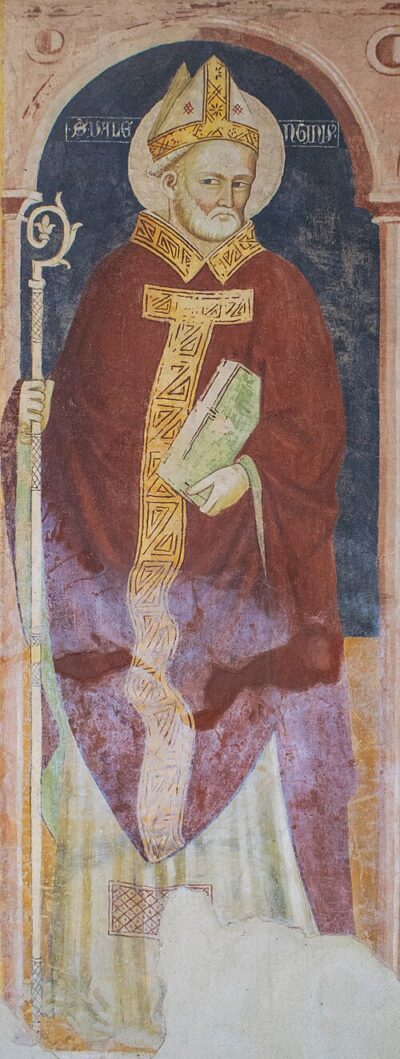
Saint Valentine
Saint Valentine was the 3rd-century Roman Christian saint. Born 175, in Terni. Died February 14, 273, in Rome. Positions held include bishop.
Facts
9 facts · 0 confirmed by two sources · 1 cited · 8 from one source
Where this comes from
Papalocal keeps its own record. It started from these sources; what each one said is kept here as it was copied, so a change on their side never changes this page by itself. Tap one to read its version.
What Wikidata says · copied November 16, 2026 · revision 2521321537
- Described as
- 3rd-century Roman Christian saint (175–273)
- Other names
- Valentinus, Valentin de Rome, Saint Valentine of Terni, St. Valentine, Saint Valentine of Rome
- Born
- 175
- Died
- February 14, 273 · 1 reference
- Born in
- Terni
- Died in
- Rome
- Cause of death
- decapitation
- Citizen of
- Ancient Rome
- Occupation
- physician
- Positions held
- bishop
- Religion
- Catholic Church
- Wikipedias with a page
- 70
Wikidata item Q192151 (wikidata.org/wiki/Q192151), public domain (CC0). Copied November 16, 2026.
What Wikipedia says · copied November 16, 2026 · revision 1380951515
Saint Valentine (Italian: Valentino; Latin: Valentinus) was a 3rd-century Roman saint, commemorated in Western Christianity on February 14 and in Eastern Orthodoxy on July 6. From the High Middle Ages, his feast day has been associated with a tradition of courtly love. He is also a patron saint of Terni, epilepsy, and beekeepers. Saint Valentine was a clergyman – either a priest or a bishop – in the Roman Empire who ministered to persecuted Christians. He was martyred and his body buried on the Via Flaminia on February 14, which has been observed as the Feast of Saint Valentine (Saint Valentine's Day) since at least the eighth century.
Relics of him were kept in the Church and Catacombs of San Valentino in Rome, which "remained an important pilgrim site throughout the Middle Ages until the relics of St. Valentine were transferred to the church of Santa Prassede during the pontificate of Nicholas IV". His skull, crowned with flowers, is exhibited in the Basilica of Santa Maria in Cosmedin, Rome. Other relics of him are in Whitefriar Street Carmelite Church, Dublin, Ireland, a popular place of pilgrimage, especially on Saint Valentine's Day, for those seeking love. At least two different Saint Valentines are mentioned in the early martyrologies. For Saint Valentine of Rome, along with Saint Valentine of Terni, "abstracts of the acts of the two saints were in nearly every church and monastery of Europe", according to Professor Jack B. Oruch of the University of Kansas.
Saint Valentine is commemorated in the Anglican Communion and the Lutheran churches on February 14. In the Eastern Orthodox Church, he is recognised on July 6; in addition, the Eastern Orthodox Church observes the feast of Hieromartyr Valentine, Bishop of Interamna, on July 30. In 1969, the Catholic Church removed his name from the General Roman Calendar, leaving his liturgical celebration to local calendars, though use of the pre-1970 liturgical calendar is also authorised under the conditions indicated in the motu proprio Summorum Pontificum of 2007. The Catholic Church continues to recognise him as a saint, listing him as such in the February 14 entry in the Roman Martyrology. The official Liturgical Calendar for the Dioceses of the United States identifies February 14 as the memorial of Saints Cyril and Methodius.
From the Wikipedia article “Saint Valentine” (en.wikipedia.org/wiki/Saint_Valentine), by its contributors, under CC BY-SA 4.0 (creativecommons.org/licenses/by-sa/4.0/). Copied November 16, 2026; not changed.
Confirmed Two sources agree. Cited One source, and it names where it got it. One source One source, without a reference of its own. Sources disagree The sources disagree. We show the best-supported value and keep theirs below.
