
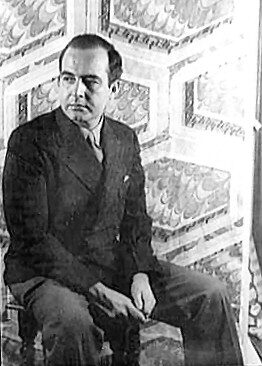
Samuel Barber
Samuel Barber was an American composer. Born March 9, 1910, in West Chester. Died January 23, 1981, in Manhattan. Known for Cello Concerto, Adagio for Strings and Agnus Dei. Educated at Curtis Institute of Music and West Chester Henderson High School. Awards include Rome Prize, Guggenheim Fellowship (3 times) and Pulitzer Prize for Music (2 times).
Facts
37 facts · 2 confirmed by two sources · 16 cited · 19 from one source
Where this comes from
Papalocal keeps its own record. It started from these sources; what each one said is kept here as it was copied, so a change on their side never changes this page by itself. Tap one to read its version.
What Wikidata says · copied November 13, 2026 · revision 2563856743
- Described as
- American composer (1910-1981)
- Other names
- Samuel Osborne Barber II, Samuel Osborne Barber
- Born
- March 9, 1910 · 14 references
- Died
- January 23, 1981 · 11 references
- Born in
- West Chester · 2 references
- Died in
- Manhattan
- Buried in
- Oaklands Cemetery · 1 reference
- Cause of death
- cancer
- Name at birth
- Samuel Osmond Barber II
- Citizen of
- United States
- Occupation
- composer · 3 references; musicologist; pianist; conductor · 1 reference; musician · 1 reference
- Education
- Curtis Institute of Music; West Chester Henderson High School · 1 reference
- Member of
- American Academy of Arts and Sciences; American Academy of Arts and Letters
- Genre
- opera; symphony
- Instrument
- piano
- Known for
- Cello Concerto; Adagio for Strings; Agnus Dei; Violin Concerto · 1 reference; Antony and Cleopatra · 1 reference; Capricorn Concerto · 1 reference; Hermit Songs · 1 reference; Knoxville: Summer of 1915 · 1 reference; Medea's Dance of Vengeance · 1 reference; Piano Concerto · 1 reference
- Awards
- Rome Prize (1934) · 1 reference; Guggenheim Fellowship (3 times) (1945, 1947, 1949) · 1 reference; Pulitzer Prize for Music (2 times) (1958, 1963) · 1 reference; Fellow of the American Academy of Arts and Sciences (1961); Edward MacDowell Medal (1980); Joseph H. Bearns Prize
- Mother
- Marguerite McLeod Barber · 1 reference
- Wikipedias with a page
- 49
Wikidata item Q216870 (wikidata.org/wiki/Q216870), public domain (CC0). Copied November 13, 2026.
What Wikipedia says · copied November 13, 2026 · revision 1373299979
Samuel Osmond Barber II (March 9, 1910 – January 23, 1981) was an American composer, pianist, conductor, baritone, and music educator, and one of the most celebrated composers of the mid-20th century. Principally influenced by nine years' composition studies with Rosario Scalero at the Curtis Institute and more than 25 years' study with his uncle, the composer Sidney Homer, Barber's music usually eschewed the experimental trends of musical modernism in favor of traditional 19th-century harmonic language and formal structure embracing lyricism and emotional expression. However, he adopted elements of modernism after 1940 in some of his compositions, such as an increased use of dissonance and chromaticism in the Cello Concerto (1945) and Medea's Dance of Vengeance (1955); and the use of tonal ambiguity and a narrow use of serialism in his Piano Sonata (1949), Prayers of Kierkegaard (1954), and Nocturne (1959).
Barber was adept at both instrumental and vocal music. His works became successful on the international stage and many of his compositions enjoyed rapid adoption into the classical performance canon. In particular, his Adagio for Strings (1936) has earned a permanent place in the orchestral concert repertory, as has that work's adaptation for chorus, Agnus Dei (1967). He received the Pulitzer Prize for Music twice: for his opera Vanessa (1956–1957), and for the Concerto for Piano and Orchestra (1962). Also widely performed is his Knoxville: Summer of 1915 (1947), a setting for soprano and orchestra of a prose text by James Agee. At the time of Barber's death, nearly all of his compositions had been recorded. Many of his compositions were commissioned or first performed by such noted groups and artists as the Boston Symphony Orchestra, the Philadelphia Orchestra, the New York Philharmonic, the Metropolitan Opera, Vladimir Horowitz, Eleanor Steber, Raya Garbousova, John Browning, Leontyne Price, Pierre Bernac, Francis Poulenc, and Dietrich Fischer-Dieskau.
While Barber composed a significant body of purely instrumental music, two-thirds of his compositional output were art songs for voice and piano, choral music, and songs for voice and orchestra. Some of his most frequently performed songs include both the solo voice and choral versions of Sure on this shining night (solo version from 1938 and choral version from 1961) with text by Agee, and the song cycle Hermit Songs (1953), with anonymous texts by Irish monks from the eighth through the thirteenth centuries. This emphasis on sung material was rooted in his own brief career as a professional baritone in his 20s which inspired a lifelong love of vocal music. In 1935, Barber recorded his own setting of Arnold's "Dover Beach" for NBC, singing the vocal part accompanied by string quartet, and he was also featured weekly on NBC Radio in 1935–1936 performing German lieder and art songs. He also occasionally conducted performances and recordings of his works with symphony orchestras during the 1950s, and taught composition at the Curtis Institute from 1939 to 1942.
- Born, in its opening lines
- March 9, 1910
- Died, in its opening lines
- January 23, 1981
From the Wikipedia article “Samuel Barber” (en.wikipedia.org/wiki/Samuel_Barber), by its contributors, under CC BY-SA 4.0 (creativecommons.org/licenses/by-sa/4.0/). Copied November 13, 2026; not changed.
Confirmed Two sources agree. Cited One source, and it names where it got it. One source One source, without a reference of its own. Sources disagree The sources disagree. We show the best-supported value and keep theirs below.
