
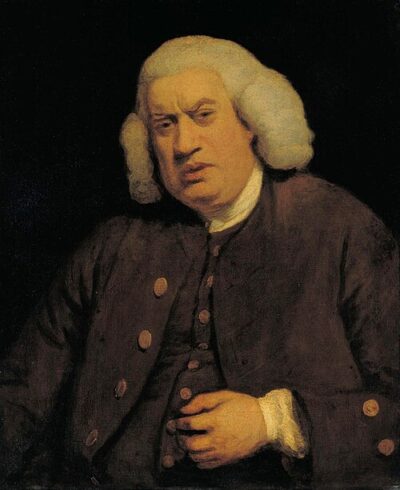
Samuel Johnson
Samuel Johnson was an English writer and lexicographer. Born September 18, 1709, in Lichfield. Died December 13, 1784, in London. Known for A Dictionary of the English Language. Educated at Pembroke College and King Edward VI College, Stourbridge.

Facts
24 facts · 2 confirmed by two sources · 10 cited · 12 from one source
Where this comes from
Papalocal keeps its own record. It started from these sources; what each one said is kept here as it was copied, so a change on their side never changes this page by itself. Tap one to read its version.
What Wikidata says · copied November 16, 2026 · revision 2568158985
- Described as
- English writer and lexicographer (1709–1784)
- Other names
- Great Moralist, Dr Johnson, Dr. Johnson
- Born
- September 18, 1709 · 15 references
- Died
- December 13, 1784 · 16 references
- Born in
- Lichfield · 4 references
- Died in
- London · 4 references
- Buried in
- Westminster Abbey · 1 reference
- Cause of death
- surgical complications
- Citizen of
- Kingdom of Great Britain
- Occupation
- lexicographer · 1 reference; linguist; poet · 1 reference; literary historian; writer · 2 references; teacher; literary critic; biographer
- Political party
- Tories
- Education
- Pembroke College (1728–1731) · 1 reference; King Edward VI College, Stourbridge; King Edward VI School
- Known for
- A Dictionary of the English Language · 1 reference
- Spouse
- Elizabeth Porter (1736–)
- Father
- Michael Johnson · 1 reference
- Mother
- Sarah Ford · 1 reference
- Religion
- Anglicanism · 1 reference
- Wikipedias with a page
- 135
Wikidata item Q183266 (wikidata.org/wiki/Q183266), public domain (CC0). Copied November 16, 2026.
What Wikipedia says · copied November 16, 2026 · revision 1385567250
Samuel Johnson (18 September [O.S. 7 September] 1709 – 13 December 1784), often called Dr Johnson, was an English writer and polymath who made lasting contributions as a poet, playwright, essayist, moralist, literary critic, sermonist, biographer, editor, and lexicographer (creator of dictionaries). The work for which he is best known is his 42,733-entry Dictionary of the English Language (1755). For this and other contributions in and to the English language, the Oxford Dictionary of National Biography has called him "arguably the most distinguished man of letters in English history".
Born in Lichfield, Staffordshire, he attended Pembroke College, Oxford, until lack of funds forced him to leave. After working as a teacher, he moved to London and began writing for The Gentleman's Magazine. Early works include the poem London (1738), the biography Life of Mr Richard Savage (1744), the poem The Vanity of Human Wishes (1749) and the play Irene (1749). After nine years' effort, Johnson's A Dictionary of the English Language (1755) appeared and was acclaimed as "one of the greatest single achievements of scholarship". Later works included The History of Rasselas, Prince of Abissinia (1759) and The Plays of William Shakespeare (1765). In 1763, he befriended James Boswell, with whom he travelled to Scotland; Johnson described his travels in A Journey to the Western Islands of Scotland (1775). Near the end of his life, he authored the voluminous and highly influential Lives of the Most Eminent English Poets (1779–1781), a series of biographies and critical appraisals of 52 poets of the 17th and 18th centuries.
Johnson was a devout Anglican Christian and a committed Tory. Although tall and robust, he was deaf in one ear and blind in one eye. For most of his life he made regular and uncontrolled gestures and tics that disconcerted some upon meeting him. Boswell and other biographers documented Johnson's behaviour and mannerisms in such detail that they have informed a posthumous diagnosis of Tourette syndrome, a condition neither defined nor manageable in the 18th century. After several illnesses, and extended periods of mental struggle and loneliness, Johnson died on the evening of 13 December 1784, aged 75; he is buried in Westminster Abbey.
Johnson became a celebrity in his later life, "the acknowledged Head of Literature in this kingdom". Following his death, he was increasingly recognised as having had a major and lasting effect on the practice of literary criticism—it was even claimed that he was the one truly great critic of English literature. A prevailing mode of literary theory in the 20th century (one focused upon the language used by literature) drew heavily upon his work, and he likewise had a lasting impact on the forms, research and writing of biography. Johnson's Dictionary had and continues to have far-reaching effects on Modern English—this was an early, major, and widely respected, dictionary of English: it was pre-eminent, at least until the arrival of the Oxford English Dictionary some 150 years later. His life was also a story worth telling: Boswell's 1791 biography, The Life of Samuel Johnson, LLD, was selected by fellow Johnson-biographer Walter Jackson Bate as "the most famous single work of biographical art in the whole of literature".
- Born, in its opening lines
- September 18, 1709
- Died, in its opening lines
- December 13, 1784
From the Wikipedia article “Samuel Johnson” (en.wikipedia.org/wiki/Samuel_Johnson), by its contributors, under CC BY-SA 4.0 (creativecommons.org/licenses/by-sa/4.0/). Copied November 16, 2026; not changed.
Confirmed Two sources agree. Cited One source, and it names where it got it. One source One source, without a reference of its own. Sources disagree The sources disagree. We show the best-supported value and keep theirs below.
