
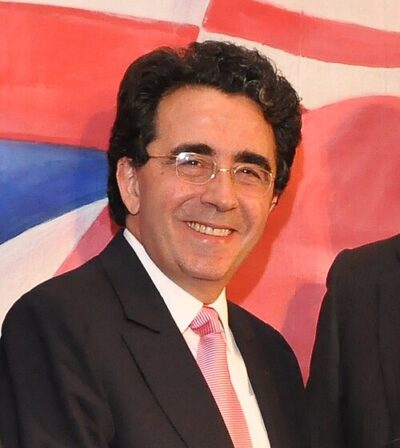
Santiago Calatrava
Santiago Calatrava is a Spanish-Swiss engineer, architect, and artist. Born July 28, 1951, in Benimàmet. Known for ponte della Costituzione, Jerusalem Chords Bridge and City of Arts and Sciences. Educated at ETH Zurich and Technical University of Valencia. Awards include Officer of Arts and Letters, Princess of Asturias Award for the Arts and James Parks Morton Interfaith Award.
Facts
46 facts · 1 confirmed by two sources · 16 cited · 29 from one source
Where this comes from
Papalocal keeps its own record. It started from these sources; what each one said is kept here as it was copied, so a change on their side never changes this page by itself. Tap one to read its version.
What Wikidata says · copied November 16, 2026 · revision 2558233719
- Described as
- Spanish-Swiss engineer, architect, and artist (born 1951)
- Other names
- Santiago Calatrava Valls
- Born
- July 28, 1951 · 4 references
- Born in
- Benimàmet
- Citizen of
- Spain · 1 reference
- Occupation
- sculptor; architect · 3 references; structural engineer; civil engineer · 1 reference; engineer · 1 reference; conservator · 1 reference; artist · 1 reference
- Education
- ETH Zurich; Technical University of Valencia
- Member of
- Reial Acadèmia Catalana de Belles Arts de Sant Jordi; Royal Academy of Fine Arts of San Fernando; Royal Swedish Academy of Engineering Sciences; Académie d'architecture · 1 reference; Pontifical Academy of Fine Arts and Letters of the Virtuosi al Pantheon; Russian Academy of Architecture and Construction Sciences · 1 reference
- Genre
- Bionic architecture · 1 reference
- Known for
- ponte della Costituzione; Jerusalem Chords Bridge; City of Arts and Sciences · 1 reference; Brookfield Place · 1 reference; Zürich Stadelhofen railway station · 1 reference; Auditorio de Tenerife · 1 reference; Turning Torso; Olympic Athletic Center of Athens "Spiros Louis"; St. Nicholas Greek Orthodox Church; World Trade Center
- Awards
- Officer of Arts and Letters; Princess of Asturias Award for the Arts (1999); James Parks Morton Interfaith Award; Saint George's Cross (1994) · 1 reference; Grand Officer of the Order of Merit of Portugal · 1 reference; Medalla de Honor al Fomento de la Invención (1993) · 1 reference; European Prize for Architecture (2015); National Architecture Award of Spain (2007); Gran Cross of the Order of James I the Conqueror (2008) · 1 reference; Honorary doctor of the University of Liège (2010) · 1 reference; honorary doctorate from Columbia University; honorary doctorate of Technion; honorary doctor of the Aristotle University of Thessaloniki; honorary citizen of Liège (2010); honorary doctorate of Lund University
- Field
- architecture · 1 reference
- Website
- https://calatrava.com
- Wikipedias with a page
- 71
Wikidata item Q168482 (wikidata.org/wiki/Q168482), public domain (CC0). Copied November 16, 2026.
What Wikipedia says · copied November 16, 2026 · revision 1375281551
Santiago Calatrava Valls (born 28 July 1951) is a Spanish-Swiss architect, structural engineer, sculptor and painter, particularly known for his bridges supported by single leaning pylons, and his railway stations, stadiums, and museums, whose sculptural forms often resemble living organisms. His works include the Olympic Sports Complex of Athens, the Milwaukee Art Museum, the Turning Torso tower in Malmö, Sweden, the World Trade Center Transportation Hub in New York City, the Auditorio de Tenerife in Santa Cruz de Tenerife, the Margaret Hunt Hill Bridge in Dallas, Texas, and his largest project, the City of Arts and Sciences and Opera House in his birthplace, Valencia. His architectural firm has offices in New York City, Doha, and Zurich.
- Born, in its opening lines
- July 28, 1951
From the Wikipedia article “Santiago Calatrava” (en.wikipedia.org/wiki/Santiago_Calatrava), by its contributors, under CC BY-SA 4.0 (creativecommons.org/licenses/by-sa/4.0/). Copied November 16, 2026; not changed.
Confirmed Two sources agree. Cited One source, and it names where it got it. One source One source, without a reference of its own. Sources disagree The sources disagree. We show the best-supported value and keep theirs below.
