
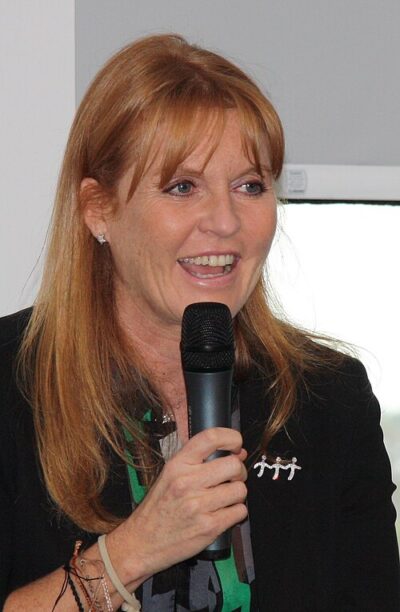
Sarah Ferguson
Sarah Ferguson is a British writer, charity patron, public speaker, film producer and television personality, and former Duchess of York. Born October 15, 1959, in London Welbeck Hospital. Positions held include chancellor (1991–1994) and Duchess of York (1986–1996). Known for Budgie the Little Helicopter and Sarah: My Story. Educated at Daneshill School and Hurst Lodge School. Awards include Order of the Smile.
Facts
29 facts · 1 confirmed by two sources · 10 cited · 18 from one source
Where this comes from
Papalocal keeps its own record. It started from these sources; what each one said is kept here as it was copied, so a change on their side never changes this page by itself. Tap one to read its version.
What Wikidata says · copied November 16, 2026 · revision 2557332753
- Described as
- British writer, charity patron, public speaker, film producer and television personality, and former Duchess of York
- Other names
- Sarah Margaret Ferguson, Sarah Mountbatten-Windsor, Sarah Margaret Mountbatten-Windsor, Fergie
- Born
- October 15, 1959 · 7 references
- Born in
- London Welbeck Hospital · 1 reference
- Name at birth
- Sarah Margaret Ferguson · 2 references
- Citizen of
- United Kingdom
- Occupation
- patron of the arts; film producer; writer; aristocrat; film director · 1 reference; duke · 1 reference
- Positions held
- chancellor (1991–1994) · 1 reference; Duchess of York (1986–1996)
- Education
- Daneshill School; Hurst Lodge School
- Known for
- Budgie the Little Helicopter; Sarah: My Story · 1 reference
- Awards
- Order of the Smile
- Spouse
- Andrew Mountbatten-Windsor (1986–1996) · 2 references
- Children
- Princess Beatrice of York · 2 references; Princess Eugenie of York · 2 references
- Father
- Ronald Ferguson · 2 references
- Mother
- Susan Barrantes · 2 references
- Siblings
- Jane Ferguson; Andrew Ferguson; Alice Ferguson; Eliza Ferguson
- Religion
- Anglicanism
- Lived in
- Royal Lodge · 1 reference
- Website
- http://www.sarahferguson.com
- Wikipedias with a page
- 57
Wikidata item Q55720 (wikidata.org/wiki/Q55720), public domain (CC0). Copied November 16, 2026.
What Wikipedia says · copied November 16, 2026 · revision 1385903635
Sarah Margaret Ferguson (born 15 October 1959), formerly Sarah, Duchess of York, and commonly known as Fergie, is a British author, spokesperson, and television personality. She is the ex-wife of Andrew Mountbatten-Windsor, the former Prince Andrew, Duke of York, the second son of Queen Elizabeth II and younger brother of King Charles III.
Ferguson grew up in Dummer, Hampshire, and attended the Queen's Secretarial College. She later worked for public relations firms in London and for a publishing company. She began a relationship with Andrew in 1985, and they were married on 23 July 1986 at Westminster Abbey, upon which she became Duchess of York. They have two daughters: Beatrice and Eugenie. Their marriage, separation in 1992, and divorce in 1996 attracted extensive media coverage.
Both during and after her marriage, Ferguson has been involved with several charities, primarily focused on supporting cancer patients and children. She was the patron of the Teenage Cancer Trust from 1990 to 2025 and founded Children in Crisis and Sarah's Trust. She has written several books for children and adults, and has worked on TV and film production.
In the years following her divorce, Ferguson was the subject of various scandals that affected her relationship with the royal family. Her friendship with the American child sex offender Jeffrey Epstein led to the termination of her roles as patron and spokesperson for multiple charities. In October 2025, Ferguson ceased using the courtesy title Duchess of York following Andrew's announcement that he would no longer use his peerage titles.
- Born, in its opening lines
- October 15, 1959
From the Wikipedia article “Sarah Ferguson” (en.wikipedia.org/wiki/Sarah_Ferguson), by its contributors, under CC BY-SA 4.0 (creativecommons.org/licenses/by-sa/4.0/). Copied November 16, 2026; not changed.
Confirmed Two sources agree. Cited One source, and it names where it got it. One source One source, without a reference of its own. Sources disagree The sources disagree. We show the best-supported value and keep theirs below.
