
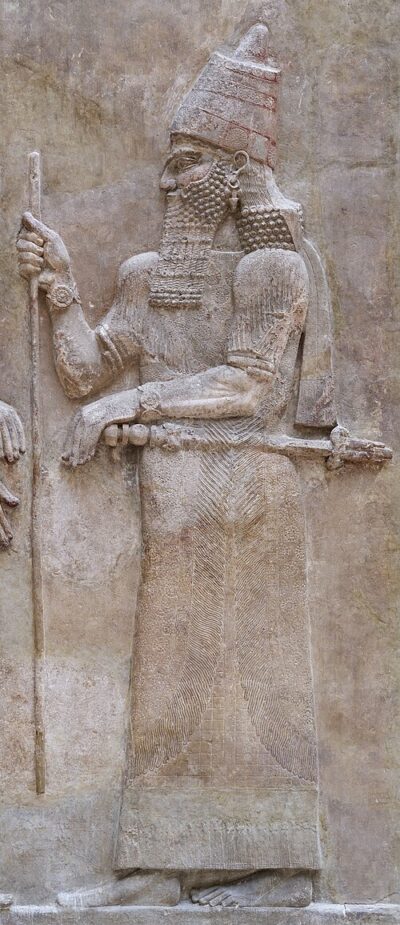
Sargon II
Sargon II was a king of Assyria (722-705 B.C). Born 765 BC, in Nimrud. Died 705 BC. Positions held include King of Assyria (-722–-705) and King of Babylon (-710–-705).
Facts
11 facts · 0 confirmed by two sources · 0 cited · 9 from one source · 2 where the sources disagree
What’s different
- Born: we show 765 BC (Sources disagree). Wikipedia says 745
- Died: we show 705 BC (Sources disagree). Wikipedia says 727
Where this comes from
Papalocal keeps its own record. It started from these sources; what each one said is kept here as it was copied, so a change on their side never changes this page by itself. Tap one to read its version.
What Wikidata says · copied November 16, 2026 · revision 2561373980
- Described as
- king of Assyria (722-705 B.C)
- Born
- 765 BC
- Died
- 705 BC
- Born in
- Nimrud
- Citizen of
- Assyrian Empire; Babylon
- Occupation
- sovereign
- Positions held
- King of Assyria (-722–-705); King of Babylon (-710–-705)
- Children
- Sennacherib
- Father
- Tiglath-Pileser III
- Siblings
- Shalmaneser V
- Wikipedias with a page
- 55
Wikidata item Q208336 (wikidata.org/wiki/Q208336), public domain (CC0). Copied November 16, 2026.
What Wikipedia says · copied November 16, 2026 · revision 1382142124
Sargon II (Neo-Assyrian Akkadian: 𒈗𒁺, romanized: Šarru-kīn, meaning "the faithful king" or "the legitimate king") was the king of the Neo-Assyrian Empire from 722 BC to his death in battle in 705. Most likely the son of Tiglath-Pileser III (r. 745–727), Sargon is generally believed to have become king after overthrowing Shalmaneser V (r. 727–722), most likely his brother. He is typically considered the founder of a new dynastic line, the Sargonid dynasty.
Modelling his reign on the legends of the ancient rulers Sargon of Akkad, from whom Sargon II likely took his regnal name, and Gilgamesh, Sargon aspired to conquer the known world, initiate a golden age and a new world order, and be remembered and revered by future generations. Over the course of his seventeen-year reign, Sargon substantially expanded Assyrian territory and enacted important political and military reforms. An accomplished warrior-king and military strategist, Sargon personally led his troops into battle. By the end of his reign, all of his major enemies and rivals had been either defeated or pacified. Among Sargon's greatest accomplishments were the continued Assyrian control over the Levant, the weakening of the northern kingdom of Urartu, and the reconquest of Babylonia. From 717 to 707, Sargon constructed a new Assyrian capital named after himself, Dur-Sharrukin ('Fort Sargon'), which he made his official residence in 706.
Sargon considered himself divinely mandated to maintain justice. Like other Assyrian kings, Sargon at times enacted brutal punishments against his enemies, but there are no known cases of atrocities against civilians from his reign. He worked to assimilate and integrate conquered foreign peoples into the empire and to extend to them the same rights and obligations as native Assyrians. He forgave defeated enemies on several occasions and maintained good relations with foreign kings and with the ruling classes of the lands he conquered. Sargon also increased the influence and status of both women and scribes at the royal court.
Sargon embarked on his final campaign, against Tabal in Anatolia, in 705. He was killed in battle, and the Assyrian army was unable to retrieve his body, preventing a traditional burial. According to ancient Mesopotamian religion, he was cursed to remain a restless ghost for eternity. Sargon's fate was a major psychological blow for the Assyrians and damaged his legacy. Sargon's son Sennacherib was deeply disturbed by his father's death and believed that he must have committed some grave sin. As a result, Sennacherib distanced himself from Sargon. Sargon was barely mentioned in later ancient literature and nearly completely forgotten until the ruins of Dur-Sharrukin were discovered in the 19th century. He was not fully accepted in Assyriology as a real king until the 1860s. Due to his conquests and reforms, Sargon is today considered one of the most important Assyrian kings.
- Born, in its opening lines
- 745
- Died, in its opening lines
- 727
From the Wikipedia article “Sargon II” (en.wikipedia.org/wiki/Sargon_II), by its contributors, under CC BY-SA 4.0 (creativecommons.org/licenses/by-sa/4.0/). Copied November 16, 2026; not changed.
Confirmed Two sources agree. Cited One source, and it names where it got it. One source One source, without a reference of its own. Sources disagree The sources disagree. We show the best-supported value and keep theirs below.
