
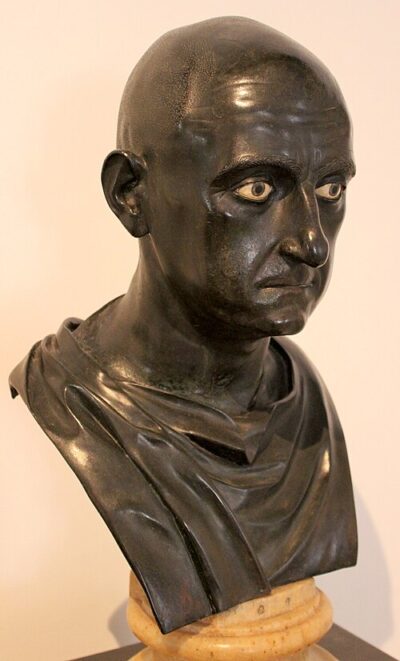
Scipio Africanus
Scipio Africanus was a Roman general and politician (236/235–183 BC). Born 235 BC, in Ancient Rome. Died 183 BC, in Liternum. Positions held include military tribune (-216), aedile (-213) and salian priest (-211–-183).
Facts
27 facts · 0 confirmed by two sources · 22 cited · 5 from one source
Where this comes from
Papalocal keeps its own record. It started from these sources; what each one said is kept here as it was copied, so a change on their side never changes this page by itself. Tap one to read its version.
What Wikidata says · copied November 16, 2026 · revision 2568843815
- Described as
- Roman general and politician (236/235–183 BC)
- Other names
- Scipio the Great, Scipio the African, Publius Cornelius Scipio Africanus, Publius Cornelius Scipio Africanus Major, Scipio Africanus the Elder, P. Cornelius Scipio, the Elder, Africanus Scipio, Scipio the Elder
- Born
- 235 BC · 3 references
- Died
- 183 BC · 3 references
- Born in
- Ancient Rome
- Died in
- Liternum
- Citizen of
- Ancient Rome
- Occupation
- politician · 2 references; military personnel; genealogist · 1 reference; military leader · 1 reference
- Positions held
- military tribune (-216) · 1 reference; aedile (-213) · 1 reference; salian priest (-211–-183) · 1 reference; proconsul (2 times) (-210–-201) · 1 reference; Roman consul (2 times) (-205–-194) · 1 reference; Roman censor (-199) · 1 reference; legatus (-190–) · 1 reference
- Field
- politics · 1 reference; military affairs · 1 reference
- Spouse
- Aemilia Tertia
- Children
- Cornelia · 3 references; Lucius Cornelius Scipio · 2 references; Publius Cornelius Scipio · 2 references; Cornelia Africana Major · 2 references; Gnaeus Cornelius Scipio · 2 references
- Father
- Publius Cornelius Scipio · 2 references
- Mother
- Pomponia · 2 references
- Siblings
- Lucius Cornelius Scipio Asiaticus · 2 references
- Wikipedias with a page
- 77
Wikidata item Q2253 (wikidata.org/wiki/Q2253), public domain (CC0). Copied November 16, 2026.
What Wikipedia says · copied November 16, 2026 · revision 1384649960
Publius Cornelius Scipio Africanus (; Latin: [ˈskiːpioː]; 236/235–c. 183 BC) was a Roman general and statesman who was one of the main architects of Rome's victory against Carthage in the Second Punic War. Often regarded as one of the greatest military commanders and strategists of all time, his crowning achievement was the defeat of Hannibal at the Battle of Zama in 202 BC, which earned him the honorific epithet Africanus ("the African").
Born into a distinguished patrician family in Rome, Scipio followed his father Publius Scipio to war against Carthage, and survived the disastrous Roman defeat at Cannae. In 210 BC, despite never having held consular office, he was elected to take command of Rome's forces in Hispania, following the death of his father and uncle in battle. His campaign culminated in the victory at Ilipa in 206 BC against Hannibal's brother Mago Barca, leading to the Roman conquest of Carthaginian Iberia. Elected consul in 205 BC, Scipio launched an invasion of the Carthaginian homeland in Africa, compelling the Carthaginians to recall Hannibal. Following failed negotiations, Scipio routed Hannibal's army at Zama, forcing Carthage to sue for peace and bringing to an end the Second Punic War.
Despite his triumphs and heroic status among the Roman public, Scipio had many political opponents, in particular Cato the Elder. In 187 BC, Scipio and his brother Lucius were subjected to trials for bribes they supposedly received from the Seleucid king Antiochus III during the Roman–Seleucid War. Disillusioned, he left Rome and retired to his villa in Liternum, where he died circa 183 BC.
From the Wikipedia article “Scipio Africanus” (en.wikipedia.org/wiki/Scipio_Africanus), by its contributors, under CC BY-SA 4.0 (creativecommons.org/licenses/by-sa/4.0/). Copied November 16, 2026; not changed.
Confirmed Two sources agree. Cited One source, and it names where it got it. One source One source, without a reference of its own. Sources disagree The sources disagree. We show the best-supported value and keep theirs below.
