
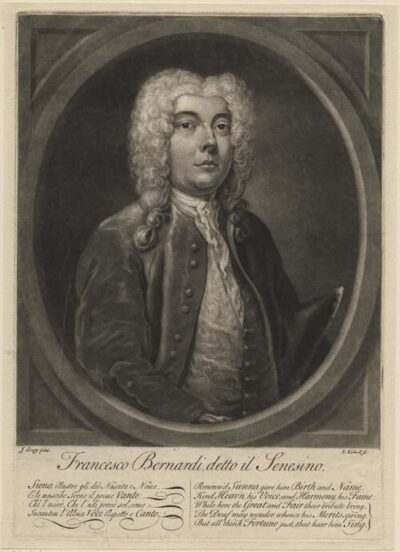
Senesino
Senesino was an Italian castrato. Born October 31, 1686, in Siena. Died November 27, 1758, in Siena.
Facts
9 facts · 2 confirmed by two sources · 0 cited · 7 from one source
Where this comes from
Papalocal keeps its own record. It started from these sources; what each one said is kept here as it was copied, so a change on their side never changes this page by itself. Tap one to read its version.
What Wikidata says · copied November 18, 2026 · revision 2559444874
- Described as
- Italian castrato (1686-1758)
- Other names
- Francesco Bernardi
- Born
- October 31, 1686
- Died
- November 27, 1758 · 1 reference
- Born in
- Siena
- Died in
- Siena
- Citizen of
- Grand Duchy of Tuscany
- Occupation
- opera singer; stage actor
- Genre
- opera
- Instrument
- voice
- Wikipedias with a page
- 24
Wikidata item Q433838 (wikidata.org/wiki/Q433838), public domain (CC0). Copied November 18, 2026.
What Wikipedia says · copied November 18, 2026 · revision 1310822983
Francesco Bernardi (pronounced [franˈtʃesko berˈnardi]; 31 October 1686 – 27 November 1758), known as Senesino (pronounced [seneˈziːno] or traditionally [seneˈsiːno]), was an Italian contralto castrato, particularly remembered today for his long collaboration with the composer George Frideric Handel. He was also involved in a public scandal with the soprano Anastasia Robinson in 1724, which was circulated widely by the satirist Jonathan Swift, and inspired a number of anonymously-written obscene, misogynistic, and at times sexually subversive epistles written between 1724 and 1736 which have become a topic of study among scholars of Restoration literature.
- Born, in its opening lines
- October 31, 1686
- Died, in its opening lines
- November 27, 1758
From the Wikipedia article “Senesino” (en.wikipedia.org/wiki/Senesino), by its contributors, under CC BY-SA 4.0 (creativecommons.org/licenses/by-sa/4.0/). Copied November 18, 2026; not changed.
Confirmed Two sources agree. Cited One source, and it names where it got it. One source One source, without a reference of its own. Sources disagree The sources disagree. We show the best-supported value and keep theirs below.
