
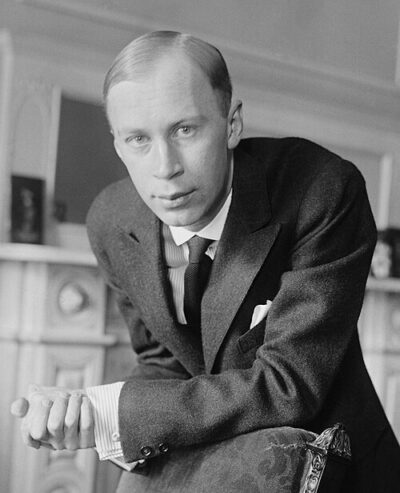
Sergei Prokofiev
Sergei Prokofiev was a Russian and Soviet pianist, composer and conductor. Born April 11, 1891, in Sontsivka. Died March 5, 1953, in Moscow. Known for Symphony No. 1, Symphony No. 4 and Symphony No. 2. Educated at Saint Petersburg Conservatory. Awards include Stalin Prize (4 times), Lenin Prize and Order of the Red Banner of Labour.
Facts
44 facts · 1 confirmed by two sources · 9 cited · 33 from one source · 1 where the sources disagree
What’s different
- Born: we show April 11, 1891 (Sources disagree). Wikipedia says April 27, 1891
Where this comes from
Papalocal keeps its own record. It started from these sources; what each one said is kept here as it was copied, so a change on their side never changes this page by itself. Tap one to read its version.
What Wikidata says · copied November 16, 2026 · revision 2565534382
- Described as
- Russian and Soviet pianist, composer and conductor (1891–1953)
- Other names
- Sergej Prokofjev, Sergei Sergeyevich Prokofiev, Sergej Sergeevič Prokofʹev, Serge Prokofiev, Serge Prokofieff, Serge Sergevitch Prokofieff, Sergey Prokofiev, Sergiusz Prokofiew
- Born
- April 11, 1891 · 1 reference
- Died
- March 5, 1953 · 18 references
- Born in
- Sontsivka · 1 reference
- Died in
- Moscow · 4 references
- Buried in
- Novodevichy Cemetery
- Cause of death
- cerebral hemorrhage · 1 reference
- Citizen of
- Russian Empire; Soviet Union
- Occupation
- composer · 3 references; pianist · 1 reference; conductor · 1 reference; choreographer; musicologist; film score composer; author; librettist
- Education
- Saint Petersburg Conservatory
- Member of
- Union of Soviet Composers
- Genre
- opera; symphony; ballet; classical music
- Instrument
- piano
- Known for
- Symphony No. 1; Symphony No. 4; Symphony No. 2; The Love for Three Oranges; Peter and the Wolf
- Awards
- Stalin Prize (4 times) (1943, 1946, 1947, 1952); Lenin Prize (1957); Order of the Red Banner of Labour; Medal "For Valiant Labour in the Great Patriotic War 1941–1945"; Royal Philharmonic Society Gold Medal (1944); People's Artist of the RSFSR; Medal "In Commemoration of the 800th Anniversary of Moscow" · 1 reference; Honored art worker of the Russian Soviet Federative Socialist Republic (1944) · 1 reference; Stalin Prize, 2nd degree (2 times) (1943, 1952) · 1 reference; State Stalin Prize, 1st degree (2 times) (1946, 1947) · 1 reference
- Field
- chess · 1 reference; music · 1 reference
- Spouse
- Lina Llubera; Mira Mendelssohn
- Children
- Oleg Prokofiev · 1 reference
- Religion
- atheism
- Wikipedias with a page
- 95
Wikidata item Q49481 (wikidata.org/wiki/Q49481), public domain (CC0). Copied November 16, 2026.
What Wikipedia says · copied November 16, 2026 · revision 1384416458
Sergei Sergeyevich Prokofiev (27 April [O.S. 15 April] 1891 – 5 March 1953) was a Russian composer, pianist, and conductor who later worked in the Soviet Union. As the creator of acknowledged masterpieces across numerous music genres, he is regarded as one of the major composers of the 20th century. His works include such widely heard pieces as the March from The Love for Three Oranges, the suite Lieutenant Kijé, the ballet Romeo and Juliet—from which "Dance of the Knights" is taken—and Peter and the Wolf. Of the established forms and genres in which he worked, he created—excluding juvenilia—seven completed operas, seven symphonies, eight ballets, five piano concertos, two violin concertos, a cello concerto, a symphony-concerto for cello and orchestra, and nine completed piano sonatas.
A graduate of the Saint Petersburg Conservatory, Prokofiev initially made his name as an iconoclastic composer-pianist, achieving notoriety with a series of ferociously dissonant and virtuosic works for his instrument, including his first two piano concertos. In 1915, Prokofiev made a decisive break from the standard composer-pianist category with his orchestral Scythian Suite, compiled from music originally composed for a ballet commissioned by Sergei Diaghilev of the Ballets Russes. Diaghilev commissioned three further ballets from Prokofiev—Chout, Le pas d'acier and The Prodigal Son—which, at the time of their original production, all caused a sensation among both critics and colleagues. But Prokofiev's greatest interest was opera, and he composed several works in that genre, including The Gambler and The Fiery Angel. Prokofiev's one operatic success during his lifetime was The Love for Three Oranges, composed for the Chicago Opera and performed over the following decade in Europe and Russia.
After the Revolution of 1917, Prokofiev left Russia with the approval of Soviet People's Commissar Anatoly Lunacharsky, and resided in the United States, then Germany, then Paris, making his living as a composer, pianist and conductor. In 1923 he married a Spanish singer, Carolina (Lina) Codina, with whom he had two sons; they divorced in 1947. In the early 1930s, the Great Depression diminished opportunities for Prokofiev's ballets and operas to be staged in America and Western Europe. Prokofiev, who regarded himself as a composer foremost, resented the time taken by touring as a pianist, and increasingly turned to the Soviet Union for commissions of new music; in 1936, he finally returned to his homeland with his family. His greatest Soviet successes included Lieutenant Kijé, Peter and the Wolf, Romeo and Juliet, Cinderella, Alexander Nevsky, the Fifth and Sixth Symphonies, On Guard for Peace, and the Piano Sonatas Nos. 6–8.
The Nazi invasion of the USSR spurred Prokofiev to compose his most ambitious work, an operatic version of Leo Tolstoy's War and Peace; he co-wrote the libretto with Mira Mendelson, his longtime companion and later second wife. In 1948, Prokofiev was attacked for producing "anti-democratic formalism". Nevertheless, he enjoyed personal and artistic support from a new generation of Russian performers, notably Sviatoslav Richter and Mstislav Rostropovich: he wrote his Ninth Piano Sonata for the former and his Symphony-Concerto for the latter.
- Born, in its opening lines
- April 27, 1891
- Died, in its opening lines
- March 5, 1953
From the Wikipedia article “Sergei Prokofiev” (en.wikipedia.org/wiki/Sergei_Prokofiev), by its contributors, under CC BY-SA 4.0 (creativecommons.org/licenses/by-sa/4.0/). Copied November 16, 2026; not changed.
Confirmed Two sources agree. Cited One source, and it names where it got it. One source One source, without a reference of its own. Sources disagree The sources disagree. We show the best-supported value and keep theirs below.
