
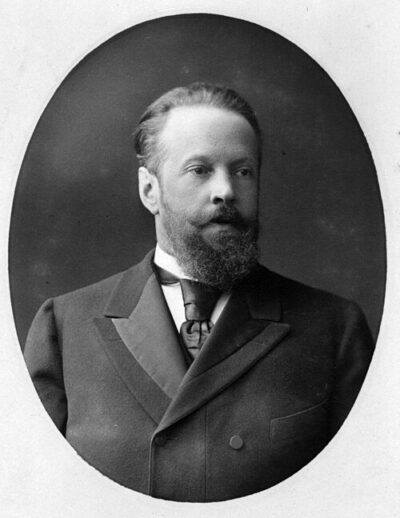
Sergei Witte
Sergei Witte was a Russian statesman and first Prime Minister of the Russian Empire. Born June 17, 1849, in Tbilisi. Died February 28, 1915, in Saint Petersburg. Positions held include Prime Minister of Russia (1905–1906), finance minister of Imperial Russia (1892–1903) and member of the State Council of the Russian Empire (1992–). Educated at Imperial Novorossiia University and Odesa University. Awards include Knight of the Order of St. Alexander Nevsky, Order of Saint Anna, 1st class and Order of St. Vladimir, 1st class.
Facts
33 facts · 0 confirmed by two sources · 6 cited · 25 from one source · 2 where the sources disagree
What’s different
- Born: we show June 17, 1849 (Sources disagree). Wikipedia says June 29, 1849
- Died: we show February 28, 1915 (Sources disagree). Wikipedia says March 13, 1915
Where this comes from
Papalocal keeps its own record. It started from these sources; what each one said is kept here as it was copied, so a change on their side never changes this page by itself. Tap one to read its version.
What Wikidata says · copied November 16, 2026 · revision 2567360181
- Described as
- Russian statesman and first Prime Minister of the Russian Empire (1849-1915)
- Other names
- Count Sergey Yulyevich Witte, Sergei Yulyevich Witte, Count Sergei Yulyevich Witte, Serguéi Yúlievich Vitte o Wite
- Born
- June 17, 1849 · 2 references
- Died
- February 28, 1915 · 1 reference
- Born in
- Tbilisi · 1 reference
- Died in
- Saint Petersburg · 1 reference
- Buried in
- Lazarev Cemetery
- Cause of death
- pneumonia · 1 reference
- Citizen of
- Russian Empire
- Occupation
- diplomat · 1 reference; politician · 1 reference
- Positions held
- Prime Minister of Russia (1905–1906); finance minister of Imperial Russia (1892–1903); member of the State Council of the Russian Empire (1992–)
- Education
- Imperial Novorossiia University (1866–1870); Odesa University
- Awards
- Knight of the Order of St. Alexander Nevsky; Order of Saint Anna, 1st class; Order of St. Vladimir, 1st class; Order of the Black Eagle; Order of Saint Stanislaus, 1st class; Order of the White Eagle · 1 reference; Order of the Red Eagle · 1 reference; Order of the Crown · 1 reference; Knight Grand Cross of the Order of Vasa (1897) · 1 reference; Grand Cross of the Order of the Dannebrog (1895) · 1 reference; Order of Leopold · 1 reference; Order of the White Eagle · 1 reference; Order of the Cross of Takovo · 1 reference; Order of Saint Alexander · 1 reference; Order of Leopold · 1 reference
- Children
- Véra Narischkine-Witte
- Father
- Julius von Witte
- Mother
- Yekaterina Fadeyeva
- Religion
- Russian Orthodox Church
- Wikipedias with a page
- 56
Wikidata item Q155329 (wikidata.org/wiki/Q155329), public domain (CC0). Copied November 16, 2026.
What Wikipedia says · copied November 16, 2026 · revision 1385042786
Count Sergei Yulyevich Witte (Russian: Сергей Юльевич Витте, romanized: Sergey Yulyevich Vitte, IPA: [sʲɪrˈɡʲej ˈjʉlʲjɪvʲɪtɕ ˈvʲitːɛ]; 29 June [O.S. 17 June] 1849 – 13 March [O.S. 28 February] 1915), also known as Sergius Witte, was a Russian statesman who served as the first prime minister of the Russian Empire, replacing the emperor as head of government. Neither liberal nor conservative, he attracted foreign capital to boost Russia's industrialization. Witte's strategy was to avoid the danger of wars.
Count Witte served under the final two emperors of Russia, Alexander III (r. 1881–1894) and Nicholas II (r. 1894–1917). During the Russo-Turkish War of 1877–1878, he had risen to a position in which he controlled all the traffic passing to the front along the lines of the Odessa Railways. As finance minister from 1892–1903, Witte presided over extensive industrialisation and achieved government monopoly control over an expanded system of railway lines.
Following months of civil unrest and outbreaks of violence in what became known as the 1905 Russian Revolution, Witte framed the October Manifesto and the accompanying government communication to establish constitutional government. However, he was not convinced it would solve Russia's problems with the Tsarist autocracy. On 20 October 1905 Witte was appointed as the first chairman of the Council of Ministers (effectively prime minister). Assisted by his Council, he designed Russia's first constitution. But within a few months Witte fell into disgrace as a reformer because of continuing court opposition to these changes. He resigned before the First Duma assembled on 10 May [O.S. 27 April] 1906. Witte was fully confident that he had resolved the main problem: providing political stability to the regime, but according to him, the "peasant problem" would further determine the character of the Duma's activity.
He is widely considered to have been one of the key figures in Russian politics at the end of the 19th century and the beginning of the 20th century. Orlando Figes has described Witte as the 'great reforming finance minister of the 1890s', 'one of Nicholas's most enlightened ministers', and as the architect of Russia's new parliamentary order in 1905.
- Born, in its opening lines
- June 29, 1849
- Died, in its opening lines
- March 13, 1915
From the Wikipedia article “Sergei Witte” (en.wikipedia.org/wiki/Sergei_Witte), by its contributors, under CC BY-SA 4.0 (creativecommons.org/licenses/by-sa/4.0/). Copied November 16, 2026; not changed.
Confirmed Two sources agree. Cited One source, and it names where it got it. One source One source, without a reference of its own. Sources disagree The sources disagree. We show the best-supported value and keep theirs below.
